A Game of Rhônes – Act Five: The Poor in Spirit
Health is the greatest of gifts, contentedness the best riches; trust is the best of relationships, Nirvana the highest happiness.
—The Dhammapada, verse 204 (trans. F. Max Müller)
The Master
The last of our five courses was the sweetest, and its guest the strangest. In Act Four a knight climbed a hill to find God alone. Meister Eckhart went looking further in.
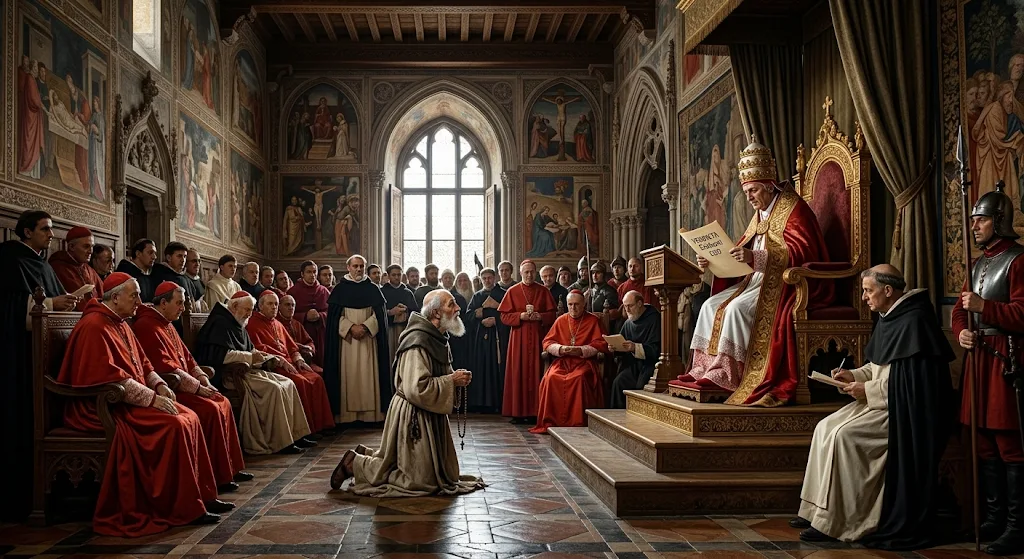
He was born around 1260, probably at Tambach, near Erfurt in Thuringia, and joined the Dominicans as a young man. He rose high. Twice he held the chair of theology at Paris, in 1302 and again in 1311, and the title that came with it, magister, became his name: Meister Eckhart. He was also, unusually for a Paris master, a great preacher in German, to the nuns and lay people of the Rhineland, and that was where the trouble began. Latin could be argued over in a lecture hall. German reached anyone who could hear.
In 1326 his accusers laid seventy-four suspect propositions before Henry of Virneburg, Archbishop of Cologne. Eckhart’s answer was that a man might be in error without being a heretic: heresy was a matter of the will, and his will was sound. In the spring of 1327 he took his case to the pope, and went to Avignon to make it. He died early in 1328, before any verdict. On 27 March 1329 John XXII issued the bull In agro dominico, “In the field of the Lord”, condemning twenty-eight of his propositions: seventeen as heretical or erroneous, and eleven as “evil-sounding” and rash, though capable of a sound meaning. It was to be published in the province of Cologne, where his words had done their damage. Eckhart himself was never declared a heretic.
Count the dates. Marsilius was excommunicated in 1327, Ockham in 1328, and Eckhart’s teaching was condemned in 1329. Three of our four guests, judged by the same old man in the same city within three years.
Two Kinds of Poverty
Here the story folds back on itself. In Act Two, Ockham was hunted for a doctrine of poverty: the Franciscan belief that Christ and his apostles had owned nothing, which John XXII declared heretical in 1323. Eckhart preached a poverty of another kind.
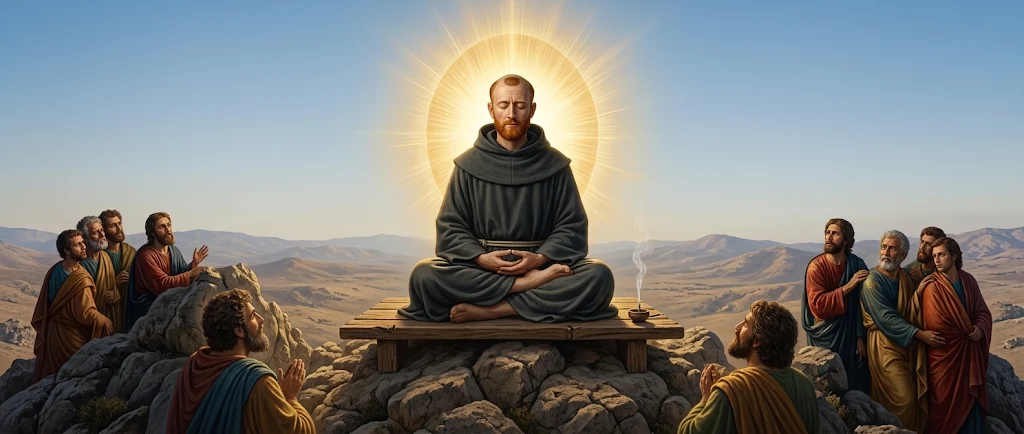
His sermon on the first Beatitude, “Blessed are the poor in spirit”, is the most daring thing he wrote. “A poor man,” he says, “is one who wills nothing, knows nothing, and has nothing.” He means each word. To own nothing is not enough. Even the wish to do God’s will is a possession: “as long as you have the will to fulfil God’s will, and a longing for eternity and for God, you are not poor.” Last of all goes God himself, or at least the God we picture and want. “Therefore, I pray God that he may make me free of ‘God’,” Eckhart says, because the ground of his being lies beyond the God we name.
So the same pope judged both men. Ockham’s friars wanted to own nothing; Eckhart wanted to want nothing. One poverty was about property, the other about the self. Avignon found fault with both.
The Ground of the Soul
What Eckhart taught can be put in four sentences, though he would have said that none of them is quite right. Beneath every power of the soul, beneath thought, memory, and will, there is a ground in which the soul encounters its deepest unity with God. To reach it a person must let go: of things, of images, and of the self that wants. Eckhart’s words for this were Abgeschiedenheit, detachment, and Gelassenheit, letting-be. When the soul is empty in this way, God gives birth to his Word in it, and beyond God as we name and imagine him lies the Godhead, which has no name at all.
The roots are older than Christianity. In the third century, Plotinus taught of a One beyond all description, from which everything flows and to which everything longs to return. Neoplatonism passed into Christian thought through writers such as Pseudo-Dionysius the Areopagite, and became part of the intellectual inheritance of Albert the Great and the Dominican school at Cologne. Eckhart drew on that inheritance, and preached its most daring implications in German to the nuns and lay people of the Rhineland.
A concession is due. Eckhart was not founding a religion of his own. He was a Dominican friar, a preacher and an administrator in his order, and he thought himself orthodox to the end: his defence was that his sayings, taken in the right sense, were sound. Many of his boldest lines are paradoxes meant to wake the listener up, not doctrines meant for a creed, which is partly why the bull condemned eleven of them only as “evil-sounding”. He died before the verdict, still a Dominican, and still insisting that he had said nothing a good Christian could not say.
The Pessimist’s Buddha
Five centuries later Eckhart found an unlikely reader. Arthur Schopenhauer, the great pessimist of German philosophy, had no use for God at all. But in 1813 a friend introduced him to the Oupnek’hat, Anquetil-Duperron’s Latin translation of the Upanishads, made from a Persian version. He began to read the first European accounts of Buddhism as they appeared, and in Eckhart he recognised something.
His own system fits in a paragraph. Behind the world we see lies the will: not a mind or a purpose, but a blind, endless striving, in us and in everything. We want, we get, and we want again. Satisfaction is brief, and when wanting stops, boredom takes its place; life, he wrote, swings like a pendulum between pain and boredom. There are only two ways out. Art gives a temporary one: while we are lost in a painting or a piece of music we stop wanting, and become for a moment a “pure, will-less subject of knowledge”. The saint and the ascetic find a lasting one, by turning the will against itself and giving up wanting altogether.
That is where Eckhart and the Buddha came in. Strip away the forms that time and place give to any teaching, Schopenhauer wrote in the second volume of The World as Will and Representation, and “we shall find generally that Sākya Muni and Meister Eckhart teach the same things”. He had reached his own view, he said, before he knew theirs. In 1858, in the private notebook he called Senilia, he went further and added himself: “The Buddha, Eckhart, and I all teach essentially the same, Eckhart within the bounds of his Christian mythology.” Buddhism, he went on, held the same ideas without the mythology, and so was “simple and clear, to the extent that a religion can be clear. Complete clarity lies with me.” Modesty was not among his virtues.
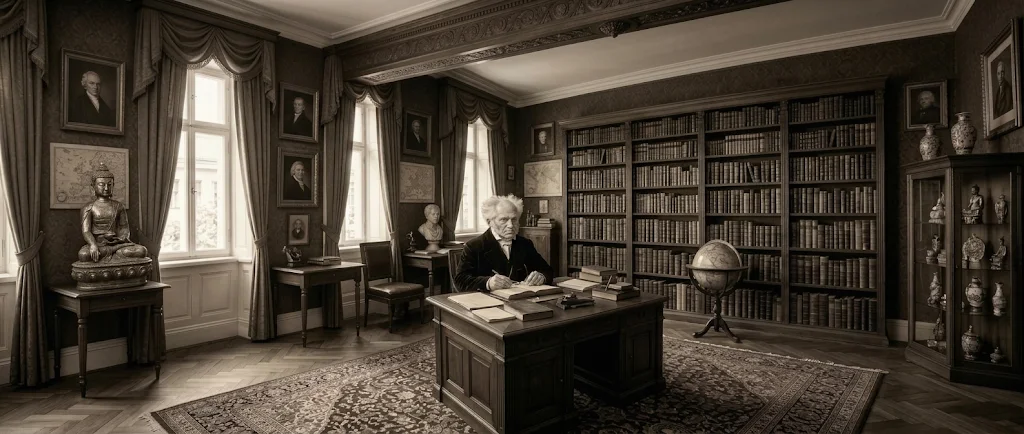
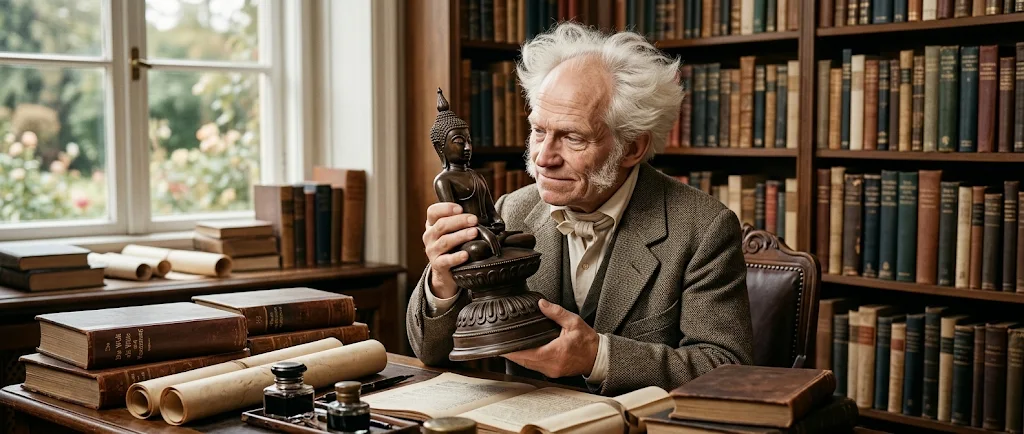
In 1856, four years before his death, a friend bought him a bronze Buddha in Paris. Schopenhauer had it gilded and kept it on a console in the corner of his sitting room in Frankfurt. He believed it was Tibetan. A recent study suggests it was Burmese, made in the Shan style two or three centuries earlier. I spend half of every month in the Shan hills, among the vines, and I like to think of a Shan Buddha smiling in the corner of the gloomiest room in Europe.

Letting Go
I write this in Phnom Penh, in a country where Theravada Buddhism is the state religion and monks walk out at dawn with their alms bowls. From here Schopenhauer’s comparison looks half right.
The two meet in practice. The Buddha taught that suffering is rooted in craving, taṇhā, a thirst that cannot be permanently satisfied, and that liberation comes through its cessation. Eckhart taught that the soul finds God when it stops wanting, even wanting God. Schopenhauer’s blind will is close to both. All three put the trouble in the self that grasps, and the cure in letting go.
Eckhart and the Buddha part at the foundations. Eckhart has a God, and a ground of the soul in which God and the soul are one. Theravada Buddhism has no creator, and it teaches anattā, not-self: there is no abiding soul to find, ground or no ground. Eckhart’s letting go ends in union; the Buddha’s ends in nibbāna (nirvana), a going out, like a flame with nothing left to burn; the extinguishing of craving and the ending of suffering. They are not the same destination.
Most of the famous comparisons since Schopenhauer, D. T. Suzuki’s among them, have set Eckhart beside Zen rather than the Theravada of Cambodia, and Zen is a different conversation again.
The likeness is still real, and it is the part that matters at the table. Both agree that the self that wants is the problem. On a Phnom Penh morning, with the burnt orange robes going by, it is not hard to see why a pessimist in Frankfurt kept a Buddha in the corner of his room.
The Moment Between
Which brings us back to dinner, and to its sweetest course. A long dinner is a small model of Schopenhauer’s world: appetite, satisfaction, the next appetite, and at the end, only if the host is careless, boredom. Schopenhauer would also have allowed one exception. In a great glass of wine, as in music, there can be a moment when wanting stops: a few seconds of pure attention in which the drinker forgets himself, forgets the clock and attends only to what is already there. Schopenhauer called that state will-less contemplation. The Dhammapada might call it contentedness, the best of riches. Eckhart might have called it a small poverty. At the end of a long table, with the last plates on their way, we were about to have such a moment.
ACT FIVE
The Flying Cigar
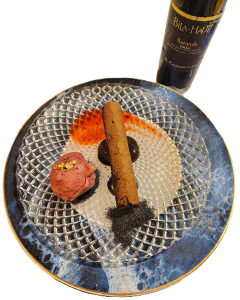
A CHOCOLATE GANACHE CIGAR
Kampot pepper, cherry sorbet
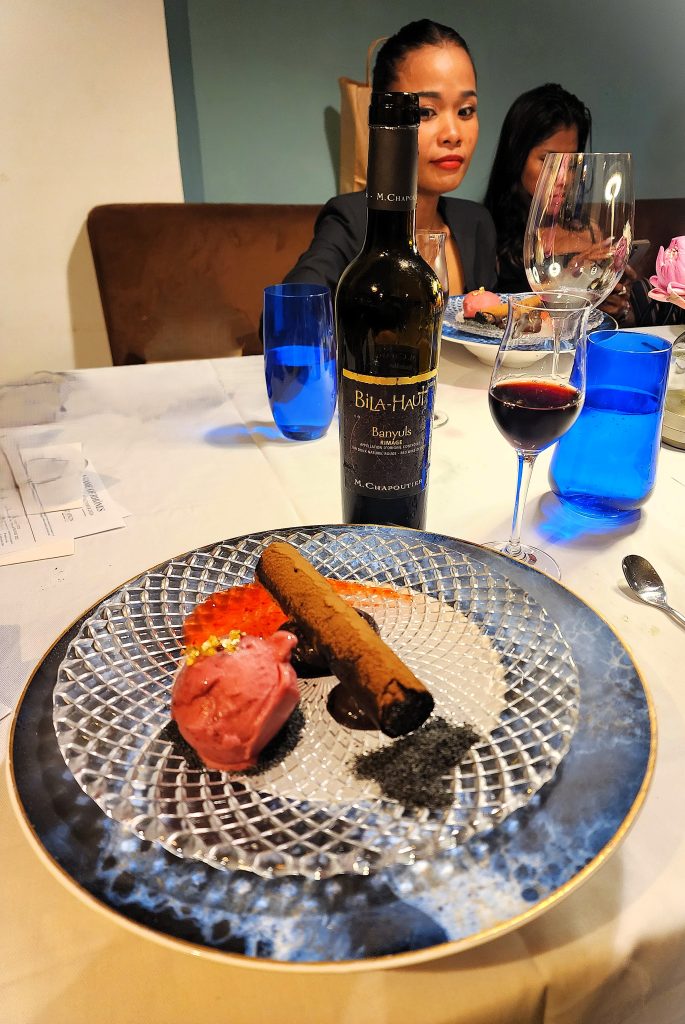
The flying cigars of Act Three came in to land at last. Châteauneuf’s mayor had banned them from his sky in 1954; Baldwins served one to each of seventeen guests. The cigar was rolled and filled with house-made dark chocolate ganache. Kampot pepper, from Cambodia’s south coast, was worked into it, a slow, floral warmth behind the chocolate. Beside it came a cherry sorbet, tart and cold enough to cut the richness. A cigar for people who do not smoke, and the last word in the evening’s long joke.
Cigars have flown before. In 1984 Randall Grahm, one of the original Rhône Rangers, named the first wine of his Bonny Doon winery in California Le Cigare Volant, in honour of the Châteauneuf decree. I wrote about it in 2013.
Chapoutier, Bila-Haut, Banyuls, Roussillon, France, 2014
The last wine leaves the Rhône, as the papacy finally would. Banyuls lies at the very end of France, on the Côte Vermeille, where the Pyrenees fall into the Mediterranean, its vines on terraces of old schist above the sea. In the fourteenth century it was not France at all: it belonged to the kings of Majorca, then to Aragon, and became French only in 1659. Avignon was not France either. It has been a dinner of borderlands. Banyuls became an appellation in 1936, the same year as Châteauneuf-du-Pape, and the house that made our bottle is an old friend: Michel Chapoutier, of Tain-l’Hermitage, bought Domaine de Bila-Haut in 1998, the year he went into partnership with Ferraton. We never quite left the hermit’s hill.
Banyuls is a vin doux naturel: the fermentation is stopped by adding grape spirit, which keeps the grape’s sugar in the wine. Tradition credits the technique, mutage, to Arnau de Vilanova, a physician from Valencia whose patients included three kings and three popes, Boniface VIII and Clement V among them. In 1311 Clement summoned him to Avignon, and he died at sea off Genoa on the way. A concession: the attribution is tradition, not record. Arnau did write a short treatise on wine, but on its uses in medicine and on rescuing wine that had spoiled, and the evidence that he invented mutage is thin. Still, it makes a fitting last link. By tradition, the sweetness of our last glass owes something to a papal doctor who died on his way to Avignon.
The wine is 100% Grenache Noir from those terraces, picked very ripe. Chapoutier adds the spirit while the juice is still on its skins, mutage sur grains, to draw out aroma and tannin, then keeps the wine for eight months in vat, away from air, to hold its fruit: the young, vintage-dated style called Rimage. It comes in at 17% alcohol. The winemaker promises that it will keep for “over 5 years” and move “from garnet red to mahogany according to the age”. Ours was twelve years old, the oldest bottle of the night, and it had done exactly that.
Deep garnet with developing mahogany hues. The bouquet opens with plums, raisins, and dried prune, lifted by violets and notes of mixed peel, fruitcake spice, and dark chocolate. The palate is generous but not heavy, with concentrated black fruit, overripe cherries, and layers of burnt toffee, and salted caramel. Fine tannins and a subtle saline-edged acidity provide some welcome restraint, carrying the sweetness through to a persistent, gently warming finish.
With a whiff of old men in smoking jackets and nana’s Christmas pudding, this was an inspired way to finish the dinner. Drink now. 88/100 DG
The Pairing
Chocolate is the hardest thing on any menu to match with wine, and Banyuls is one of the few wines built for it. The sweetness of the wine met the bittersweet ganache and kept it from turning too bitter; the cherries in the sorbet found the overripe cherries in the glass; the toffee and salted caramel sat easily with the rich, confected cocoa blend. The Kampot pepper did the most interesting work, its slow warmth meeting the warmth of the spirit, and the saline edge of the finish kept the whole ensemble from cloying. Sweet against sweet, then, but with enough salt, spice, and tannin to make it a conversation rather than an echo.
The last glass had left the Rhône, and in the end so did the popes. In 1377 Gregory XI took the court back to Rome. What followed was the real game of thrones: two popes, then three, and one last claimant holding out in a castle by the sea.
Glasses drained, and the night not quite over, there was one dragon left to slay.
Next, the Coda: two popes, then three, and the last dragon.
Darren Gall
A Game of Rhônes – Coda: The Last Dragon
…until the last dragon is slain.
—from the invitation
The Way Back
The papacy came to the Rhône in Act One. It took the best part of seventy years to leave.
Urban V tried first. Pressed by Petrarch, among others, he reached Rome on 16 October 1367, the first pope in sixty years to set foot in his own diocese. Three years later, at the urging of the French cardinals, he sailed back to Avignon, and died there that December. The cardinals had their Beaune back.
Gregory XI made it stick. Catherine of Siena wrote to him fourteen times, pressing him to go home to Rome. In September 1376 he left Avignon, against the protests of the King of France and most of his cardinals, and on 17 January 1377 he entered Rome. He died there fourteen months later.
The Real Game of Thrones
Then the game began in earnest. In April 1378, with a Roman crowd outside demanding a Roman pope, or at least an Italian one, the cardinals elected the Archbishop of Bari, who took the name Urban VI. Within months the French cardinals had decided that the election was invalid, made in fear of the mob, and on 20 September 1378, at Fondi, they elected a pope of their own, Clement VII. He took ship for Avignon and set up his court in the palace again. Europe split behind the two of them.
Act One promised that before the century was out there would be more men claiming the throne than there were thrones. By 1378 there were two. In 1409 a council at Pisa, meaning to end the scandal, declared both popes deposed and elected a third, Alexander V. Neither of the others stood down, and now there were three. Here the pun in our title stops being a pun. It took the Council of Constance to end it: on 11 November 1417 it elected Martin V, and most of Christendom accepted him.
The Last Dragon
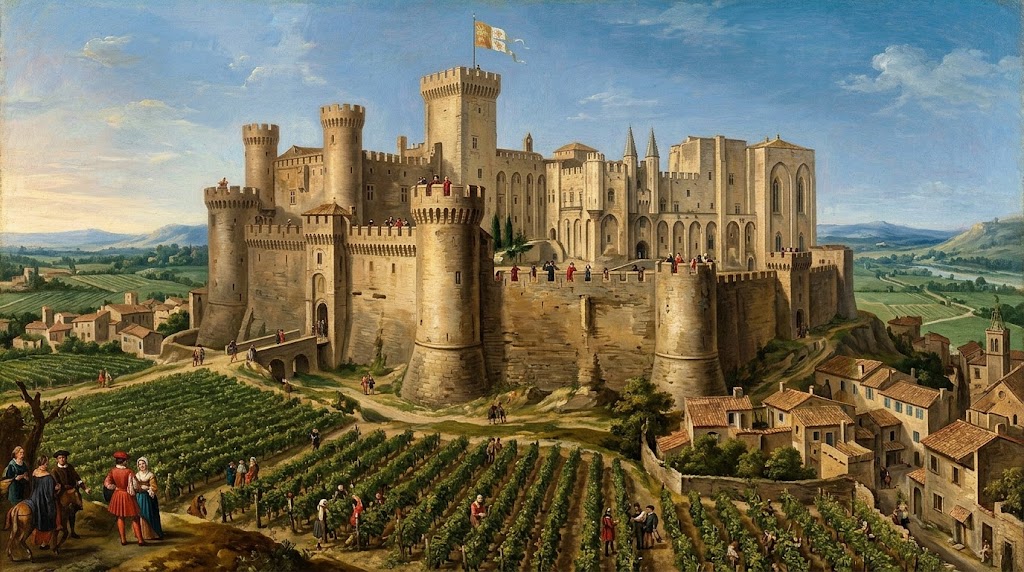
One claimant would not go. Pedro de Luna, an Aragonese nobleman, was elected at Avignon in 1394 as Benedict XIII, on the understanding that he would work to end the schism. He did not. In 1398 France withdrew its obedience, and Marshal Boucicaut’s troops besieged him in the Palais des Papes. The siege dragged on for five years. On 12 March 1403 he slipped out of Avignon and found shelter elsewhere, and the city, without him, submitted to him again.
Constance declared him deposed in 1417. He took no notice. He spent his last years in the castle of Peñíscola, on a rock above the sea on the coast of Valencia, with a handful of loyal cardinals. He died there in 1423, still the true pope in his own eyes. The Spanish called him Papa Luna.
Here, then, is the last dragon the invitation promised. It is fitting that he was Spanish. Our evening began with Pata Negra and a Basque pil pil before Italy had finished its first glass, and the story of the Avignon popes ends on a Spanish rock. Even this dragon took some killing. His remaining cardinals elected a successor, who called himself Clement VIII. A dissenter, Jean Carrier, promoted another claimant, who called himself Benedict XIV. Clement VIII finally abdicated in 1429, bringing the principal Avignon succession to an end.
Where the Rivers Meet
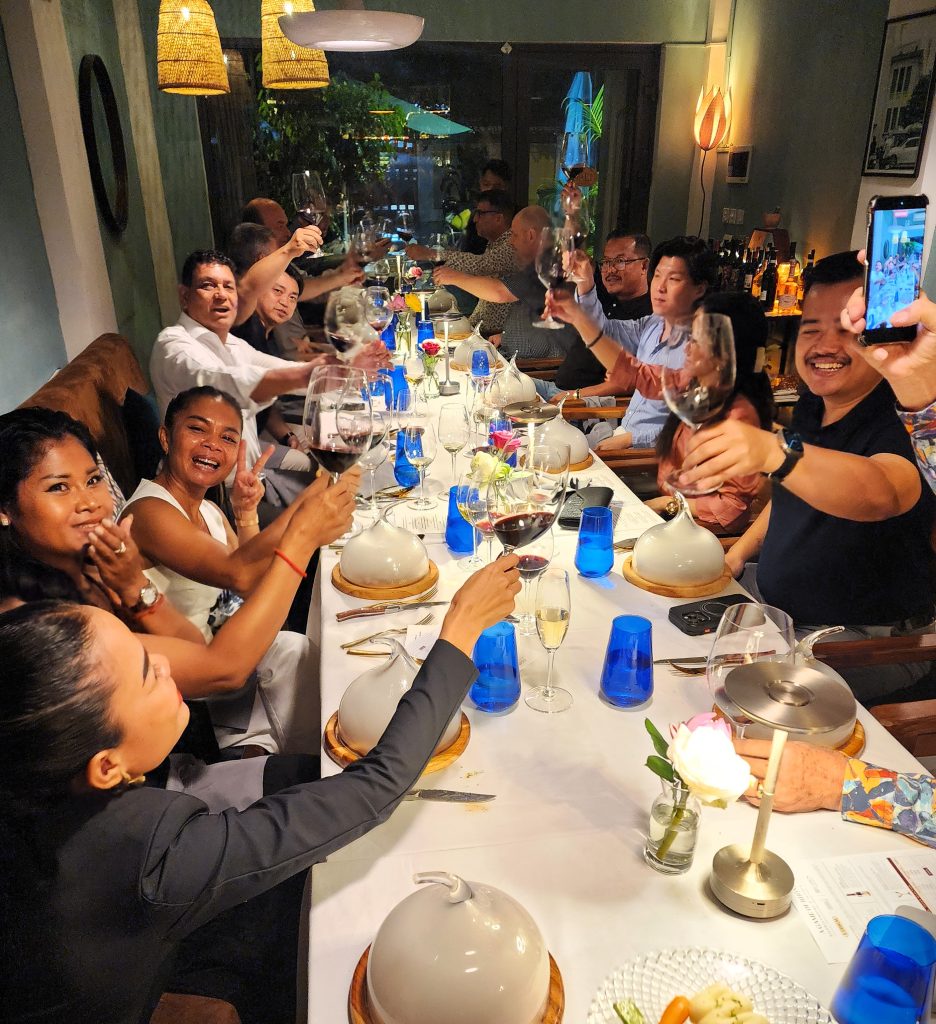
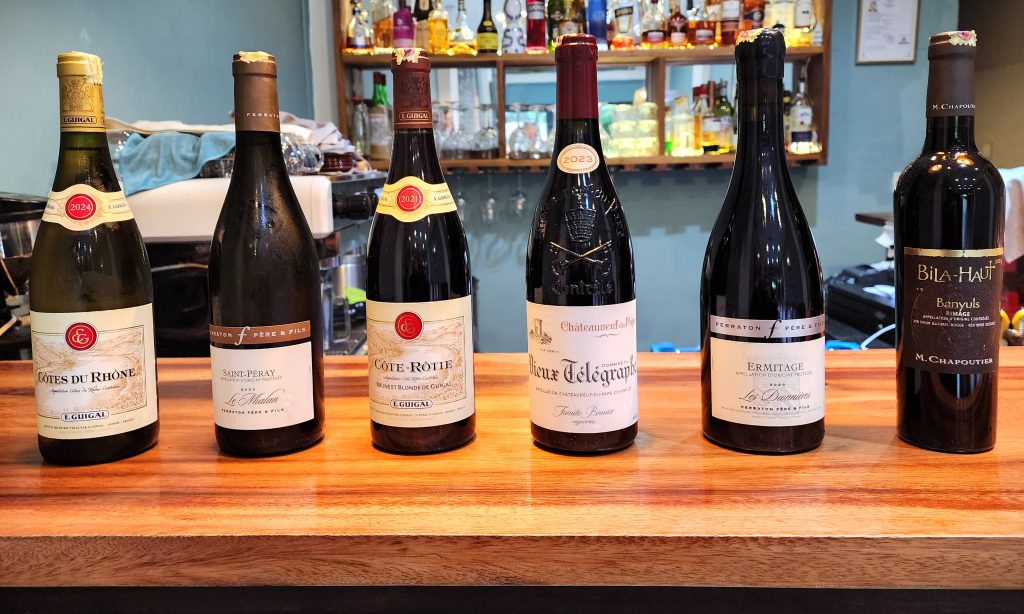
Our own dragon was slain rather sooner. The plates were cleared, the Banyuls glasses were empty, and seventeen of us were still at the long table at Baldwins, a short walk from the Chaktomuk, where the Mekong, the Tonlé Sap, and the Bassac meet. Lyon, Avignon, Phnom Penh: cities built where rivers meet, and all rather good places to have dinner. We had zigzagged up and down the Rhône, from the roasted slopes of Côte-Rôtie to the galets of Châteauneuf and back to the hermit’s hill, then slipped out of the valley to Roussillon. Five courses and seven wines had carried us through four of the pope’s awkward customers, a run of popes, and a flying cigar.
My thanks to Guy Baldwin and his kitchen team, who cooked a menu built around the wines and lifted the whole evening. Thank you also to Frankie Baroudi, a great friend who occasionally lets me organise these events and run amok in his and Guy’s restaurant; and to everyone who came battle-ready and stayed until the end.
Convivium
The last word belongs to Cicero, from the book that gave Act Four its epigraph. “For our fathers did well,” says Cato in On Old Age, “in calling the reclining of friends at feasts a convivium, because it implies a communion of life, which is a better designation than that of the Greeks, who call it sometimes a ‘drinking together’ and sometimes an ‘eating together’, thereby apparently exalting what is of least value in these associations above that which gives them their greatest charm.”
We ate well, and we drank better. But it was the communion of life and friendship that kept seventeen people at a long table in Phnom Penh until the last dragon was slain.
Darren Gall