
A Game of Rhônes – Act Three: The Pope’s New Castle
Tranquility, wherein peoples prosper and the welfare of nations is preserved, must certainly be desirable to every state.
—Cassiodorus, quoted at the opening of Marsilius of Padua’s Defensor Pacis (trans. Alan Gewirth)
The Doctor from Padua
The third of our five courses at Baldwins on 8 October brought the pope’s own wine to the table, at the exact centre of the menu, just as John XXII sits at the centre of our story. In Act Two an English friar slipped out of Avignon by night. Our next guest did his damage from a safer distance.
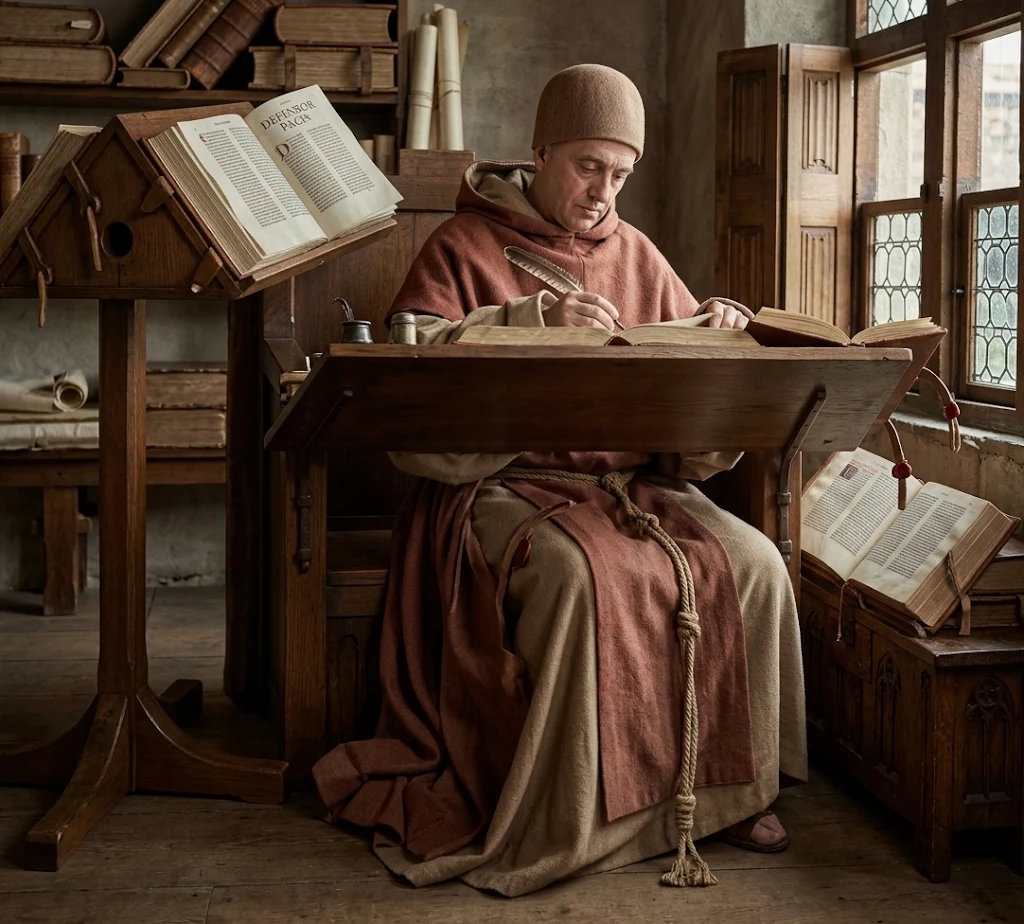
Marsilius was born in Padua, in northern Italy’s Veneto region, probably between 1275 and 1280. Torn, so a contemporary tells us, between law and medicine, he chose medicine, and by the winter of 1312/13 he was rector of the University of Paris. In 1324 he finished the book that made his name and made him an exile: Defensor Pacis, The Defender of the Peace. When his authorship became known in 1326, he fled, with the Paris master John of Jandun, to Louis of Bavaria at Nuremberg. Louis took them at first for heretics, then into his inner circle. In April 1327 John XXII excommunicated them both; that October a papal commission condemned five of the book’s propositions.
A Cause Aristotle Never Knew
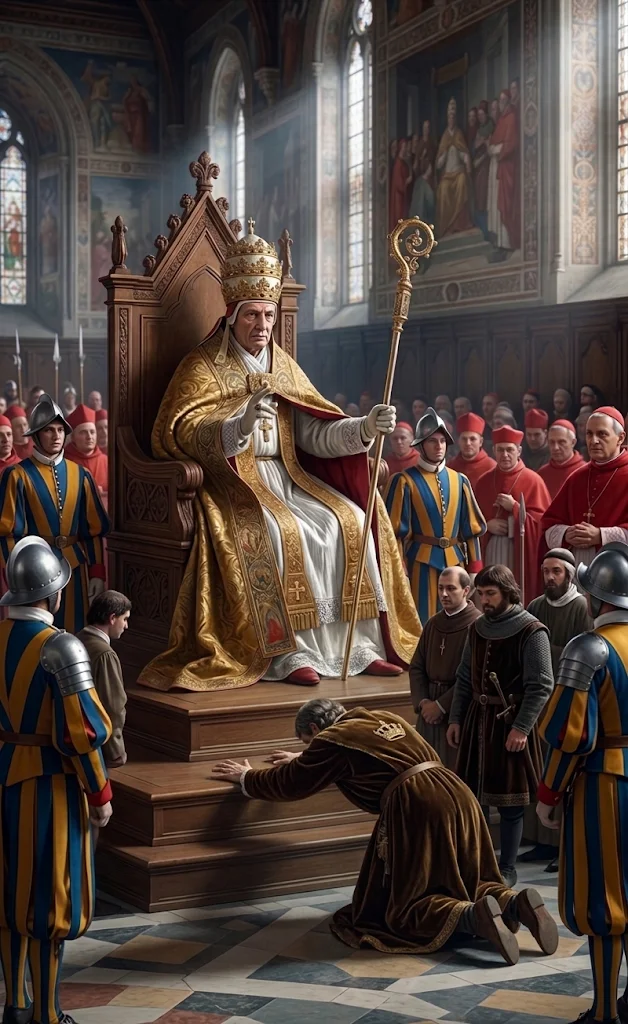
The book opens with the line at the head of this Act: peace is what a state is for, and discord is its disease. Marsilius had read his Aristotle on the causes of strife, but there was one cause Aristotle could not have examined, because in his day it did not exist. It was the papal claim to a “fullness of power”, the belief that kings ruled only by the pope’s leave. Marsilius called it a “singular cause of strife”, and he took it apart in three moves.
First, law comes from below. Its source is what he called the human legislator: “the people or the universal body of the citizens, or else its prevailing part”. The ruler carries out the law and answers to those who made it.
Second, the power to compel belongs to the law, and to no one else. Priests, he wrote, “neither can nor should hold anyone to such things by coercive power in this world.” A priest is like a physician: he can examine, advise, and warn, but he cannot force a patient to take the cure. It is an apt comparison from a doctor.
Third, God’s law and the people’s law govern different worlds. Divine law has its rewards and punishments in the next life; human law has its own in this one. The pope might keep the honour of his office, but in this world he had no power to compel anyone, and questions of faith belonged to a general council of the faithful, not to the pope alone. No pope could have read it calmly.
Rome, 1328
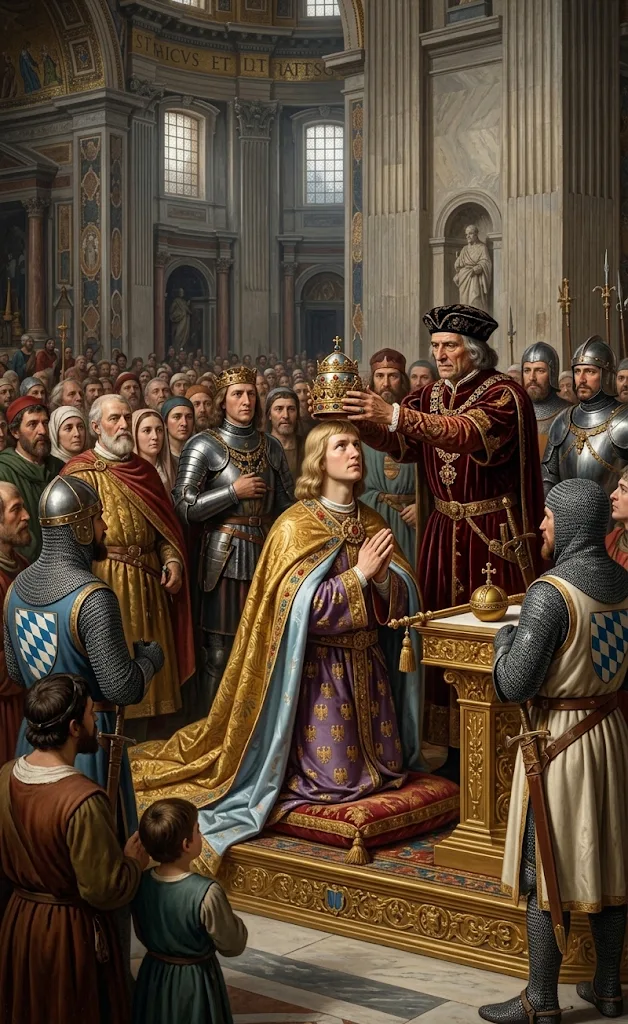
Marsilius lived to see his theory staged. Louis, already King of the Romans, King of Italy, and Duke of Bavaria, entered Rome in January 1328. On 17 January he was crowned Holy Roman Emperor, a title he kept until his death in 1347. There was no pope in sight: the ceremony was performed by Sciarra Colonna, acting for the Roman people. Twenty-five years earlier, at Anagni, the same Sciarra had reportedly slapped Pope Boniface VIII in the face during an attempt to arrest him. He was not a man who stood on papal ceremony.
In May 1328, an assembly of priests and laymen chose a Franciscan friar, Pietro Rainalducci, as pope. He took the name Nicholas V and was consecrated in Saint Peter’s on 12 May. Marsilius, meanwhile, served as the emperor’s vicar in the city and dealt harshly with clergy who stayed loyal to Avignon. A Paduan doctor’s book was being acted out in the streets of Rome.
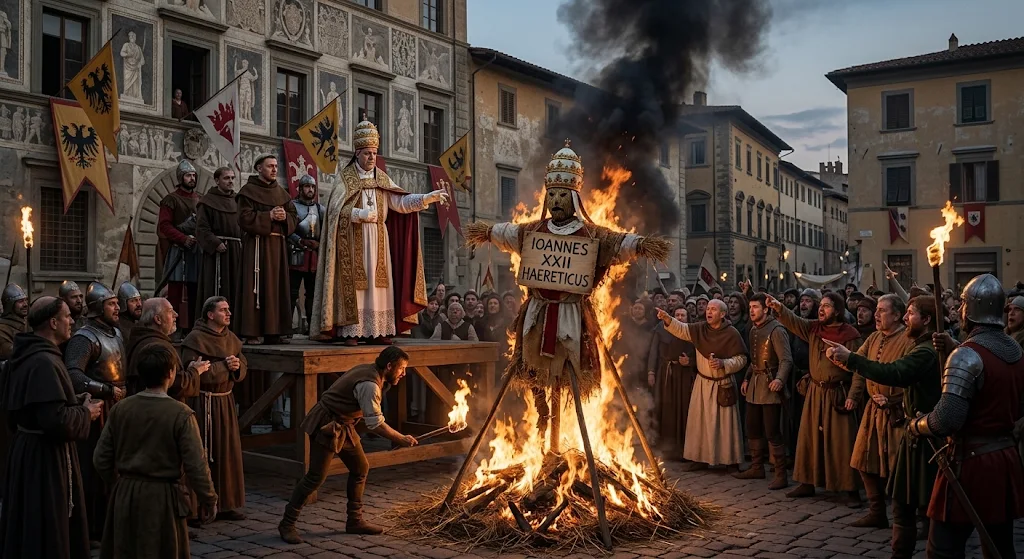
It did not last. Within four months Louis had withdrawn, his antipope in tow. In February 1329 in Pisa, Nicholas presided over a ceremony in which a straw figure of John XXII, dressed in papal robes, was condemned, stripped of its office, and handed over to be “executed”. By August 1330 Nicholas was in Avignon, confessing to the real John XXII, who absolved him and kept him in honourable confinement in the papal palace until his death in 1333. Marsilius died, still under the emperor’s protection, in or around 1342.
A concession is due. Modern admirers have hailed Marsilius as a prophet of democracy, and the scholars are warier. His “people” were not ours, his legislator was as much a theoretical device as a parliament, and he was perfectly content with kings. But the book outlived its moment. It was first printed at Basel in 1522; in 1535 Thomas Cromwell paid William Marshall to translate it into English, to support Henry VIII’s break with Rome; and by 1559 it was on the Index of Prohibited Books.
The Castle and the Code
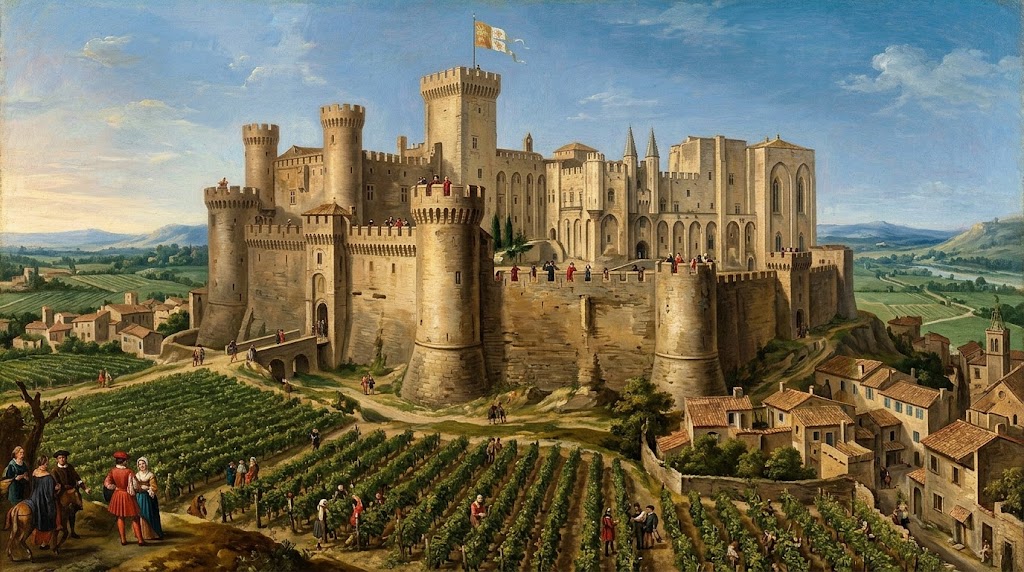
John XXII’s castle, begun in 1317 and finished around 1333, fared worse than his reputation. During the Wars of Religion it changed hands, and in 1563 the Baron des Adrets burned part of it. After the Revolution it was sold off and quarried for its stone. On 20 August 1944, the retreating German garrison blew up the munitions it had stored inside, and the north side of the castle went with them. A wall of the keep still stands above the village.
The law that now governs the vineyards below it was made in a way Marsilius would have recognised. In 1923 Baron Pierre Le Roy de Boiseaumarié, of Château Fortia, led the growers in establishing their own regulations: which grapes could be planted, how much each vineyard might yield, what minimum strength the wine must reach, and where vines could grow at all. The landscape offered its own test: the dry, stony country where lavender and thyme thrive. Those rules became the model for France’s national system of appellations d’origine contrôlée, and in 1936 Châteauneuf-du-Pape became one of the first. Law made by the people who would live under it: the human legislator, in a vineyard.
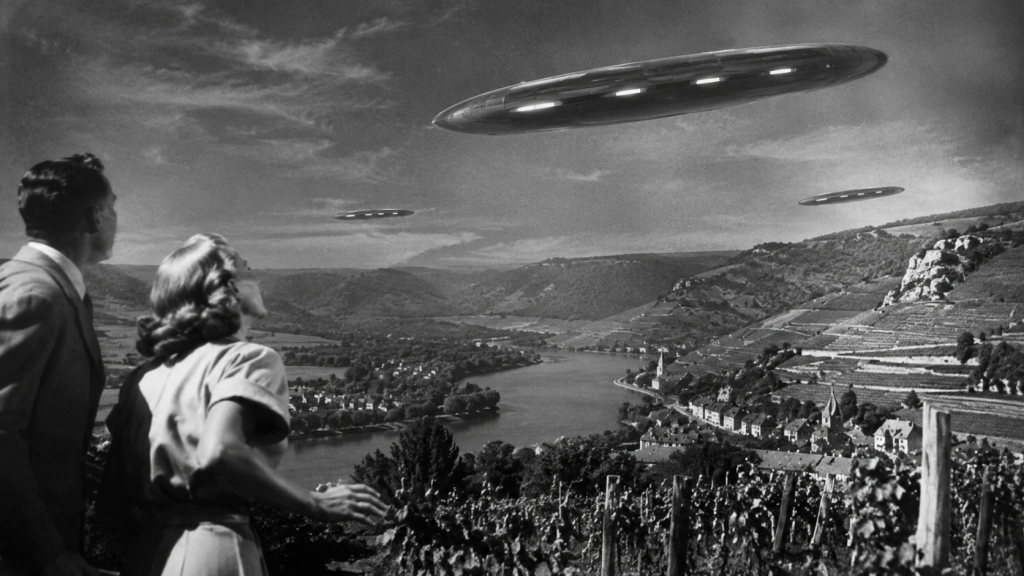
The village has used its sovereignty more creatively since. In October 1954 the mayor, Lucien Jeune, banned “flying saucers or flying cigars”, of whatever nationality, from flying over, landing in, or taking off from the commune. Any that landed would be impounded, and the village policeman was charged with enforcing the order. It was still in force in 2016. Remember the flying cigars. They will land in Cambodia at dessert.
ACT THREE
The Pope’s Own Wine
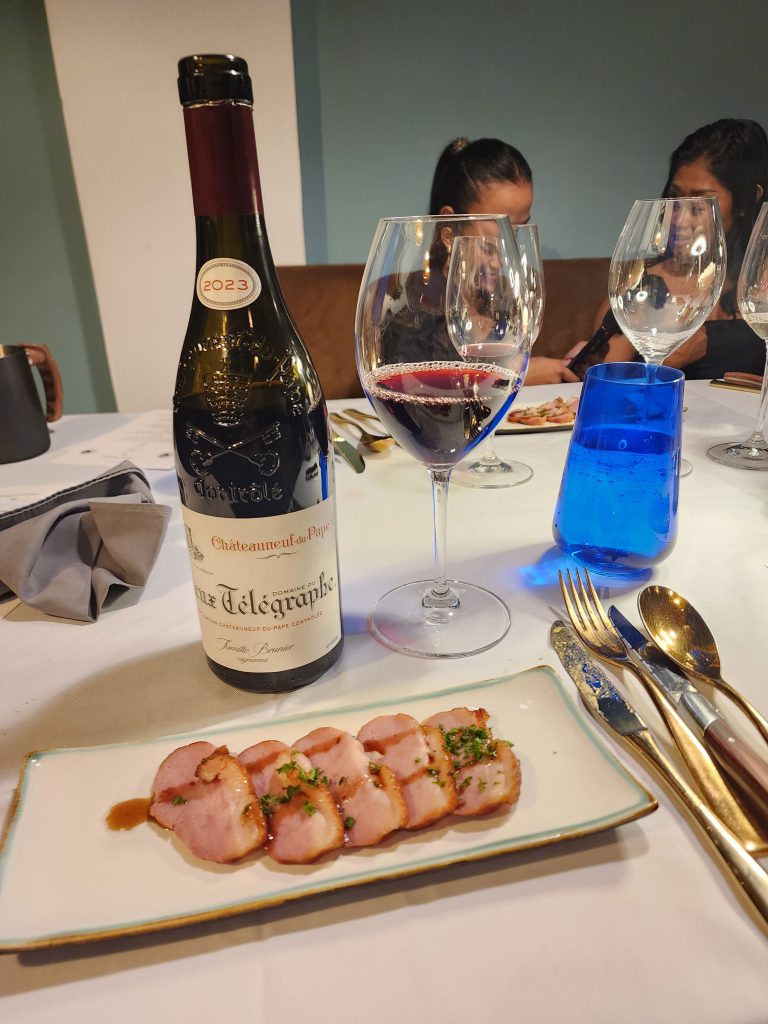
DUCK BREAST SMOKED OVER SUGAR CANE
The most local touch of the evening met the most papal wine. Sugar cane provided the smoke: the same cane pressed for juice on carts all over Phnom Penh, especially along the riverbank where the Tonlé Sap meets the Mekong. The duck came to the table plump, juicy, and just a little gamey, with a faint, toasted sweetness somewhere between molasses and burnt toffee. A plate to make a duck lover of anyone.
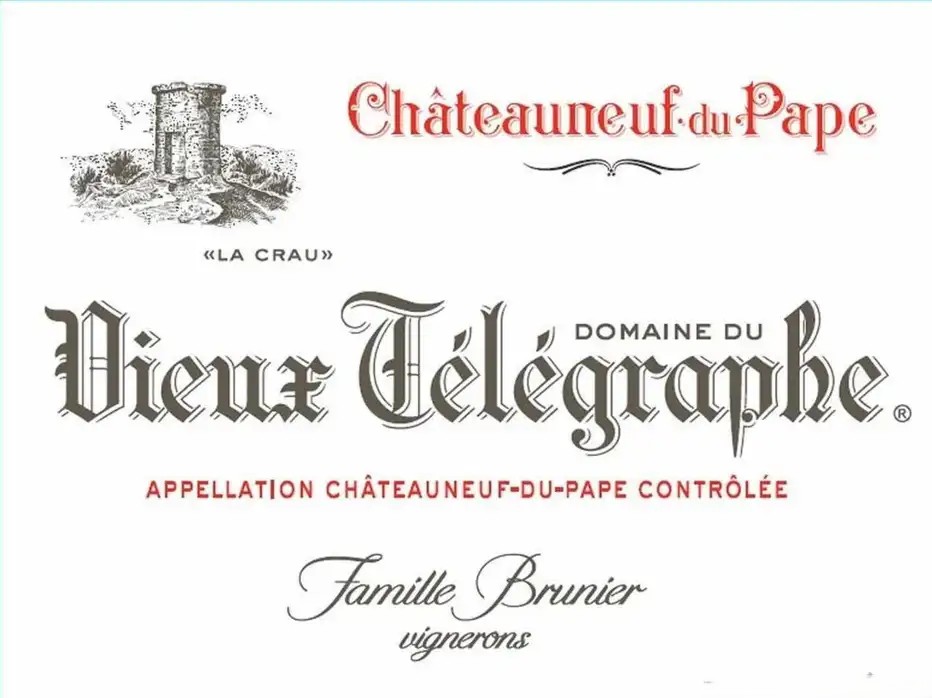
Domaine du Vieux Télégraphe, La Crau, Châteauneuf-du-Pape, Rhône, France, 2023
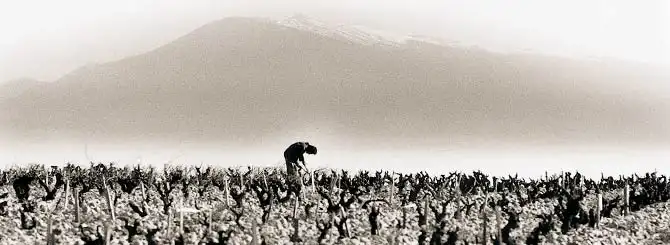
La Crau is a plateau on the eastern side of the appellation, near Bédarrides, covered in galets roulés: rounded quartzite pebbles deposited by the Rhône and its tributaries. The stones absorb the heat of the day and release it at night, whilst also reflecting sunlight and warmth back up under the canopy. The estate describes a layer of pebbles over sand, then red clay that is two-thirds stone. These are the galets of the invitation, and not one of them was left unturned. Hippolyte Brunier planted his first hectare here at the end of the nineteenth century, on a plot his father gave him with the words “Fais ce que tu veux”: do as you like. A relay tower of the Chappe optical telegraph once stood where the cellar is now and gave the estate its name.
The appellation permits thirteen grape varieties, eighteen if you count their colours separately. Vieux Télégraphe calls on four of them: Grenache 65%, Mourvèdre 15%, Syrah 15%, Cinsault 5%. A wine shaped not by a single voice but by a general council. The 2023, Manon Brunier says, balances acidity and ripeness in the manner of 2015 and 2020. It is also young. It was poured, in truth, a few years before its time: the fruit was already generous, but the structure had yet to find its full integration.
The wine displays aromas of crushed violets, raspberries, boysenberries, fruit mince, Chinese five-spice, mocha, and earthy tones of graphite, petrichor, and wild herbs. It is immediately evident that there is a lot going on here. Salome’s dance of the seven veils comes to mind. The wine reveals a little more of itself as it sheds another layer with every swirl of the glass.
On the palate, the wine is medium- to full-bodied, with focused, ripe, and eminently attractive fruit. Red and black forest berries fan out across the palate, while a deeper compote-like richness floods into its core.
Then the scaffolding arrives. Lively mineral notes emerge across the back palate, supported by clean, precise acidity, a touch of spice, and a hint of smoke. The effect is cleansing and bracing, the unmistakable energy of a wine still in its youth. The ripe fruit returns on the finish, lingering like the memory of a first kiss: vivid, sensual, and difficult to relinquish.
This is a legendary wine for good reason. It is one of the world’s finest red wines, and you don’t need a telegraph to make you aware of that. Decant for a couple of hours or cellar carefully for a couple of decades. Drink it with smoked duck or a civet de chevreuil. 96/100 DG
The Pairing
The smoke and the stones understood each other. The sweet cane smoke met the wine’s wild herbs and stony minerality, while its ripe red and black fruit provided something akin to a coulis alongside the duck. The wine’s acidity refreshed the palate, and the fine, firm tannins proved a counterpoint to the richness of the meat and cut cleanly through the fat. Neither outweighed the other: the pope’s wine and a Cambodian kitchen performed a mesmerising pas de deux. An almost perfect pairing, dish and wine elevating each other: this is what aristologists mean by the art of the table.
The telegraph relayed messages across distance, tower to tower. Our next guest relayed them across time: a poet who grew up in Avignon’s shadow, called it Babylon, and wrote letters to a man fourteen centuries dead.
Plates cleared, and the pope’s wine still opening in the glass, we were ready for the poet.
Next, Act Four: a poet climbs Ventoux, and a knight lays down his sword.
Darren Gall
