
The View From Nowhere
A philosophical investigation into perception, thought, and being
The eye cannot see itself.
— Wittgenstein, Tractatus Logico-Philosophicus, 5.633
For Canard
I absolutely adore ducks; I’ve nibbled on their webs and sucked on their tongues in Chinese palaces. I’ve eaten their livers “with some fava beans and a nice Chianti” in Italian cucinas. I’ve chased Peking ducks to the four corners of the globe, legs, breasts, it doesn’t matter; just about any way that you want to slice, cook, and serve them to me, I’ll be back for seconds.
As wine-food goes, duck is just about the perfect protein from its skin, legs, breasts, liver; whether fat and juicy or lean and gamey, rich or spicy, tender or crispy. You can coat them in salt-cake and herbs, flay them and wrap their skin in little Chinese crepes, cover them with pastry in a terrine, you can stuff their innards into little pockets of Ravioli pasta, smoke them whole in tea leaves or, smear their breasts and thighs in sauces made from cepes, l’Orange, plums, figs, quinces, Gaeng Phed Yang (Thai Red Curry), Hoi Sin, Szechuan peppers even chocolate in one famous Belgium restaurant.
I love them all.
However, I suspect one of the reasons I love them so much is their astonishing ability of this Anatidae to pair brilliantly with Pinot Noir; indeed, the two seemed made for each other, a synergistic culinary symphony like no other. One is Giazotto to the other’s Albinoni, they complete each other like few pairings can hope to achieve. Part sorcery and part Saucery, the combination can elevate a degustation from a pasticcio, an intermezzo, to an opera eroica, an azione sacra, an unforgettable gastronomic masterpiece.
Pinot Noir, that most seductive and alluring of grapes, that siren of the dark arts, the enchantress in black. As Andre Tchelistcheff, Chief Winemaker at Beaulieu from 1938 – 1973, said, “God made Cabernet Sauvignon, whereas the devil made Pinot Noir.”
I can think of no greater joy in the art of aristology, than the pairing of this bird with this grape to dance and swirl and perform across a crowded table in six acts (courses), captivating their audience and sating their appetite for food, art and culinary adventure.
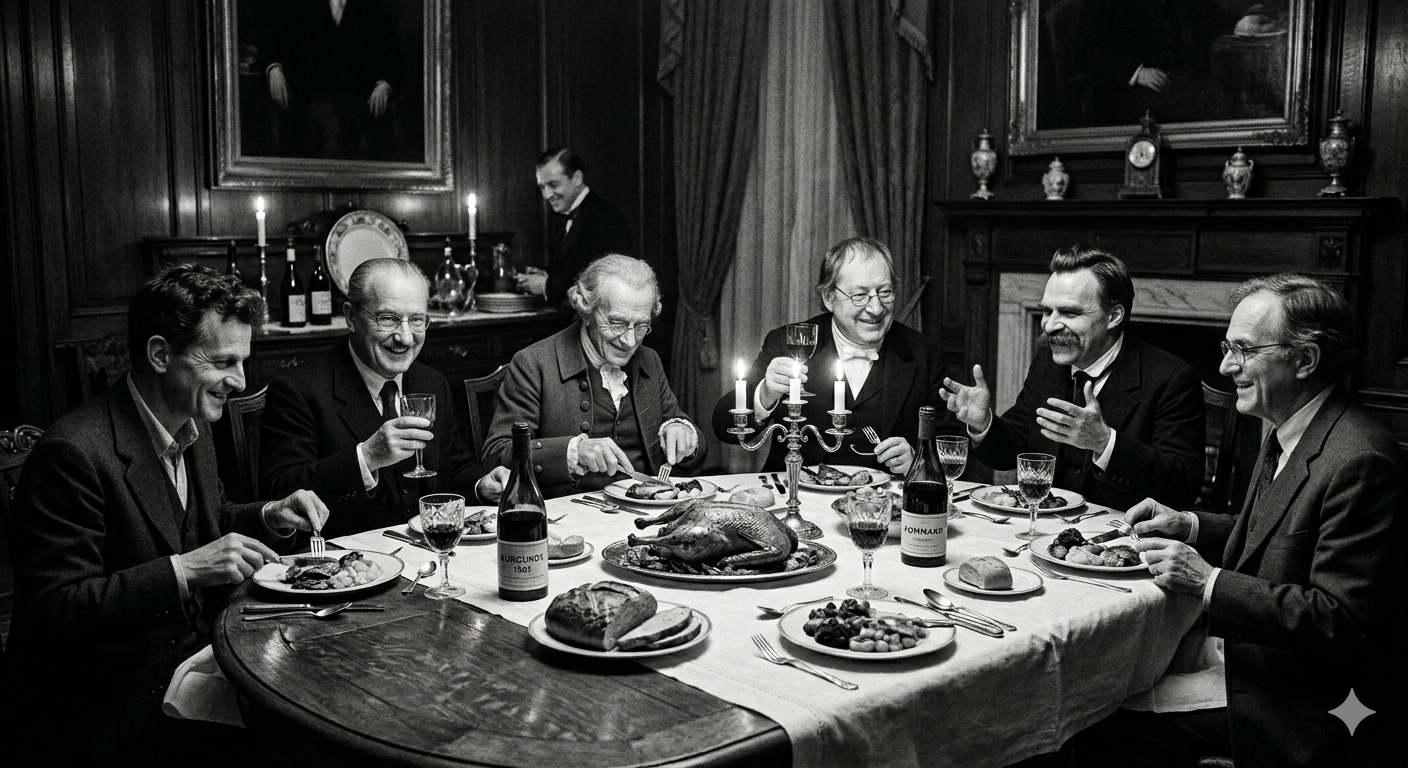
And so, I planned a dinner at the eponymously named Baldwin’s restaurant in Phnom Penh, and this got me thinking about ducks, and this got me thinking about Ludwig Wittgenstein, and this got me thinking…about thinking.
The Question That Does Not Release You
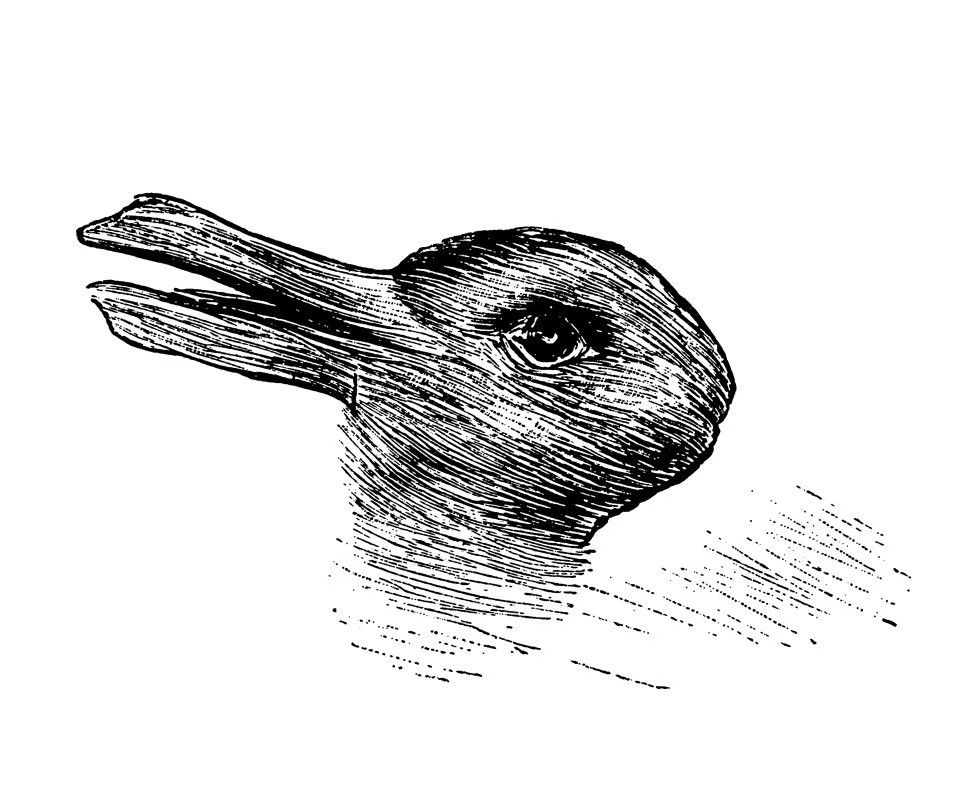
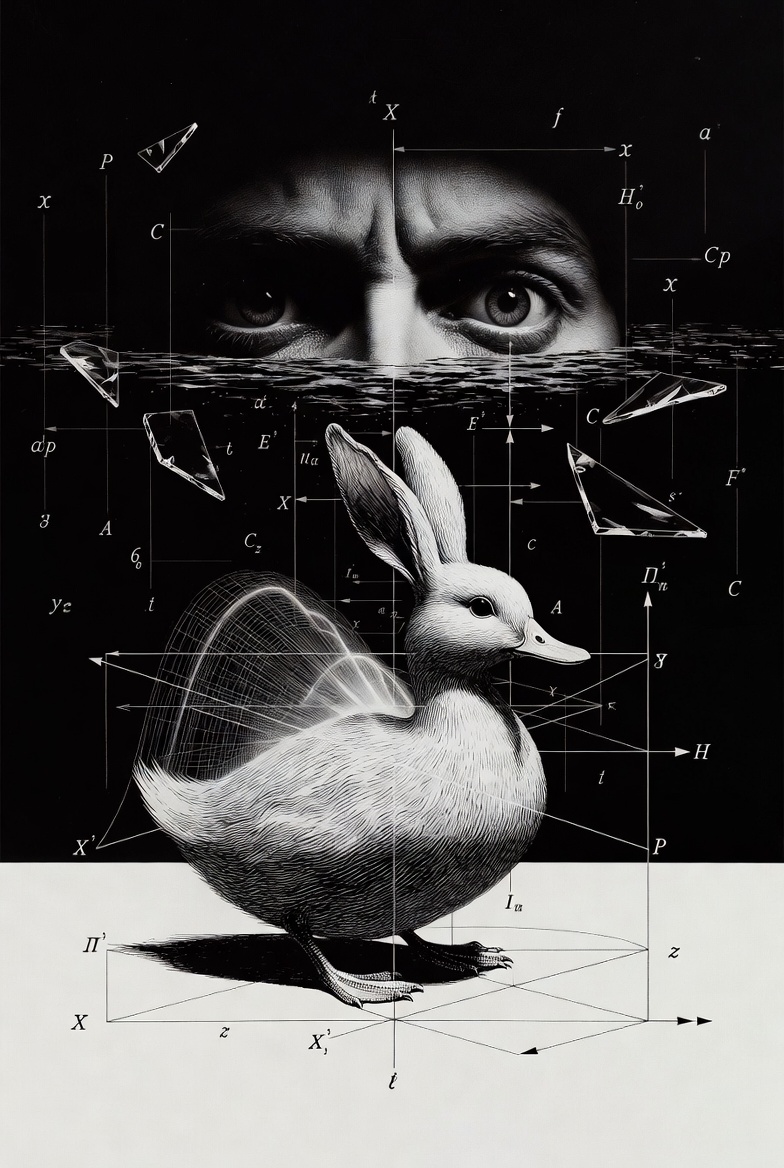
Begin with the simplest possible observation about perception, and follow it as far as it goes. Look at a rough sketch — barely more than a handful of lines — and you see a duck. Look again and the duck becomes a rabbit. The bill that pointed left is now a pair of ears pointing right. Nothing in the image has changed. The light hitting your eyes is identical. And yet what has happened is not a minor adjustment at the margins of experience. It is a total perceptual transformation: a different creature, a different orientation, a different world — produced by the same data, the same eyes, the same moment.
This observation, which began as an illustration in a German humour magazine in 1892, became one of the most productive philosophical instruments of the twentieth century. Ludwig Wittgenstein seized on it in Philosophical Investigations not as a curiosity of visual psychology but as a revelation about the structure of perception itself. What changes when you switch from seeing the duck to seeing the rabbit is not the image. It is the aspect under which the image is held: the conceptual framework through which the mind organises what it receives. Wittgenstein called this seeing-as, and the lesson he drew from it reverberates, as this inquiry will show, through physics, metaphysics, ethics, and the question of how a conscious being ought to live.
But the lesson is wider and stranger than even Wittgenstein saw. The Duck-Rabbit, taken seriously, opens onto a territory that nineteen thinkers across three millennia and three intellectual traditions have each, from their different vantage points, explored: the territory of what every act of knowing leaves behind. Not what it fails to grasp through inadequacy or error. What it structurally, necessarily, constitutively cannot hold — the remainder that is not a deficiency of knowledge but a feature of its very operation.
This inquiry is an attempt to map that territory honestly. It does not pretend to stand outside it. Every act of philosophical description is itself an act of knowing, subject to the very limits it describes. The eye cannot see itself — but it can, with sufficient discipline, become aware of its own blind spots, even if that awareness does not dissolve them. That discipline is what follows.
Before the Mind: The Body That Already Knows
Maurice Merleau-Ponty • 1908–1961
Arthur Schopenhauer • 1788–1860
William James • 1842–1910
The Duck-Rabbit is a visual puzzle presented to a cognitive system. It is a model of perception as a mental event: data arrives, frameworks are applied, an aspect is produced. This model is not wrong. But it begins in the middle of the story, presupposing a layer of knowing that it never examines — the knowing that the body performs before the mind categorises anything at all.
Maurice Merleau-Ponty’s Phenomenology of Perception (1945) is the most sustained philosophical examination of what this omission costs. Merleau-Ponty argues that the body is not the vehicle through which a disembodied mind perceives the world. The body is the subject of perception — it perceives. It has its own intentionality, its own pre-reflective grasp of the world, irreducible to any act of cognitive categorisation. He calls this the body schema: the pre-conscious, motor-intentional knowledge that allows a surgeon to cut without calculating angles, a musician to respond to a chord change before the conscious mind registers it, a craftsman’s hands to follow the grain of wood in a way that no description of wood could substitute for. This knowledge is not organised by concepts in any sense that Wittgenstein’s seeing-as captures. It does not flip between aspects. It does not hold hypotheses and test them. It is an older, more intimate, more fundamental form of being-in-the-world.
The implication is immediate and uncomfortable. An inquiry into perception that begins with the Duck-Rabbit is already committed, before it makes its first move, to a disembodied and intellectualised model of the knowing subject. Most of what human beings actually know, in the course of actually living, is not known at the level of conceptual aspect-perception. It is known in the hands, in the habits of the body, in the pre-reflective attunement that allows a nurse to sense that something is wrong with a patient before she has consciously registered any specific symptom. A philosophy of perception that does not account for this layer has not yet fully addressed its subject.
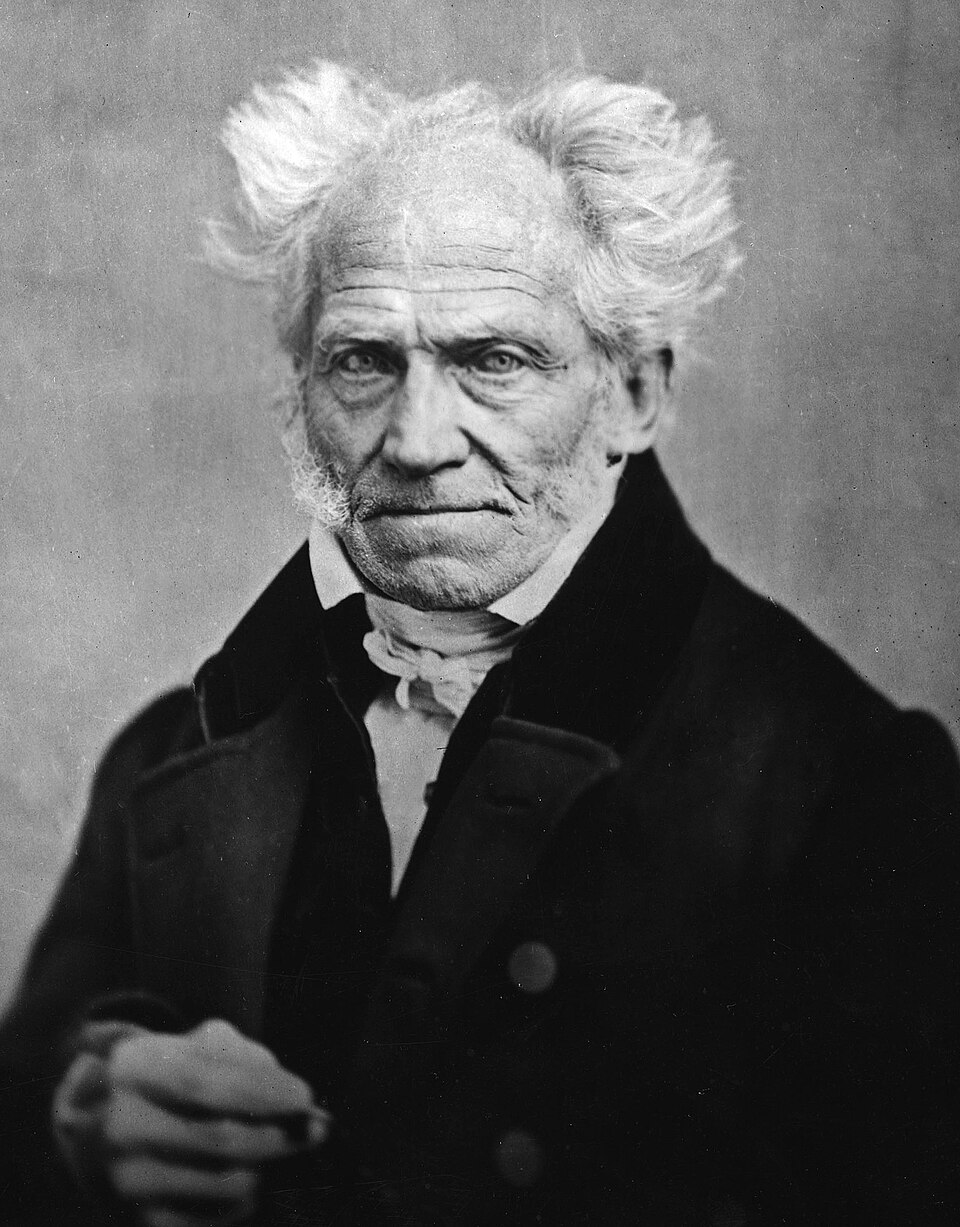
Arthur Schopenhauer, a century earlier, located the same gap from a different direction. Kant had argued that the thing-in-itself — the world as it is independent of our cognitive forms — is permanently inaccessible to human knowledge. Schopenhauer agreed, with one critical exception. Through the immediate experience of bodily willing — the felt sense of reaching, striving, moving — something of what lies behind appearance briefly becomes accessible, not as cognitive knowledge but as direct acquaintance. When I reach for something, I do not first represent my arm as an object in space and then causally explain its motion. I will the motion and feel the willing. In that willing, Schopenhauer believed, the thing-in-itself is momentarily disclosed to us from the inside — not known in Kant’s sense, but felt.
William James extends this from the American pragmatist tradition. His radical empiricism — the thesis that relations between experiences are themselves experienced, that the stream of consciousness is a continuous flow prior to any division into subject and object — challenges the cognitive model of the knower from yet another angle. For James, the subject-object structure that organises most Western epistemology is not a metaphysical given. It is a practical abstraction, performed for specific purposes, within a prior field of pure experience that is neither mental nor physical. The duck and the rabbit, for James, are conceptual carvings from a prior experiential flow in which the distinction between perceiver and perceived has not yet been made. That flow — the stream of pure experience — is the more fundamental phenomenon.
The Image That Flips: Wittgenstein’s Seeing-As
Ludwig Wittgenstein • 1889–1951
Wilfrid Sellars • 1912–1989
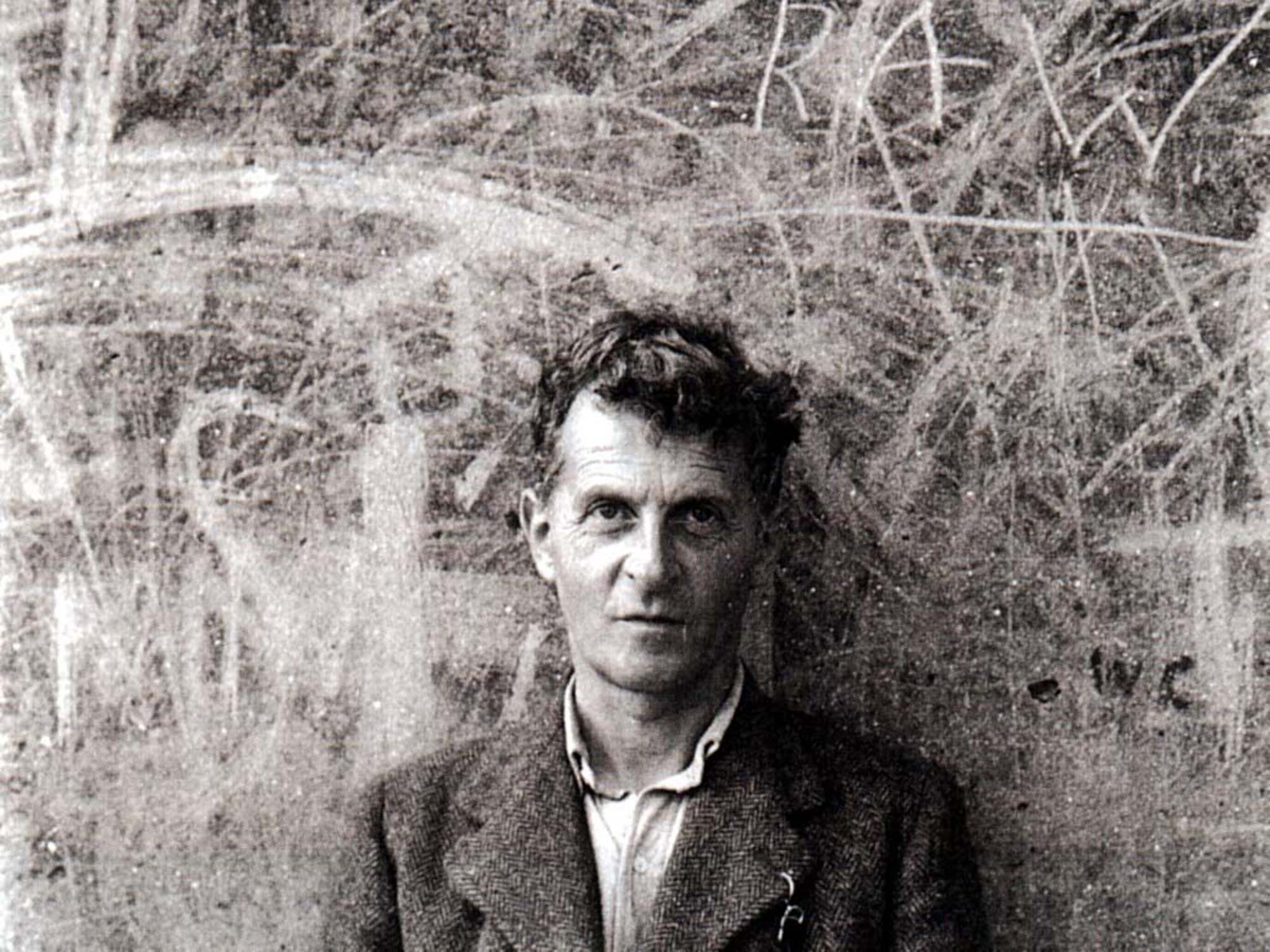
At the cognitive level — the level above the bodily and pre-reflective — Wittgenstein’s observation retains its full force. Perception here is never the neutral reception of raw data. It is always already organised by frameworks: concepts, habits, and what Wittgenstein calls forms of life, the shared practices and contexts that constitute a human world. The two aspects of the Duck-Rabbit are mutually exclusive: you cannot hold both simultaneously, because each act of seeing-as is a total commitment to one interpretive framework that forecloses the other for its duration. This mutual exclusivity is not a psychological limitation to be overcome. It is structural — built into what seeing-as means.
The philosophical stakes of this observation are considerable. If seeing is always seeing-as, then the empiricist dream of a pure, unmediated encounter with reality — a bedrock of raw sensory data on which knowledge is neutrally built — is conceptually incoherent. There is no pre-interpretive experience available for comparison with our interpreted experience. The neutral baseline does not exist.
Wilfrid Sellars establishes the same point from within analytic philosophy, with greater precision. His critique of the myth of the given — developed in Empiricism and the Philosophy of Mind (1956) — demonstrates that there is no pre-conceptual given: no layer of pure sensory intake that exists prior to and independent of the conceptual frameworks applied to it. Every cognitive state that can serve as evidence for a belief is already a conceptual state, already caught up in the web of inference and justification that constitutes knowledge. The categories do not process a neutral raw material. They go all the way down. This does not mean that nothing is real or that all perception is fabrication. It means that the concept of a perception entirely prior to all interpretation — the view from nowhere that empiricism required as its foundation — is a philosophical myth.
Wittgenstein does not develop, and Sellars does not supply, an account of where the frameworks themselves come from. Forms of life are not eternal structures of human cognition. They are historically produced, culturally specific, and — as Kuhn, Foucault, and Derrida will each establish from different directions — shot through with interests and power relations that they do not advertise. The frameworks that constitute perception are themselves part of what every act of perceiving leaves unexamined.
The Physical Constraint: Heisenberg and Schrödinger
Werner Heisenberg • 1901–1976
Erwin Schrödinger • 1887–1961
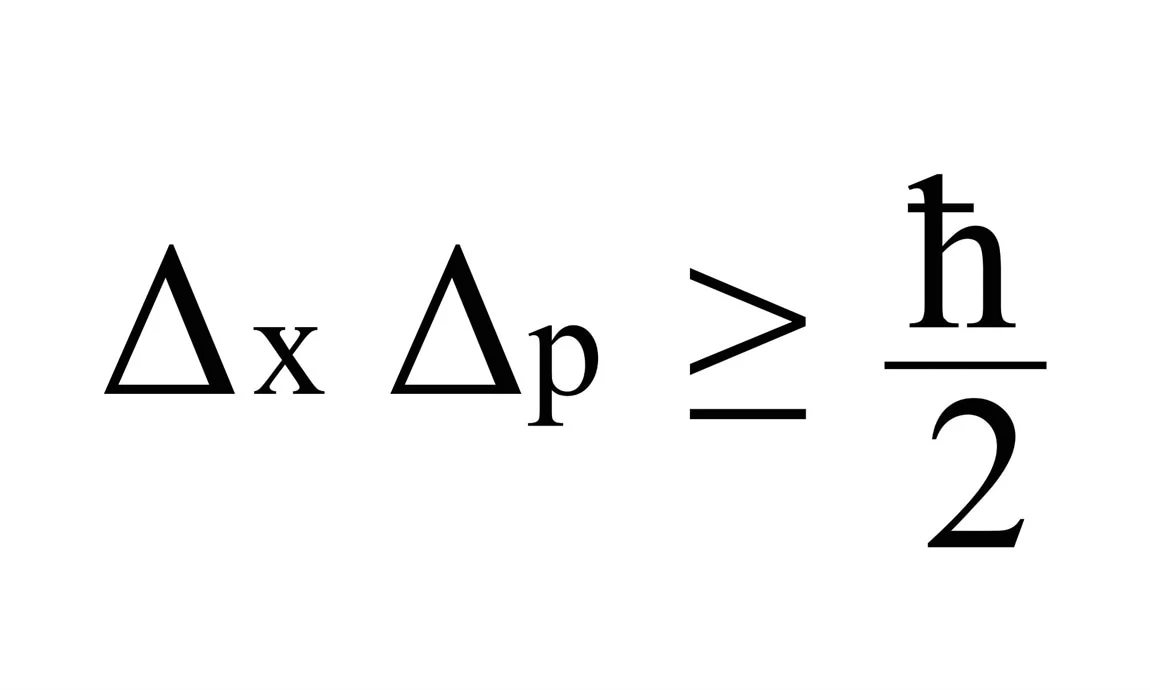
In 1927, Werner Heisenberg published the uncertainty principle: the product of the uncertainty in a particle’s position and the uncertainty in its momentum cannot fall below a fixed minimum set by Planck’s constant. This is not an instrumental limitation. Position and momentum are conjugate variables — quantities so structurally entangled in the mathematics of quantum mechanics that they cannot simultaneously possess sharp values. Nature itself does not hold them both at once. To sharpen one is, by necessity, to blur the other.
The structural parallel with the Duck-Rabbit is real and philosophically generative. Both involve a system with two legitimate descriptions that cannot be simultaneously maximised. Both implicate the act of observation in the determination of what is found. Both challenge the classical ideal of a world of fully determinate, observer-independent facts available for complete and simultaneous description. In Heisenberg’s physics as in Wittgenstein’s philosophy, to know one thing precisely is to loosen one’s grip on another.
Erwin Schrödinger extended this to its most vivid formulation in 1935. A cat in a sealed box, its fate dependent on a quantum event, exists in a superposition of alive and dead until the box is opened. The act of observation does not reveal a pre-existing state. It determines what becomes the case. The observer is not outside the system. The observer is constitutively entangled with it.
The qualification that honesty requires: the analogy between physics and philosophy of perception cannot be pressed to identity. The uncertainty principle’s ontological interpretation — that the particle genuinely lacks simultaneous determinate values — depends on accepting the Copenhagen interpretation, which remains contested. Many-worlds, pilot wave, and objective collapse theories propose alternatives in which something definite is happening prior to measurement. What physics provides is not philosophical proof but independent evidence, from a wholly different domain, that the act of knowing participates in the constitution of what is known. That is significant. It is not a demonstration.

The Architecture of Appearance: Kant and the Cracked Foundation
Immanuel Kant • 1724–1804
Immanuel Kant’s Critique of Pure Reason (1781) remains the indispensable philosophical foundation for the problem this inquiry is tracing. Kant’s central insight is that the mind does not passively receive experience. It constitutes it. Space, time, and the categories of the understanding — causation, substance, unity, necessity — are contributions of the knowing subject, not features of the object. The phenomenal world, organised by these forms, is real and knowable. The world as it is in itself, independent of any perceiver and independent of the forms and categories imposed upon it — the thing-in-itself, the Ding an sich — is real, causally relevant to experience, and permanently inaccessible to human knowledge.
The thing-in-itself is not merely unknown. It is unknowable — not because it is hidden behind a curtain that might one day be lifted, but because the very instruments of human knowledge are constitutively incapable of reaching it. To know something is necessarily to impose the forms of space, time, and causation upon it. The thing-in-itself is precisely what remains when those impositions are removed: the world without a human perspective on it. Since we cannot step outside our own perspective, we cannot access it. We are permanently enclosed within the boundaries of possible human experience.
This is an enormously powerful insight. But two cracks run through the foundation on which it rests. The first: to say that the thing-in-itself exists but is unknowable is already to know something about it — that it exists, that it is distinct from appearances, that it stands in a particular relationship to the knowing mind. The moment you name the limit, you have, to some extent, crossed it. Kant relies on the thing-in-itself to explain why experience has the character it does, even while insisting it cannot be known. This is not a minor inconsistency. It is a fundamental instability that every subsequent thinker in this inquiry will inherit and attempt to address.
The second crack: Kant presents the forms of intuition and the categories of the understanding as universal and ahistorical — the same for all human beings at all times. But this claim is itself a philosophical thesis, not a datum, and it sits uneasily with everything we know about the historical variability of human conceptual frameworks. The categories through which a medieval theologian organises experience are not those available to a twenty-first century physicist. If the forms of cognition are themselves historically conditioned, Kant’s claim to have identified the universal necessary conditions of human experience is more precarious than it appears.
The Moving Horizon: Hegel’s Dialectic
G.W.F. Hegel • 1770–1831
Georg Wilhelm Friedrich Hegel was Kant’s most penetrating critic, and his objection must be stated with full force. To draw the limit of knowledge is to stand on both sides of it. The philosopher who says ‘here is the knowable world, there beyond it lies what cannot be known’ must already occupy a position from which both the knowable and the unknowable are visible — which is to say, a position that has already, in some sense, crossed the limit it is claiming to identify. The thing-in-itself, far from being a stable resting point, is a contradiction. And contradictions, in Hegel’s system, are not dead ends. They are engines — the motor by which thought moves toward more adequate formulations of itself.
The dialectical movement Hegel proposes proceeds through what he calls Aufhebung — a German term meaning simultaneously to cancel, to preserve, and to elevate. Any position pushed to its limits generates its own negation. Holding the two together yields a synthesis that preserves what was true in both while raising both to a higher level of comprehension. Applied to the Duck-Rabbit: the mutual exclusivity of aspects is not the terminus of the inquiry. It is the beginning of a reflection that can hold duck-seeing and rabbit-seeing together not as competing perceptions but as moments in a richer understanding of what the image is and why it works the way it does.
Hegel’s most ambitious claim is that the gap between appearance and reality — between the world as it appears to us and the world as it is in itself — is not a permanent structural feature of the human cognitive situation but a historical stage in the development of Geist, of mind or spirit moving toward adequate self-understanding. The Absolute — the totality of reality as it is in and for itself — is not a thing we can never reach. It is the process of reaching itself.
This inquiry does not accept that conclusion. The confidence that contradictions are resolved rather than merely superseded, that the movement of thought has a direction and a destination, that history is the autobiography of Geist — this confidence requires more than Hegel demonstrated, and considerably less than subsequent history has confirmed. But Hegel’s challenge cannot be dismissed by registering a disagreement with his conclusion. He forces a more uncomfortable acknowledgement: the framework within which this entire inquiry operates — the framework of a knowing subject confronting a world that exceeds its knowledge — is itself a perspective. Hegel would regard it as a penultimate perspective. Whether that is a limitation or a fate is something the inquiry cannot determine from inside itself.
The Concealment That Discloses: Heidegger
Martin Heidegger • 1889–1976
Heidegger’s membership in the National Socialist Party from 1933, his rectorship at Freiburg under the regime, and his lifelong failure to offer any unambiguous public reckoning with these choices cannot be set aside. They must be held alongside his philosophy — not as a reason to dismiss the thought, but as a permanent complication in how it is received. A thinker who asked with extraordinary depth what it means for human beings to be thrown into a world they did not choose was himself thrown into a political catastrophe, and his choices within it were not merely those of a man navigating impossible circumstances. The question of how this bears on the philosophy is one that the philosophy itself, taken seriously, should be able to address — and the fact that Heidegger never performed that analysis on his own case is itself a philosophical datum.
With that acknowledgement in place, Heidegger’s most radical contribution to this inquiry can be stated. His central move is a distinction he believed Western philosophy had forgotten since the pre-Socratic Greeks: the distinction between Being — Sein — and beings — Seiende. Beings are the things that exist: tables, particles, thoughts, people. Being is the condition of their existing at all — the sheer fact that there is something rather than nothing. Western philosophy and science, he argued, have been almost exclusively preoccupied with beings — cataloguing, measuring, explaining, manipulating the things that exist — while the question of Being itself has been not answered incorrectly but forgotten entirely, buried under centuries of metaphysical assumption so deep that philosophers no longer notice they are standing on it.
Truth, for Heidegger, is aletheia — unconcealment. Not a property of propositions but an event: a happening in which Being discloses itself through beings. And this disclosure is always partial. Every act of unconcealment simultaneously conceals. What is brought into the light necessarily leaves something else in shadow. This is not a deficiency of knowledge. It is the structure of disclosure itself. Light requires shadow. Every act of revealing is, in its structure, an act of hiding.
Dasein — Heidegger’s term for the kind of being that we are — is always thrown, geworfen, into a situation it did not choose and cannot fully comprehend. We are always already in a world prior to any act of reflection, embedded in a historical horizon that both enables and limits what can show itself to us. We do not know what we do not know. The depth of that unknowing is not fixed by the universal structure of the human mind — as Kant thought — but by the particular historical moment in which we find ourselves thrown, a moment whose concealing structures are largely invisible from inside it.
Heidegger’s deepest challenge to this inquiry is not additive but foundational. The other thinkers assembled here — Kant, Wittgenstein, Heisenberg — frame the problem of the unknowable remainder in terms of the relationship between a knowing subject and a known object. Heidegger questions whether the subject-object framework is itself adequate to the problem. The reason we keep running into limits is not merely that the subject is finite and the object recalcitrant. It is that the question of Being is being asked within a framework — the framework of subject confronting object — that already conceals more than it reveals. The real question is not how a subject can know an object. It is how anything can be disclosed at all. And that question cannot be answered within the subject-object framework. It requires dismantling it.
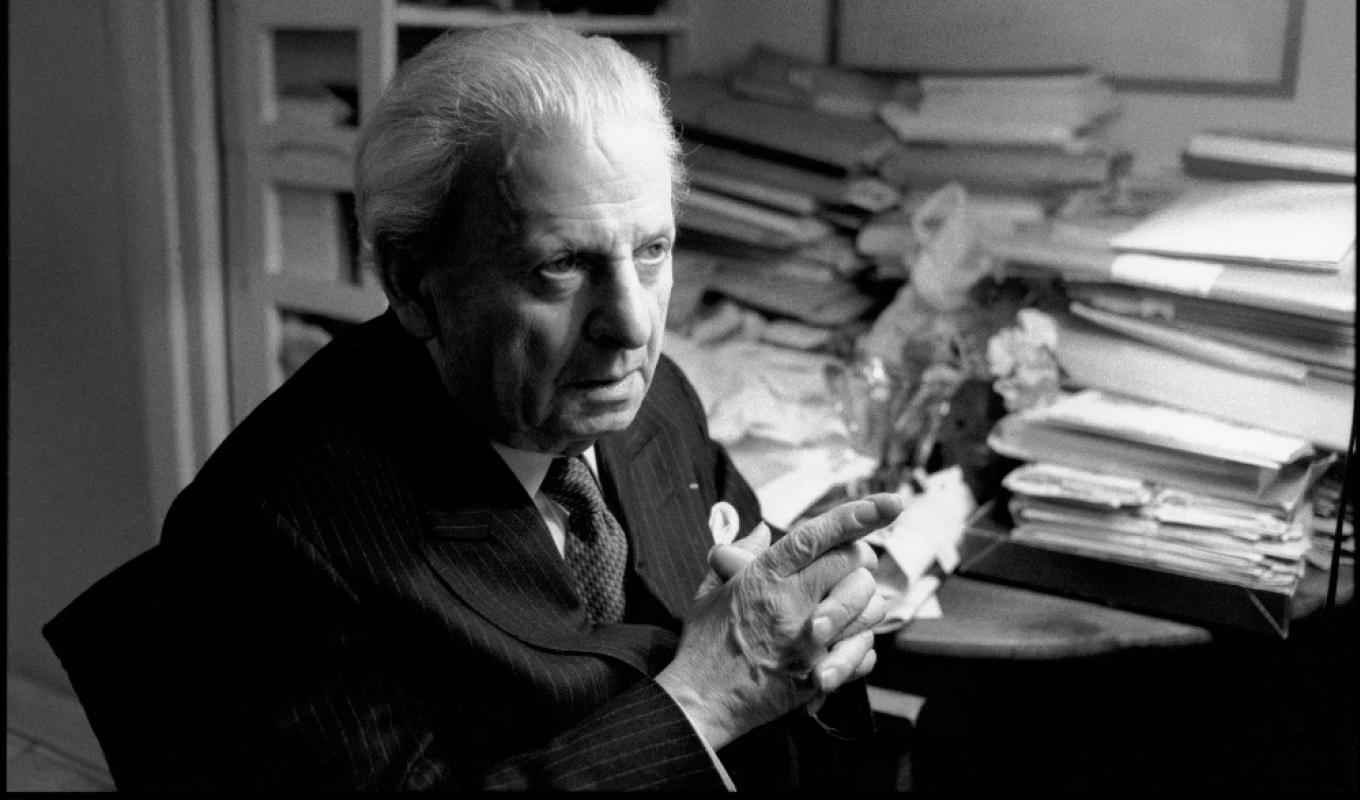
The Face That Cannot Be Subsumed: Levinas
Emmanuel Levinas • 1906–1995
Every thinker assembled so far — however much they differ on the nature of the remainder, the structure of the limit, the character of what knowing leaves behind — is concerned primarily with the knowing subject’s relationship to a world of objects, phenomena, particles, or Being. The other person — the being who is not an object of knowledge but a subject with an irreducible interiority — has not been the central case. Emmanuel Levinas makes it the central case, and in doing so he transforms the entire inquiry.
His work, developed through Totality and Infinity (1961) and Otherwise Than Being (1974), begins from the encounter with the face. The face of another person makes an ethical demand that precedes and exceeds all theoretical understanding. It is not an object to be known. It is an infinite excess — a presence that overflows every category, every framework, every attempt at cognitive assimilation. It says, before any words are spoken: you cannot reduce me.
This irreducibility is not primarily epistemological. It is ethical. The face of the other does not merely resist knowing in the way that the thing-in-itself resists Kant’s categories or the unseen aspect resists the perceiver locked into one gestalt. It resists knowing in a way that obligates. The remainder the face presents is not a philosophical puzzle about the limits of cognition. It is a demand — for recognition, for response, for a responsibility that cannot be evaded by noting how cognitively difficult the other person is to fully comprehend.
This dimension was absent from philosophical accounts of these themes before Levinas brought it into focus, and its absence is not innocent. An investigation into the limits of knowing that treats the world as a collection of phenomena, particles, and ontological horizons — and that reaches the knower only in the abstract formulation of consciousness as the unexplained explainer — has quietly excluded the most immediate and most ethically urgent form of the unknowable remainder: the other person standing before you, whose inner life no neurological data, philosophical argument, or empathetic imagination can fully reach, and whose irreducibility is not a problem to be solved but a responsibility to be borne.
Levinas forces a reorientation of the entire inquiry. The question is not only: what does knowing leave behind? It is also: what does what knowing leaves behind demand of us? The remainder is not merely an epistemological limit. In its most important form, it is an ethical summons.
Emptiness and Attunement: Nagarjuna and Zhuangzi
Nagarjuna • c. 150–250 CE
Zhuangzi • c. 369–286 BCE

The problem of perception, thought, and the limits of knowing is not a problem the Western philosophical tradition stumbled upon and uniquely possesses. It is a structural feature of any sufficiently developed philosophical tradition, and the Western framing of it — in terms of subject and object, appearance and reality, the knowable and the unknowable thing-in-itself — is one framing among several, with specific strengths and specific blindnesses. Two non-Western thinkers, separated by five centuries and a vast cultural distance, each arrived at accounts of the relation between appearance and reality that are philosophically sophisticated, internally rigorous, and systematically different from the Western tradition in ways that illuminate its concealed assumptions.
Nagarjuna, the second-century Indian philosopher who founded the Madhyamaka school of Buddhist philosophy, developed the doctrine of sunyata — emptiness — with a logical rigour that has no direct equivalent in the Western tradition. His central claim, established through a series of reductio ad absurdum arguments in the Mulamadhyamakakarika, is that all phenomena are empty of svabhava — own-nature, inherent, self-subsistent existence. Things do not exist in the way they appear to exist, as solid, independent, self-identical objects with determinate intrinsic properties. They exist dependently — as nodes in a web of conditions, relations, and conceptual designations. Remove the conditions and the object is not an object. Remove the conceptual designation and nothing is singled out for reference.
Nagarjuna’s two truths doctrine holds that at the level of conventional truth — the level at which tables, persons, causal relations, and scientific laws exist — things are real and can be coherently described. At the level of ultimate truth, all these conventionally real things are empty of the intrinsic existence that would make them what they are independently of conditions and designations. They are dependently originated: their existence is relational all the way through. The remainder that every act of knowing leaves behind is not, on this account, a residue of hidden intrinsic properties awaiting better instruments. It is the emptiness of the known thing itself: its dependence on conditions and designations that extend beyond any single act of knowing, indefinitely.
The parallel with the Western tradition is striking. Nagarjuna’s method — the prasanga, the reductio deployed against any attempt to assert a final, intrinsically existing description of reality — is structurally analogous to Hegel’s dialectic, without Hegel’s teleological confidence that the contradictions are moving somewhere. Nagarjuna’s emptiness is not a stage on the way to Absolute Knowing. It is the permanent character of the way things are. Where Hegel sees the limit as generative and moving, Nagarjuna sees it as constitutive and still.
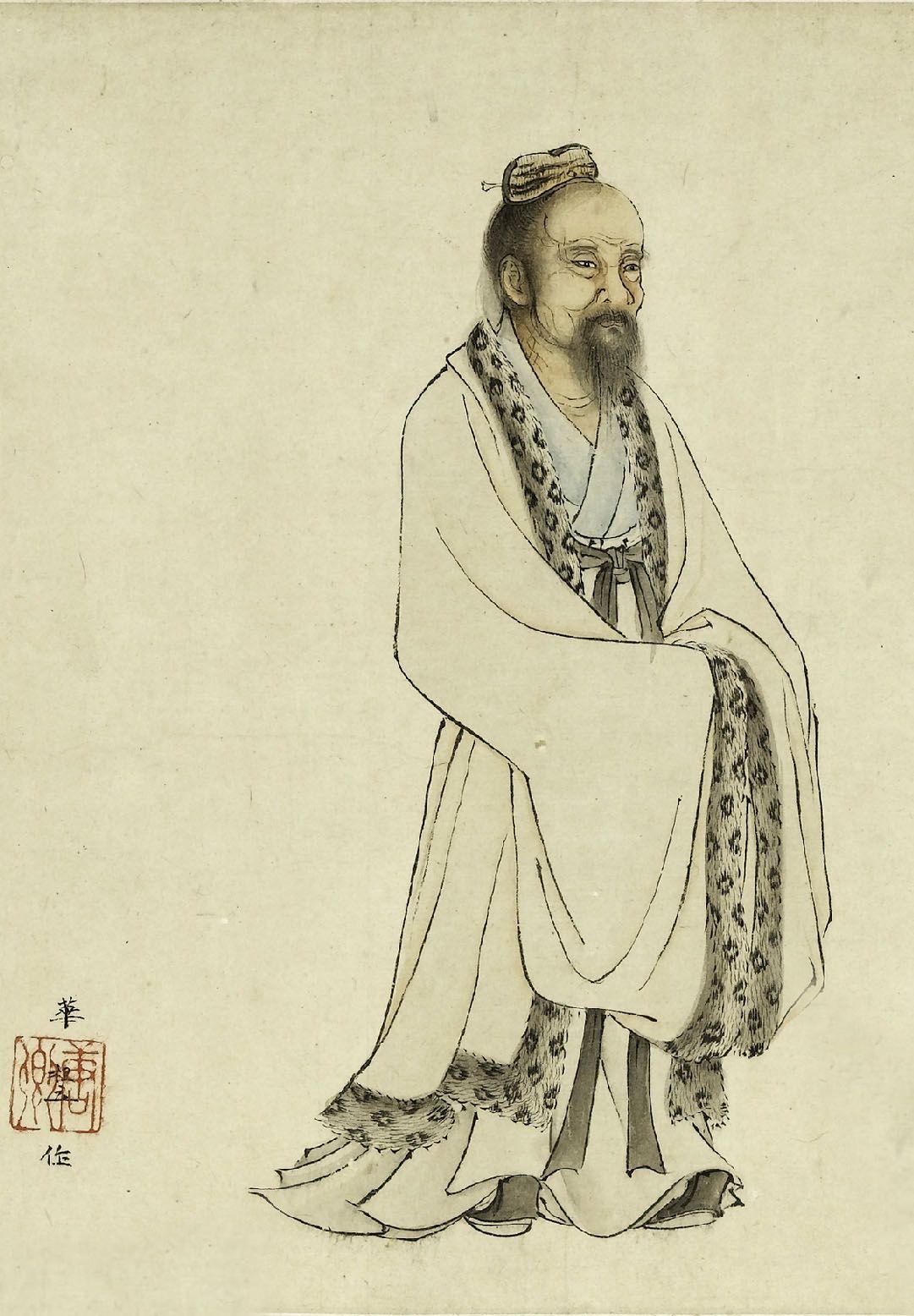
Zhuangzi, writing in fourth-century BCE China, approaches similar territory through narrative, parable, paradox, and irony — a philosophical method whose form is inseparable from its content. The butterfly dream — in which Zhuangzi wakes from dreaming he was a butterfly, uncertain whether he is a man who dreamed of being a butterfly or a butterfly now dreaming of being a man — is not merely an illustration of perceptual unreliability. It is an argument about the relationship between perspective and reality: that no single perspective is total, that the butterfly and the man are equally real, and that the question of which is the true one presupposes a standpoint outside both perspectives that does not exist.
The cook who cuts the ox according to its natural joints, following the way things are rather than imposing a predetermined pattern upon them, embodies a form of knowing that is neither subjective construction nor objective representation. It is a responsive attunement — a wu wei, a not-forcing — that discloses the structure of the ox without claiming to possess or exhaust it. Where the Western tradition tends to frame the remainder as a deficit — as what knowing fails to reach — Zhuangzi reframes it as an invitation. The fact that no perspective is total is not a limitation to be lamented. It is the sign of an inexhaustibility that cannot be exhausted by any one perspective, and that is available, in its abundance, to a knowing that is responsive rather than extractive.
The Framework Is Not Innocent: Kuhn, Foucault, Derrida
Thomas Kuhn • 1922–1996
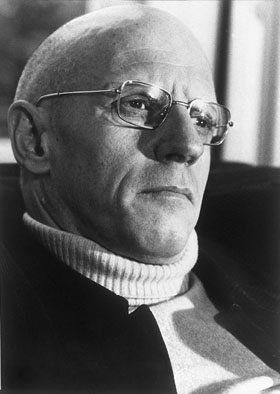
Michel Foucault • 1926–1984
Jacques Derrida • 1930–2004
The frameworks through which we perceive and know the world are not neutral instruments. Every thinker in this inquiry has established, in their different ways, that the organisation is not supplied by the world alone. What three thinkers assembled here add is a more disturbing account of where those frameworks come from — one more disturbing than Kant’s transcendental deduction, Wittgenstein’s appeal to forms of life, or Heidegger’s analysis of thrownness suggests.
Thomas Kuhn’s Structure of Scientific Revolutions (1962) demonstrates through meticulous historical analysis that science does not progress by accumulating truths within a stable framework. It progresses through paradigm shifts — revolutionary moments when the framework itself changes. Scientists operating within different paradigms do not merely disagree about answers to the same questions. They disagree about what the questions are, what counts as evidence, and what a solution would look like. They live, in a sense, in different perceptual worlds. Kuhn drew the parallel with Wittgenstein’s Duck-Rabbit explicitly: the paradigm shift is a gestalt switch at the level of an entire scientific community, extended over decades. This is Heidegger’s historical horizon of disclosure operating at the specific level of scientific practice — and it means that the frameworks through which the most disciplined of our knowing activities proceed are themselves historically contingent, subject to revision in ways that cannot be predicted from inside the current framework.
Michel Foucault extends this analysis into the domain of power. His concept of the episteme — the historical a priori that determines what can be thought, said, and known within a given epoch — is structurally analogous to Kuhn’s paradigm, but Foucault adds what Kuhn does not adequately theorise: the role of social power in constituting the frameworks through which reality is made intelligible. The reason certain things cannot be thought in a given epoch is not only that the conceptual tools are unavailable. It is that the social institutions, disciplinary practices, and knowledge-producing systems of that epoch actively enforce some possibilities and suppress others. What counts as knowledge, who is authorised to produce it, and whose experience qualifies as evidence are political questions as much as epistemological ones.
The frameworks assembled in this inquiry — transcendental idealism, phenomenology, analytic philosophy of language, quantum mechanics — are not the natural categories of human reason encountering its limits. They are the products of specific institutions, specific social formations, specific historical moments, conducted almost exclusively by European men in conditions of relative social privilege. The things those frameworks conceal are not only metaphysical remainders. They include ranges of human experience systematically excluded from the domain of legitimate philosophical testimony: the experience of those whose epistemic authority has been denied, whose ways of knowing have been dismissed, whose relationships to embodiment, community, land, language, and loss have not been granted philosophical standing. This inquiry is itself produced within and by a specific tradition, and its blind spots are not merely intellectual. They are the blind spots of a particular social location.
Jacques Derrida operates at the level of language and text. His concept of differance — the neologism condensing difference and deferral — points to the fact that meaning in language is never fully present, never fully graspable, always deferred through a chain of signification that has no final anchor. Words mean by differing from other words. No word steps outside language to ground the whole structure in something non-linguistic. Meaning is always partially withheld in the very moment of appearing — which is to say, language itself has the structure of the Duck-Rabbit: it delivers something while withholding something else, and what is withheld is not an accidental remainder but the condition of the delivery.
Derrida’s deconstructive practice turns this insight on the philosophical tradition itself. Every text in the Western canon, read carefully enough, is found to contain the traces of what it tries to exclude. The thing-in-itself that Kant places outside the domain of knowledge keeps returning inside his system. The Being that Heidegger distinguishes from beings keeps threatening to collapse back into a special kind of being. The consciousness that Nagel identifies as irreducibly subjective keeps being described in the very objective vocabulary it is supposed to exceed. The remainder is not only beyond the text. It is within it — as the mark of what the text cannot say while saying what it says.
The Knower Is the Mystery: Nagel
Thomas Nagel • 1937–

Thomas Nagel’s contribution to this inquiry is not an addition to the list of things that knowing leaves behind. It is a challenge to the entire procedure by which such lists are compiled. His central observation — that consciousness, the subjective character of experience, the what-it-is-like, is precisely what the objective third-person description of the world cannot capture — does not merely add another philosophical puzzle. It points to the fact that the knower itself is the most unexplained thing in the universe the knower is trying to explain.
The bat essay of 1974 makes this with characteristic economy. Bats navigate by echolocation. We can describe the neurophysiology of this process in complete objective detail. What no amount of such description yields is access to what it is like to experience the world through echolocation — the phenomenal quality of bat experience from the inside. This is not a practical limitation. It is a philosophical one. The subjective character of experience — what philosophers call qualia — is precisely what the objective, third-person description systematically omits. And this applies not only to bat experience. It applies to all experience, including human experience. The felt quality of the gestalt switch as the Duck-Rabbit flips from duck to rabbit, the specific phenomenal character of that sudden perceptual transformation, is not captured by any description of the neural processes underlying it.
The self-referential implication must be stated plainly. This essay is an exercise in objective, third-person philosophical description. It describes the limits of knowing from a philosophical altitude, making arguments designed to be valid regardless of who reads them. But if Nagel is right, this procedure leaves out the most important fact about the knowing it describes: that it is someone’s knowing, conducted from inside a specific phenomenal life, with a specific felt character that no philosophical description can fully capture. The inquiry into the limits of knowledge is itself subject to the limit it identifies. The eye cannot see itself.
Nagel refuses both consolations available at this impasse. Against reductionism — the thesis that consciousness will eventually be explained in purely physical terms — he argues that the hard problem (why any physical process should be accompanied by subjective experience at all) is not an empirical problem that more neuroscience will solve. It is a conceptual problem about the relationship between two fundamentally different kinds of description. Against mysticism — declaring the problem insoluble and the inquiry closed — he argues that intellectual surrender is not an honest response. What is needed are better concepts, ones not yet available, that may require a reconceptualisation of both mind and matter as radical as anything in the history of science.
In Mind and Cosmos (2012), Nagel pushed his position to its most provocative formulation: the standard neo-Darwinian account of nature is almost certainly false as a complete explanation of a world that contains minds. If consciousness is a genuine feature of reality, and if the physical description of the world cannot account for it, then perhaps the physical description is incomplete in a more fundamental sense — perhaps mind, or something proto-mental, is woven into the fabric of nature at a level far deeper than current theory acknowledges. Whether this is correct is uncertain. That it is honest is not.
Attention and Practice: Murdoch and Weil
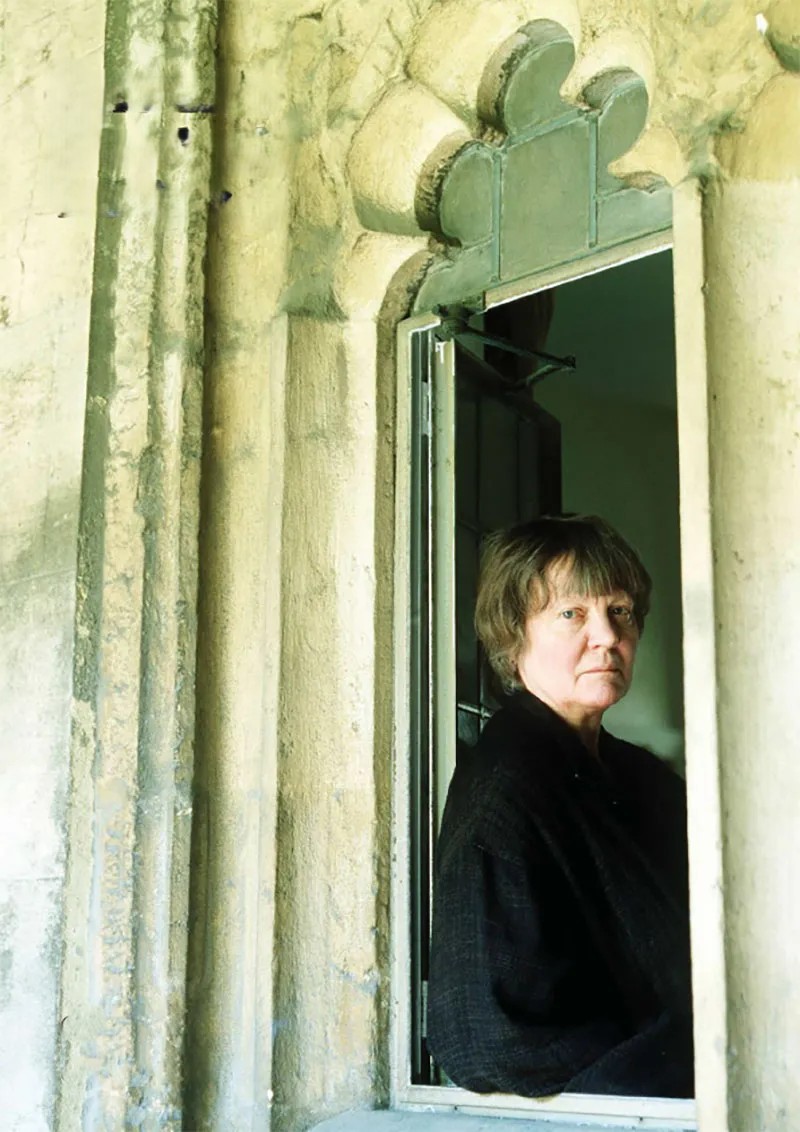
Iris Murdoch • 1919–1999
Simone Weil • 1909–1943
The inquiry has now established, through convergent testimony from multiple traditions, that every act of knowing leaves something behind: that the frameworks through which we perceive are not neutral, that the subject is not outside the world, that the other person makes a demand that cognition cannot meet, and that consciousness itself remains the most unexplained feature of the universe it is trying to understand. None of this tells us what to do. Two thinkers, both insufficiently recognised within the canonical philosophical tradition, provide the most rigorous answers to that question available.
Iris Murdoch’s central observation, developed through The Sovereignty of Good (1970) and her philosophical notebooks, is this: moral failure is primarily a failure of perception, not of will. We do wrong not because we see clearly and choose badly, but because we see badly — because the self’s desires, anxieties, consoling fantasies, and self-serving narratives distort what we perceive before the moment of choice arrives. The neurotic who cannot see his colleagues as they are, only as occasions for his own projections; the person whose comfort depends on not noticing the suffering of others — these are not cases of clear seeing followed by immoral choice. They are cases of vision already corrupted.
The remedy Murdoch proposes is what she calls unselfing: the cultivation of a disciplined attention that progressively removes the distorting pressure of the self’s needs from what it perceives, allowing what is actually there to show itself more clearly. This is not a cognitive technique. It is a moral and spiritual practice — the practice of attending to what is real rather than to what is convenient, to what is there rather than to what one needs to be there. And it has immediate consequences for the philosophical inquiry this essay has been conducting. The Duck-Rabbit’s lesson — that perception is always organised by frameworks — is not, for Murdoch, a reason to accept the inevitability of distorted seeing. It is a reason to cultivate the kind of attention that can notice when the framework is distorting and begin, painstakingly, to correct for it.
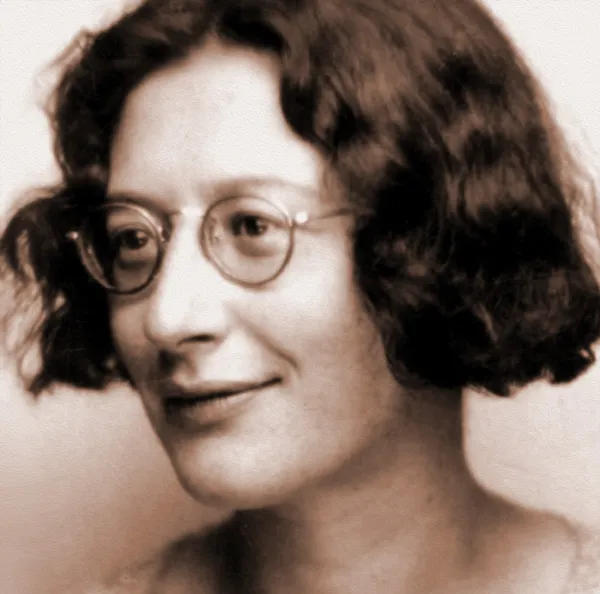
Simone Weil, writing in the years before her death in 1943, develops a concept of attention that is simultaneously philosophical, ethical, and spiritual. Attention, for Weil, is not concentration in the ordinary sense. It is the suspension of the self’s interpretive drive — the willingness to remain open to what is actually there rather than imposing a predetermined meaning upon it. In Waiting for God and her philosophical notebooks, she connects this receptive attentiveness directly to justice: to truly attend to another person’s suffering is not merely to register it cognitively. It is to allow it to enter the self in a way that demands response. The person who truly attends cannot remain uninvolved.
Weil’s concept of attention also speaks directly to the epistemological problem this inquiry has been tracing. The remainder that every act of knowing leaves behind is not, for Weil, something to be grasped more forcefully. It is something to be waited upon — attended to without forcing, received without possessing. The appropriate orientation toward what exceeds knowing is not extraction but receptivity; not the production of more information from a reluctant world but the cultivation of a stillness in which what the world offers freely can be received. This is close to what Heidegger means by meditative thinking, close to what Zhuangzi means by wu wei. But where Heidegger is primarily ontological and Zhuangzi primarily existential, Weil is primarily ethical: the point of receptive attentiveness is not the philosophical truth it yields but the love it constitutes and the justice it enables.
The Abyss and What It Costs: Nietzsche
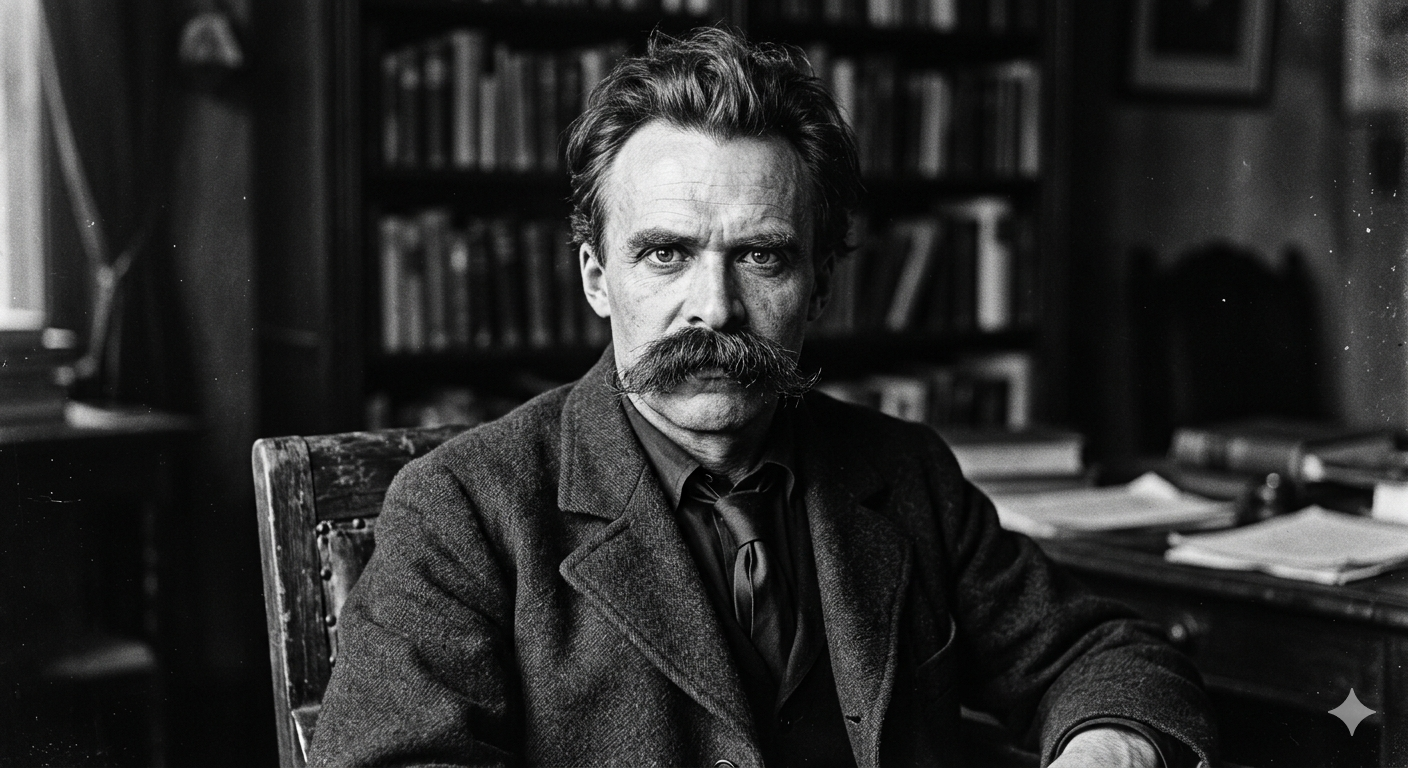
Friedrich Nietzsche • 1844–1900
Friedrich Nietzsche was born in Röcken, Prussia, in 1844, the son of a Lutheran pastor who died of a brain disease when Nietzsche was four. He was appointed professor of classical philology at Basel at twenty-four, before completing his doctorate. He spent the 1880s in productive isolation, wandering between boarding houses in Switzerland, Italy, and France, producing in rapid succession some of the most explosive philosophical writing of the modern period. In January 1889, in Turin, he collapsed — allegedly after witnessing a horse being flogged in the street and throwing his arms around its neck. He spent his last eleven years in mental incapacitation, his legacy subsequently distorted and appropriated by his sister Elisabeth in ways that would have horrified him.
From Beyond Good and Evil, aphorism 146: whoever fights monsters should see to it that in the process they do not become a monster. And if you gaze long enough into an abyss, the abyss will gaze back into you.
The abyss, properly understood, is not darkness or horror in a literary sense. It is groundlessness: the condition of a world from which the metaphysical and moral frameworks that previously provided orientation have been removed. Nietzsche’s declaration that God is dead — announced most fully in The Gay Science (1882) — is not atheist triumphalism. It is a diagnosis of catastrophe. Remove the theological underwriting of value and you remove not only religion but the entire architecture of meaning that depended on it: objective morality, cosmic purpose, the inherent dignity of persons, the intelligibility of suffering. What remains is not freedom. It is vertigo.
The abyss gazes back for three distinct reasons. Psychologically: prolonged encounter with groundlessness changes the person who sustains it. The void is not passive. It exerts a pull toward nihilism, toward the exhausted acceptance that nothing means anything and the will collapses into indifference. Epistemologically: the act of genuinely investigating the foundations of knowing — not academically but with full existential pressure — does not leave the investigator unchanged. It exposes the investigator’s own presuppositions and intellectual comforts to the same scrutiny being applied to everything else. Wittgenstein dismantled his own first philosophical system and spent the rest of his life circling problems he had once thought he had dissolved. Kant emerged from twelve years of thinking about the conditions of knowledge with a transformed understanding of what the mind is. Heidegger emerged from his destruction of Western metaphysics speaking a language many of his contemporaries barely recognised. The inquiry changes the inquirer. Ontologically: the abyss is not simply the absence of meaning but the presence of everything that remains when the human projections of meaning and purpose are stripped away — raw existence, groundless, purposeless, but intensely, overwhelmingly there.
Nietzsche believed that the will to truth — the drive that produces elaborate philosophical investigations into the conditions of knowledge — is itself a form of the ascetic ideal: a way of fleeing from life into the consolation of system. The philosopher who builds a careful account of the limits of knowing may be doing so not because intellectual honesty demands it but because the construction provides a substitute for the direct, embodied, risk-laden encounter with existence that Nietzsche thought was the only authentic response to the death of God. This challenge cannot be met from inside the philosophical essay. The essay form is itself a systemic response to groundlessness — a way of converting existential pressure into intellectual structure. What Nietzsche demands is not a better essay but a different relationship to the inquiry: one in which the philosophical analysis does not insulate the philosopher from the existential stakes of what is being analysed.
What Nietzsche contributes that no other thinker in this inquiry supplies is the dimension of cost. Every thinker assembled here went far enough to encounter resistance — from the material, from colleagues, from the culture, from themselves. The philosophical encounter with the limits of knowing is not a spectator sport. It is something that happens to the one who genuinely conducts it. The abyss gazes back. The only honest response — the only response that does not betray the inquiry — is not to look away.
The Objection That Cannot Be Dismissed
The inquiry has so far been conducted almost entirely within a tradition — broadly, the philosophy of finitude — that takes as its central datum the perspectival, situated, and constitutively limited character of human knowing. This tradition is internally rich and generates impressive convergences. It is also a tradition, with its own assumptions, and like all traditions it has serious opponents.
The scientific realist tradition argues that the inference from perspectival knowing to the permanent inaccessibility of mind-independent reality is invalid. The history of science, on this view, is precisely the history of thought progressively freeing itself from observer-relative constraints — moving from the observer-dependent properties of colour, heat, and texture to the observer-independent properties of electromagnetic frequencies, molecular kinetic energies, and quantum field strengths. This progressive detachment is real and valuable. The laws of physics do not depend on whether the observer is human or otherwise, sighted or blind, culturally embedded in one tradition or another. They describe something genuinely perspective-independent.
Against the Duck-Rabbit, the realist argues that Wittgenstein has established something about the psychology of perception, not about the metaphysics of reality. The fact that human perceptual experience is organised by conceptual frameworks does not entail that reality itself lacks determinate, observer-independent properties. The duck and the rabbit are both projections onto a set of lines that has its own perfectly determinate physical structure, independent of how any perceiver organises it. Wittgenstein’s lesson is about the perceiver. It is not about the lines.
Against Kant, the realist deploys inference to the best explanation. The reason our cognitive frameworks track the world as successfully as they do — the reason science works, the reason bridges stand, the reason predictions come true — is most plausibly explained by supposing that those frameworks are genuinely tracking mind-independent features of reality, however imperfectly. Kant’s transcendental idealism makes the success of science mysterious. If the categories of the understanding are contributions of the subject rather than features of the object, why should they so reliably generate predictions that allow effective intervention in the world?
These are not knockdown objections. The philosophy of finitude has responses to all of them. Quantum mechanics suggests that the assumption of fully determinate, observer-independent properties breaks down at a certain scale. Nagarjuna’s emptiness suggests it mischaracterises the relational structure of all phenomena at every scale. Heidegger suggests it is the product of a specific historical concealment. But the realist can hold the assumption against all of these — and is entitled to — by acknowledging that it is an assumption, not a discovery.
The honest position is this: the case for the perspectival limitation of human knowing is strong, philosophically sophisticated, and supported by convergent testimony from multiple independent disciplines and traditions. It is not conclusive. The debate between the philosophy of finitude and scientific realism is live, and any treatment of these themes that presents its conclusions as though the debate has been settled is doing its readers a disservice. The conclusions of this inquiry are reached from within a tradition, and a tradition is not a proof.
What the Looking Leaves Behind: A Final Reckoning
Nineteen thinkers, across three millennia, two hemispheres, and disciplines from quantum physics to Buddhist metaphysics to ethics, have each arrived at versions of the same threshold. A Prussian philosopher who never left his hometown. A Viennese polymath who dismantled his own first philosophy. A German physicist who found his most important idea on a windswept island while recovering from hay fever. An Austrian physicist trying to ridicule a theory he had helped create. A Swabian idealist who believed history was the autobiography of God. A Black Forest thinker who asked what it means that anything exists at all. An American philosopher asking what it is like to be a bat. A French phenomenologist attending to the face of the other. A second-century Indian logician demonstrating that everything is empty. A fourth-century Chinese thinker whose cook knew the ox from the inside. A French archaeologist of knowledge exposing the power beneath every framework. An Algerian-French philosopher reading texts against themselves. A Franco-Lithuanian phenomenologist who found in the other’s face an infinite demand. A British novelist-philosopher insisting that moral failure is a failure of vision. A French mystic waiting for what cannot be possessed.
None of them were trying to arrive at the same place. All of them did. That the question of what knowing leaves behind keeps returning the same structural answer, regardless of the direction from which it is approached, is the most compelling evidence this inquiry has that the answer is true.
What can be said with confidence
Every act of knowing is constitutively perspectival. This is not a limitation to be overcome with better methods. It is the condition of knowing anything at all. The subject-object structure within which most of this inquiry has operated is a historically specific framework with its own concealments — not the neutral ground of all possible thought, but one way of organising the encounter between mind and world, with strengths and blindnesses proper to it.
Something is always left behind in every act of knowing. Kant calls it the thing-in-itself. Heidegger calls it what Being withholds in the act of disclosing. Nagarjuna calls it the emptiness beneath the conventional designation. The Duck-Rabbit’s unseen aspect, Heisenberg’s dissolved conjugate variable, Schrödinger’s foreclosed superposition, Derrida’s deferred meaning, Nagel’s phenomenal consciousness — these are structurally analogous descriptions of the same fundamental feature of the knowing situation. The remainder is not a residue of hidden properties awaiting better instruments. It is structural: the necessary shadow cast by every light.
The inquiry’s founding model of the knowing subject — a mind receiving and organising perceptual data — is inadequate as a general account of how human beings know the world. Most knowing is bodily, practical, and pre-reflective, conducted below the level at which seeing-as operates. A philosophy of knowing that does not account for this layer has not yet fully addressed its subject.
The frameworks through which knowing proceeds are historically produced, socially enforced, and power-laden. What the framework excludes from the domain of legitimate testimony is not philosophically uninteresting. It is excluded because of who has historically had the authority to determine what counts as philosophy. The concealments are not only metaphysical. They are political.
The most urgent form of the unknowable remainder is not the thing-in-itself or the withdrawn Being or the unseen aspect. It is the face of another person — whose inner life no cognitive framework, however refined, can fully reach, and whose irreducibility is not a problem to be solved but a responsibility to be borne.
What follows from it
The most important question the inquiry raises is not what we cannot know. It is what we should do in the light of what we cannot know. Murdoch and Weil provide the most rigorous answer available: the cultivation of a disciplined attention that progressively reduces the distorting pressure of the self on what it perceives, allowing what is actually there to show itself more clearly. This is simultaneously an epistemological and an ethical practice. To see more clearly is to act more justly, because moral failure is primarily a failure of vision.
Zhuangzi’s cook and Weil’s waiting and Murdoch’s unselfing and Nagarjuna’s liberation through the recognition of emptiness are not different names for the same thing. They are related proposals, from different traditions, about what it looks like to live well inside the structural limitation that this inquiry has described. They share a common orientation: responsiveness rather than extraction, receptivity rather than possession, attentiveness rather than mastery. Not the accumulation of a complete description of what is there, but the cultivation of a relationship with what exceeds description.
The self-referential acknowledgement
This inquiry is itself subject to the limits it describes. It is conducted from within a specific tradition, a specific social location, a specific historical moment, by a specific consciousness whose phenomenal character no philosophical description can fully capture. Its conclusions are perspectival. Its frameworks conceal as well as reveal. Its realist critics have arguments it cannot fully answer. The self-referential implication — that an account of the limits of knowing is itself an instance of the limited knowing it describes — is not a paradox that disqualifies the project. It is the condition under which any honest inquiry of this kind must proceed. Acknowledging it does not dissolve it.
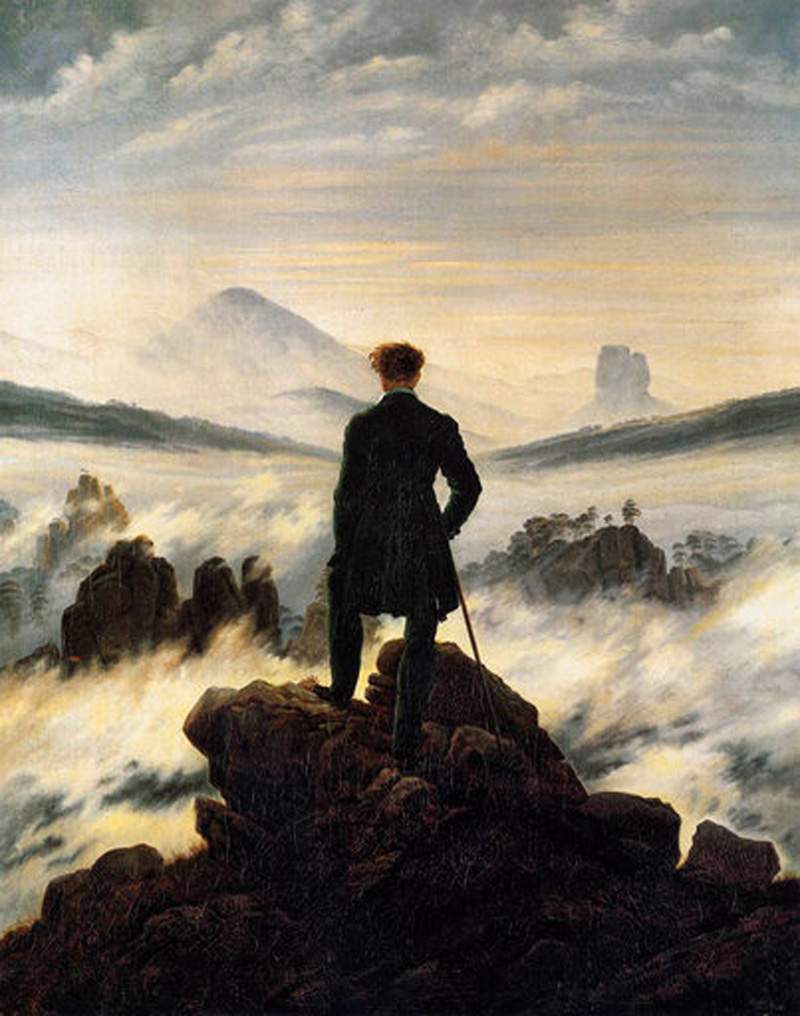
Wanderer Above the Sea of Fog 1818
Oil on canvas
The final recognition
What the looking leaves behind is not nothing. It is as real as what is grasped — and in its most important form, it is not a philosophical puzzle but an ethical demand, not a cognitive deficit but an abundance that exceeds all cognitive grasp, not a failure of the inquiry but the sign that the inquiry is genuine.
We are finite beings inside an inexhaustible world. The duck will become the rabbit. The rabbit will become the duck. The box will never fully open. The face will never be fully known. The meaning will always be deferred. Being will always withdraw in the act of disclosing. The body will always know things the mind cannot articulate. The frameworks will always conceal as well as reveal. The consciousness conducting this inquiry will always remain, at its own centre, unexplained.
And the task — for which there is no method, no terminus, and no exemption — is to keep looking, keep attending, keep responding, and keep honest about how much the looking, the attending, and the responding leave behind.
That is not a counsel of despair. It is a description of what it means to be alive to the world.
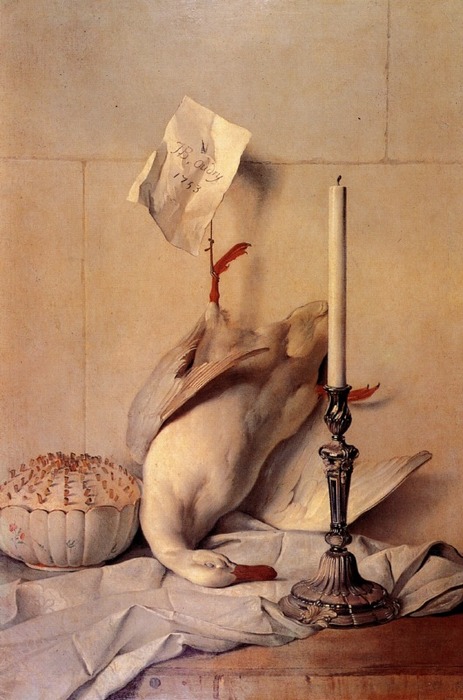
“I live in eternal hope that when I finally ascend to that great restaurant at the top of the universe, the waiter will smile, wink -and without even bothering to take my order- pop out to the kitchen and call for a dish of red curried duck; whilst over my shoulder, the sommelier is already decanting a brilliant Pinot Noir from an excellent vintage.”
Darren Gall
