A Miracle in Kagoshima
Satsuma Gyu: The Quiet Empire at the Edge of Japan
At the southern end of Kyushu, where the old provinces of Satsuma once looked out across the East China Sea, the land is warm, green, and heavy with volcanic history. Kagoshima Prefecture is Japan’s wagyu heartland; more Japanese Black cattle are raised here than anywhere else in the country, roughly 330,000 head spread across its valleys and hill farms. Out of that vast herd comes one of the most quietly exacting beef programs in the world: Satsuma Gyu, and within it, the rare tier its twelve producing farmers simply call ‘the Miracle.’
The Breed Behind the Brand
Only four cattle breeds in the world carry the official designation ‘Wagyu,’ literally Japanese cow. They are the Japanese Black (Kuroge Washu), the Japanese Brown (Akage Washu), the Japanese Shorthorn (Nihon Tankaku Washu), and the Japanese Polled (Mukaku Washu). The Japanese Black accounts for more than nine in every ten wagyu raised in Japan, and it is this breed, genetically predisposed toward dense intramuscular fat, which gives the wagyu world its famous marbling.
Satsuma Gyu is full-blood Japanese Black, born and raised within Kagoshima Prefecture, with no crossbreeding. This matters because the term ‘Wagyu’ travels loosely in the global market. What is raised abroad as “Australian Wagyu” or “American Wagyu” is typically Japanese genetics bred into Angus or other Western cattle lines, not a lesser animal, but a different one. The Japanese Wagyu bloodline, by law and by long-held discipline, remains closed.
Kamichiku and the Twelve Meijin
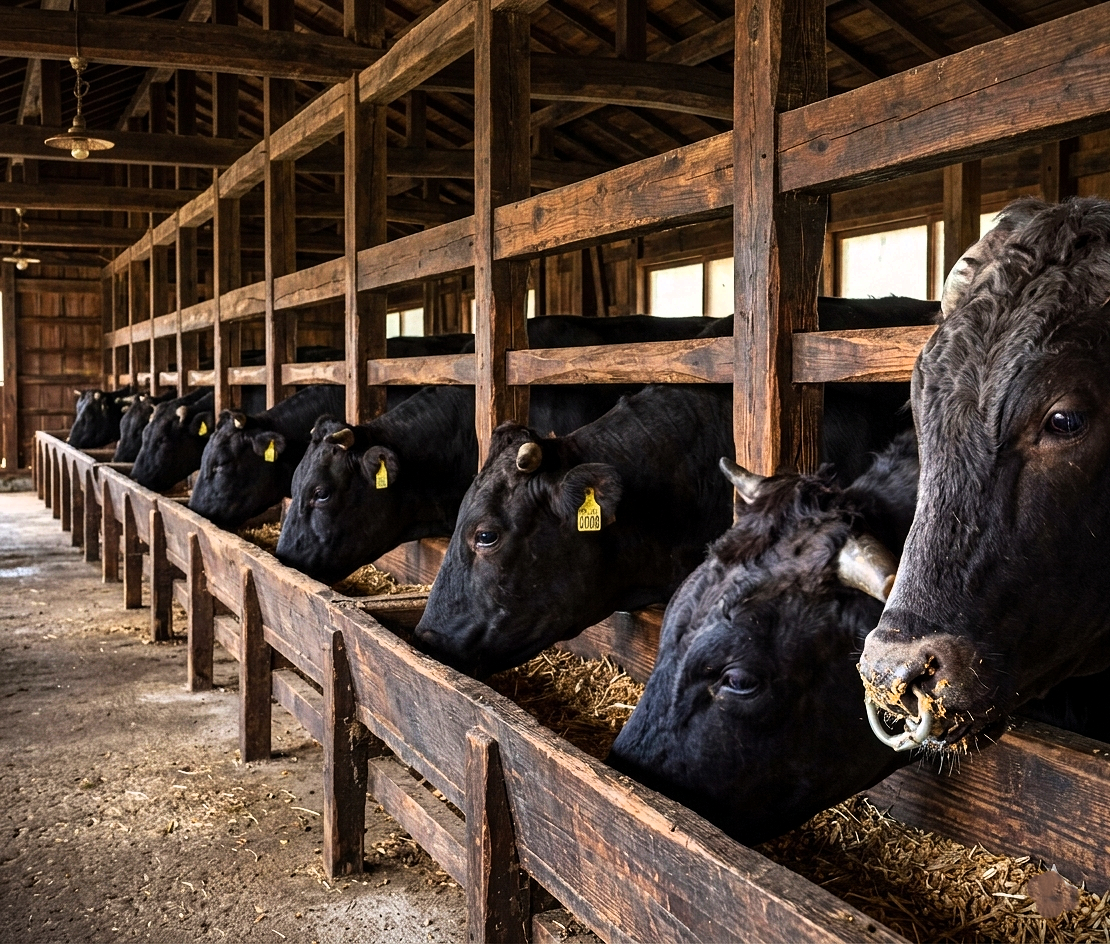
Satsuma Gyu is a brand, not a breed, and behind it stands the Kamichiku group, a vertically integrated Kagoshima producer that has been building its program since the 1980s. The brand’s physical home is the Minami-Satsuma Valley, a stretch of gentle mountain country around Mount Kinpō, where twelve master farmers raise the cattle under a shared protocol.
In Japanese agriculture, the word ‘meijin’ (名人)denotes a recognized master, not a self-awarded title, but one earned, quite literally, by winning at regional and national beef competitions. The twelve farmers who hold that status within the Kamichiku fold form the entire production base of Satsuma Gyu. There is no thirteenth farm waiting in the wings to scale supply.
This is where scarcity begins to take its shape. Approximately 3,000 head are finished each year under the Satsuma Gyu standard, Japanese Black, born and raised in Kagoshima, meeting the marbling and quality thresholds the program requires. Of those, only a small fraction climb to the very top of Japan’s grading scale. The carcasses that crest into the densest, most evenly distributed marbling the system recognizes are what the Kamichiku farmers call the ‘4% Miracle’. Four per cent. From three thousand head, somewhere between one hundred and one hundred and twenty animals in a given year.
What the “Miracle” Actually Measures
The name is poetic; the standard beneath it is coldly technical.
Japan’s grading system, administered by the Japan Meat Grading Association, assigns every carcass a letter (A–C, reflecting yield) and a number (1–5, reflecting quality). An A5 rating is the ceiling, but even within A5 there is enormous variation, because A5 simply requires a Beef Marbling Standard (BMS) score of 8 or higher on a 12-point scale. BMS 12 sits at the extreme edge. Cuts in that range carry an intramuscular fat content of roughly 50 to 60 per cent, figures that would be meaningless in Western beef, where USDA Prime typically marbles around BMS 4 or 5.
Across all Japanese wagyu, only around 10 to 15 per cent of carcasses reach A5 at all. To reach BMS 11 or 12 within that elite tier is rarer still, and the Kamichiku program is designed, from genetics to feed to finishing age, to push as many animals as possible into that narrow window. Even so, the ratio does not improve: the Miracle remains, stubbornly, four in every hundred.
These are animals whose muscle tissue has become a lattice of fat so fine the meat looks, in cross-section, more like marble than beef.
Terroir, in a Barn
The French like to argue that terroir is for wine. The Kamichiku program argues, in its own way, that it applies equally to cattle.
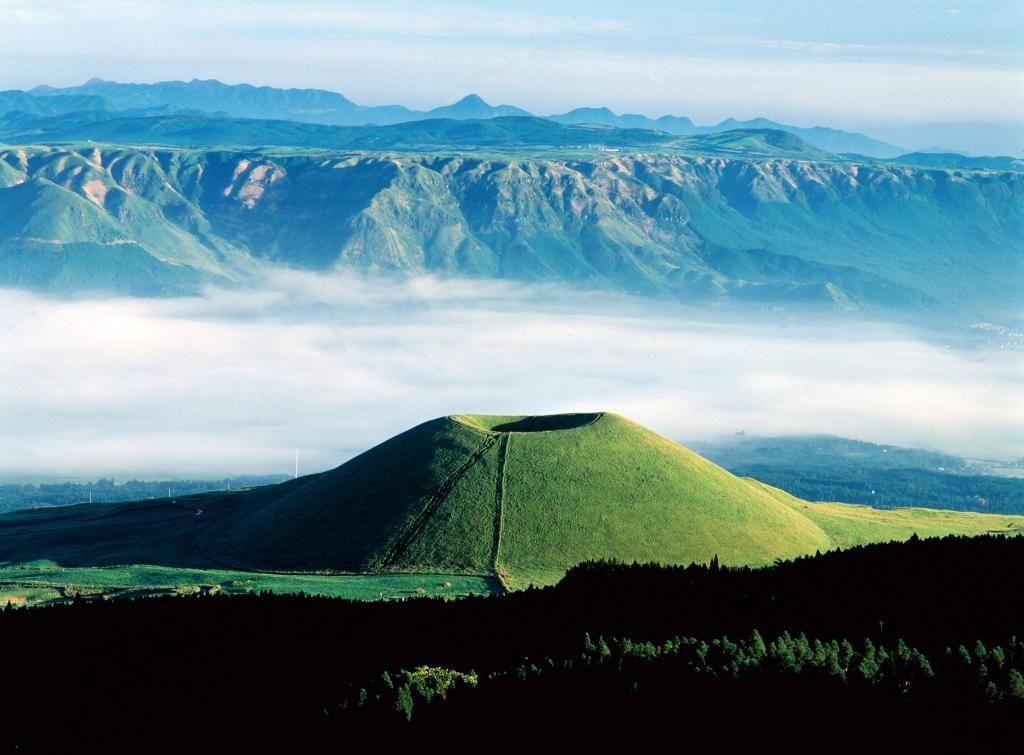
The Satsuma Gyu feed program is built on 100 percent domestically grown ingredients, with the animals’ primary energy source drawn from rice plants cultivated on the volcanic slopes of Mount Aso in neighbouring Kumamoto Prefecture. The farms also repurpose by-products from nearby industries. ‘sakekasu,’ the lees left behind by sake breweries, finds its way into the ration. The feed itself is the subject of continuing research between the farmers and local universities, who study which rice varieties and harvest windows produce the most favourable fatty-acid profile in the finished beef.
None of this is mystical. It is agricultural craft, measured and iterated, across the long arc of an animal’s life, typically thirty months from birth to harvest, more than double the age at which a commodity steer in the United States would be slaughtered. Those extra months are what it takes for marbling to develop the depth that BMS 12 demands. You cannot hurry it.
The Wagyu Olympics
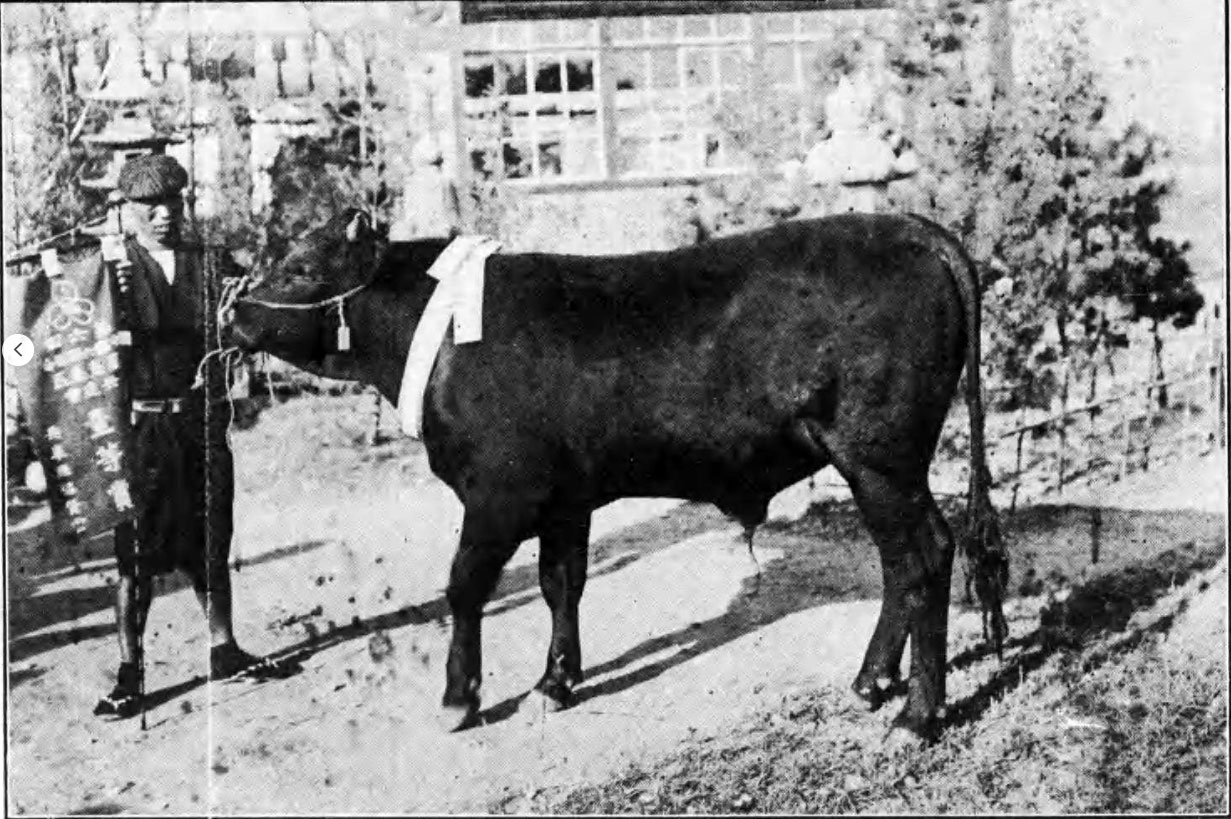
Every five years since 1966, Japan’s beef industry gathers for a national competition whose formal name the Zenkoku Washu Nōryoku Kyōshinkai, or National Japanese Beef Ability Exposition, almost no one outside the guild uses. Internationally, it is simply the Wagyu Olympics.
The 12th edition, held in October 2022, was hosted by Kagoshima itself. Four hundred and thirty-eight cattle from forty-one of Japan’s forty-seven prefectures competed. Kagoshima won: first place in six of nine divisions, including the all-important Breeders’ Division and its top honour, the Prime Minister’s Prize. The prefecture had also taken the overall crown at the previous Olympics in 2017, held in Miyagi. Two consecutive gold medals, at the most closely watched competition in the Japanese beef calendar, is not an accident. The 13th Olympics are scheduled for 2027.
Eating the Rarest Beef in Japan
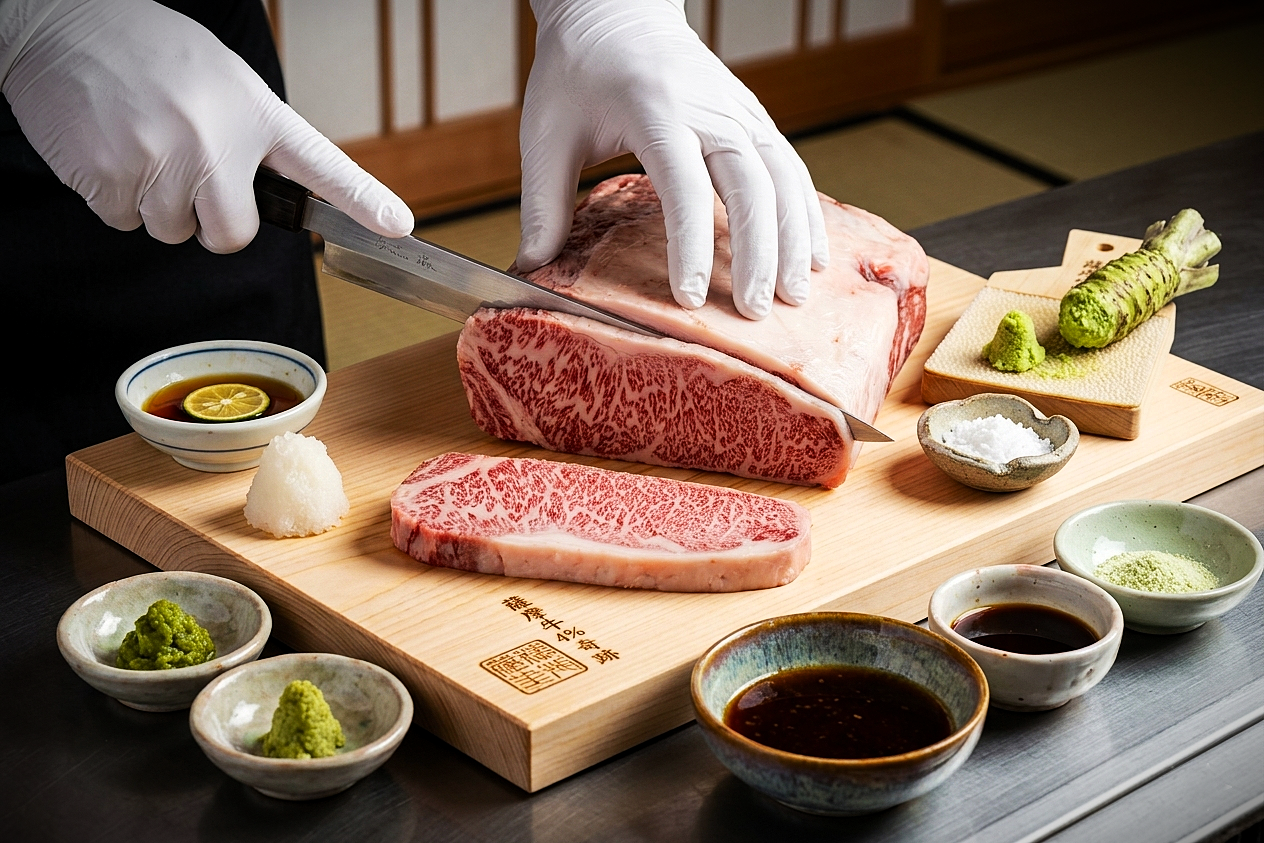
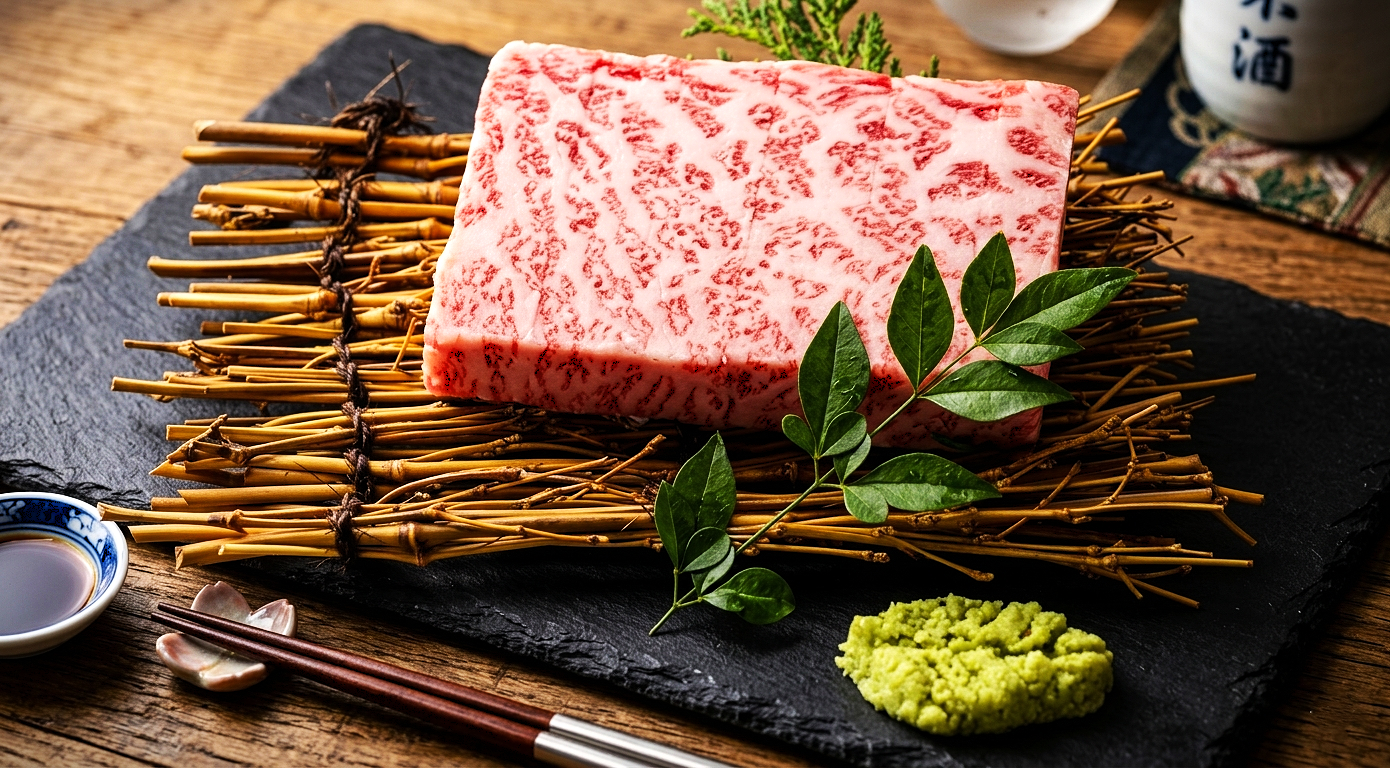
A ribeye cut from a 4% Miracle carcass arrives looking almost too rich to be real, a field of white marbling webbed through a pale rose canvas. Against a hot pan, the first thing you notice is how quickly it begins to render: the intramuscular fat in BMS 12 beef has a melting point near human body temperature, which is why a sliver rested on the tongue genuinely dissolves rather than chews.
The flavour is buttery, but not sweet in the flat sense of industrial beef. There is a savoury, nutty depth from the oleic-acid-rich fat, and a long umami finish that lingers well past the last swallow. Chefs who cook with this grade tend to serve it in smaller portions than diners expect. Forty or fifty grams is often enough. Beyond that, the richness becomes less a pleasure than a test.
This is not everyday beef. It is not meant to be. The Kamichiku farmers raise cattle that feed a small number of people slowly, with enormous attention, rather than many people quickly. The restraint is part of the product.
 The Quiet Case for Rareness
There is a temptation, in writing about beef like this, to reach for superlatives until the thing loses shape. Satsuma Gyu does not need them. Twelve farmers. Three thousand animals a year. Four per cent of those crossing into the Miracle tier. A thirty-month life on feed drawn from a volcano in the next prefecture. A gold medal at the industry’s most competitive showcase, twice running.
These are the facts. Around them, if you want romance, a whole story grows on its own: Of a small corner of southern Japan that chose depth over scale, to take things slowly, without ever raising its voice, to create some of the most extraordinary beef on earth.
Darren Gall