
CHAPTER FIVE
The Prophet
Kahlil Gibran
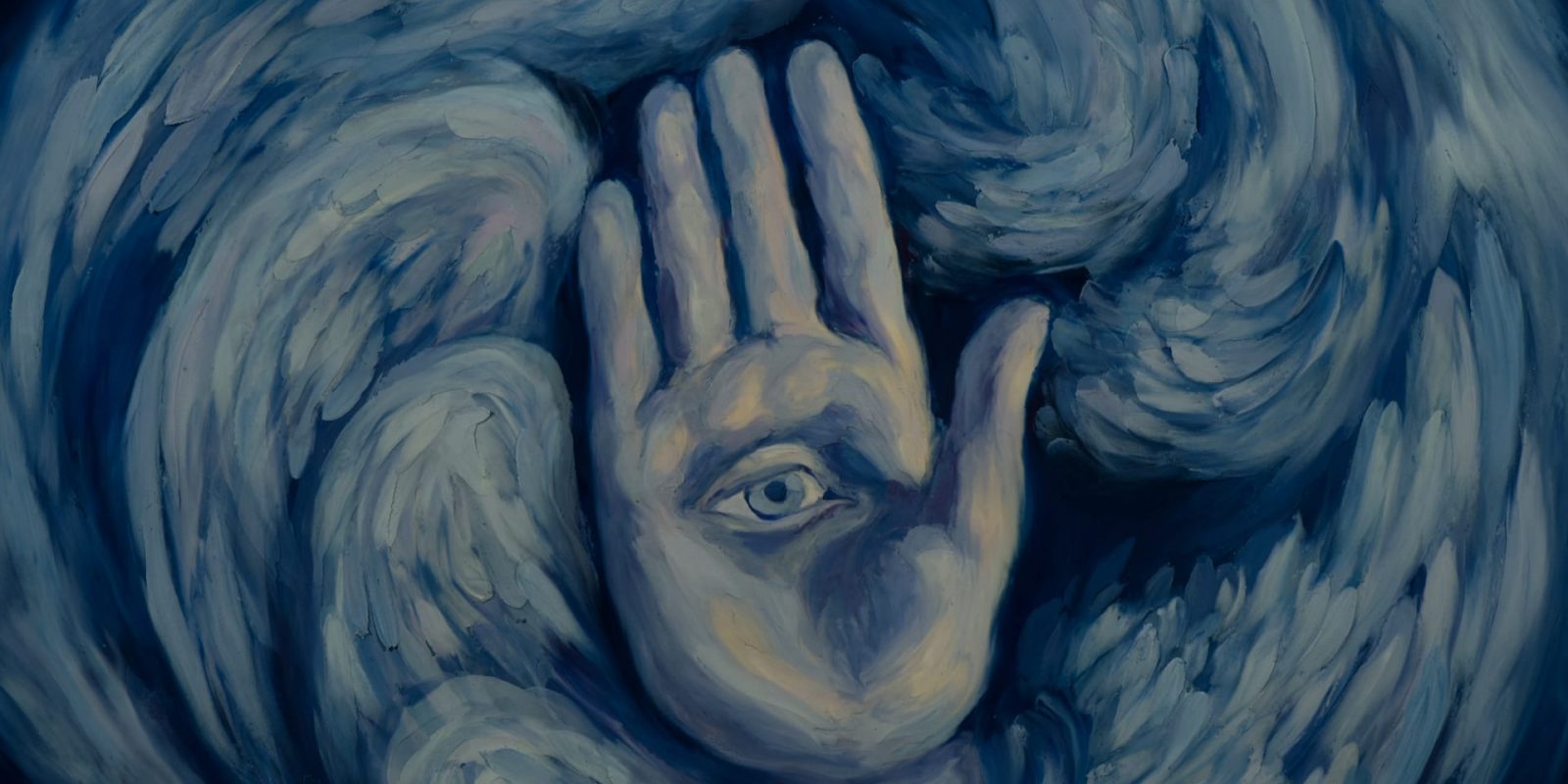
Bsharri
He was born on 6 January 1883, in the village of Bsharri, high in the mountains of what is now Lebanon — then part of the Ottoman Empire’s Mount Lebanon Mutasarrifate, a territory of cedar forests and limestone valleys whose communities had been navigating the pressures of empire, religious division, and poverty for centuries. The village sat at nearly fifteen hundred metres above sea level, overlooking the gorge through which the Kadisha River ran cold from the mountains. The cedars for which Lebanon has always been named grew nearby — enormous, ancient, their presence a reminder that this landscape carried its own deep memory, older by far than any of the empires that had passed through it.
The Gibran family was Maronite Christian — one of the Eastern Christian communities that had maintained their faith and their liturgical traditions in Arabic and Syriac through centuries of Ottoman rule, developing in the process a capacity for cultural synthesis that would prove essential to the work their most famous son would eventually make. His mother Kamila was the daughter of a priest. His father Khalil was a tax collector who accumulated gambling debts he could not pay, was imprisoned for embezzlement, and had his property confiscated by the authorities. The family lived in poverty. The boy had almost no formal schooling in those early years — a priest ran a one-room school in which he learned the rudiments of Arabic, Syriac, and arithmetic — but he had the mountains, and he had what the mountains gave him: a sense of the natural world as a living thing, ancient and indifferent and sublime, which would enter every page of his mature work.
When Gibran was twelve years old, his mother made the decision that shaped everything. In 1895, Kamila gathered her children — Gibran, his two younger sisters Marianna and Sultana, and his older half-brother Boutros — and emigrated to the United States. She had a brother already in Boston. The family settled in the South End of the city, one of the largest Syrian-Lebanese communities in America at that time, in the narrow streets and crowded tenements of an immigrant neighbourhood that would have felt, to a boy raised among mountain cedars, like a form of confinement. The city gave him language, contacts, possibility, and grief — all in roughly equal measure.
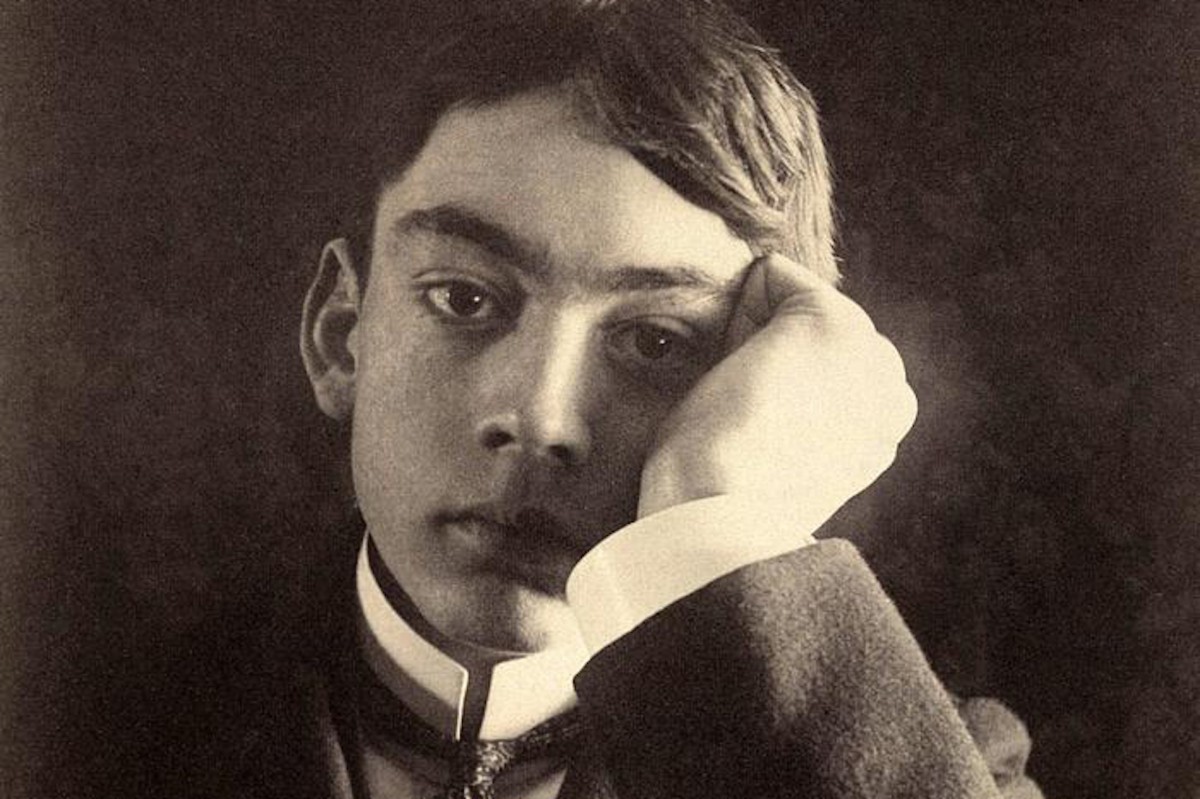
Boston — The Artist Found
At the Josiah Quincy School, enrolled in a special class for immigrant children to learn English, his name was registered in the anglicised form that would follow him: Kahlil Gibran, a simplification of Gibran Khalil Gibran that stuck. His creative abilities were noticed immediately by his teachers, and through them he was introduced to Fred Holland Day — an avant-garde Boston photographer and publisher who used some of his drawings for book covers and connected him to the city’s artistic community. Through Day, Gibran’s artwork eventually reached the attention of a woman who would change his life entirely.
Before that meeting, however, came the losses. Gibran’s mother had sent him back to Beirut at fifteen to absorb more of his cultural heritage, enrolling him at the Collège de la Sagesse, where he distinguished himself in Arabic and French, founded a student magazine, and was named the college poet. He returned to Boston in April 1902, two weeks after his youngest sister Sultana had died of tuberculosis. She was fourteen. In March 1903, his half-brother Boutros died of the same disease. Three months later, his mother died of cancer. Three deaths across barely thirteen months, after which only his sister Marianna remained — Marianna, who would work as a dressmaker for years to support them both while Gibran pursued his art.
He was twenty years old. He was an orphan. He had almost no money. And he kept working.
In 1904, his drawings were exhibited at Day’s studio in Boston. During this exhibition he met Mary Haskell — headmistress of a girls’ school in the city, nine years his senior, a woman of progressive views and considerable resources who looked at his work and understood, with the directness of someone who trusts their own perception, that she was in the presence of something rare. Their friendship lasted the rest of his life.
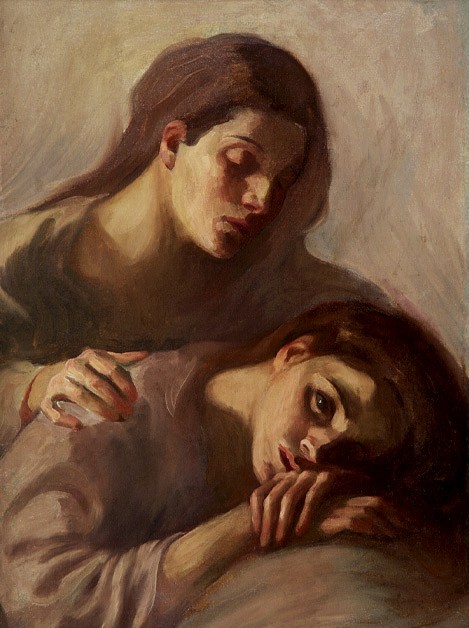
Mary Haskell — The Woman Who Made The Prophet Possible
It would be easy, and reductive, to describe Mary Haskell simply as Gibran’s patron. She was his patron — she funded his studies, subsidised his living costs, edited every English manuscript he produced, and provided the financial stability without which a man of his economic circumstances could not have spent his working life making art and writing prose poetry. But the diaries she kept, and the correspondence that survived them both, reveal something more than a patron-client relationship.
She believed in him with the clear-eyed conviction of someone who has assessed the evidence and arrived at a conclusion. She did not merely admire his work in the vague, encouraging way of a benefactress uncomfortable with honest criticism. She edited his English manuscripts with rigour — questioning word choices, challenging passages that seemed unclear or inflated, pushing back on the mystical oracularity that was one of his genuine weaknesses. The Prophet, as published in 1923, had passed through her hands many times. The spare, luminous quality of its prose is partly his and partly the product of a collaboration that never sought public credit.
Their romantic relationship remains ambiguous in the biographical record. They were briefly engaged around 1910 to 1911, before Haskell ended the arrangement, telling Gibran she preferred his friendship to the burdens of marriage. She later married another man in 1926, while remaining Gibran’s closest confidante and most dedicated supporter. In letters from his final years, he wrote of her with the particular tenderness of a man who knows he is dying and who cannot think of the person most essential to his life without feeling both the depth of the debt and the impossibility of fully expressing it. She preserved everything — his letters, her diaries, the manuscripts — and eventually left the world’s largest public collection of his visual art to the Telfair Museum in Savannah, Georgia. Without Mary Haskell, The Prophet would not have found its final form. It is possible that without her, it would not have been written at all.
Paris 1908 — Rodin’s Studio
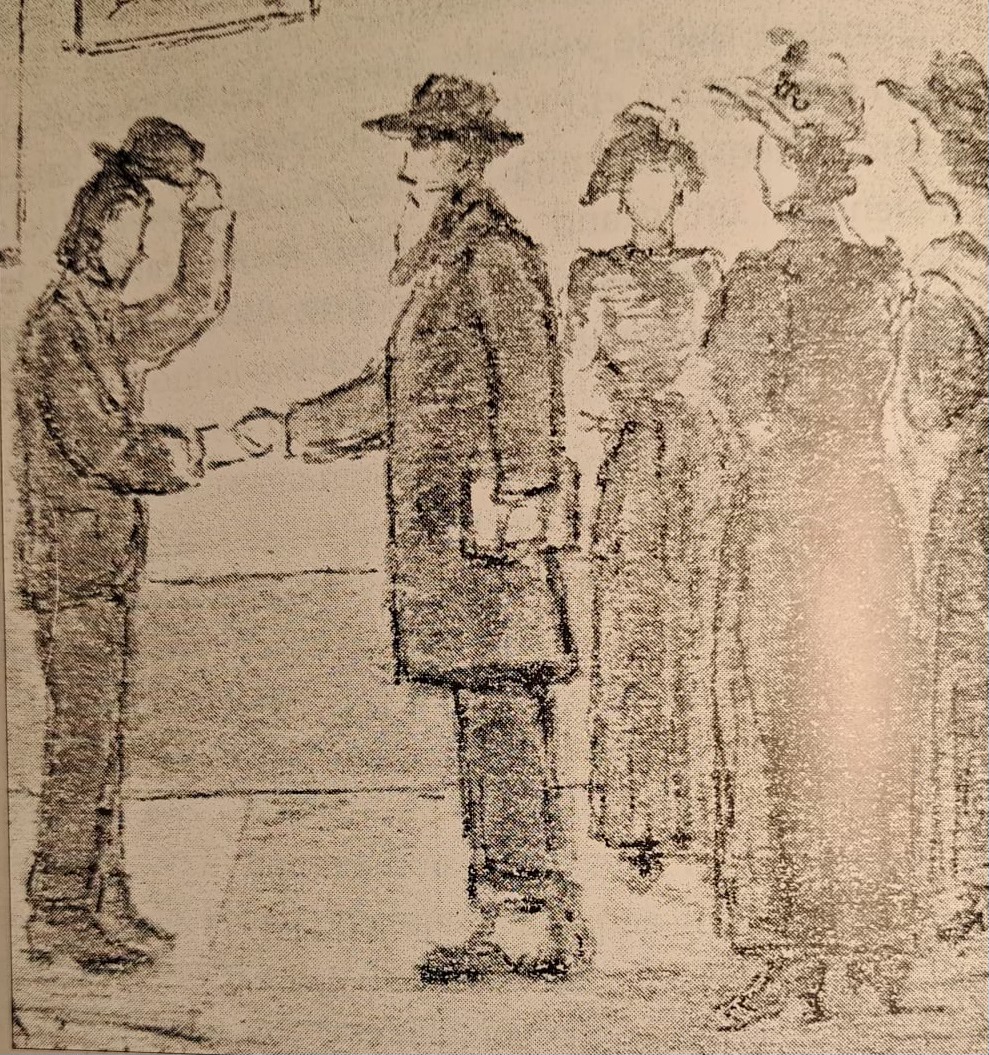
In July 1908, with Haskell’s financial support, Gibran went to Paris to study at the Académie Julian. He was twenty-five years old — a published writer in Arabic, an emerging visual artist, a man whose aesthetic sensibilities had been formed by the Bible’s King James rhythms, by William Blake’s prophetic books, by the mountains of Lebanon and the immigrant streets of Boston’s South End. He arrived in Paris in the last years of Rodin’s full creative power, when the sculptor’s studio at Meudon was still the most vital artistic address in Europe.
Through the network of connections that radiated outward from the Paris artistic world, Rodin had seen some of Gibran’s drawings before they met in person. When they did meet, the sculptor is reported to have made a remark that Gibran would carry for the rest of his life, and that would appear on the frontispiece of several of his books: that he was the William Blake of the twentieth century. The precise words, it should be said, come down to us through secondary sources and later retellings rather than from a verbatim primary-source record — but the substance of Rodin’s recognition of Gibran’s talent is well attested in the accounts of those who were present in the Paris artistic world of those years.
The comparison to Blake was not casual. Rodin himself had been deeply influenced by Blake — had encountered his work through the circuits of artistic exchange that brought so many influences to bear on his vision, and had recognised in Blake’s combination of visual art and prophetic poetry something that resonated with his own insistence on the body as the vehicle of spiritual truth. To call the young Lebanese-American the Blake of a new century was to identify in his work the same quality: the fusion of the visual and the verbal in service of a vision that was genuinely mystical rather than merely decorative.
That fusion was present in The Prophet as a physical object. Gibran drew twelve illustrations for the first edition — images of the human form in attitudes of grief and surrender and transcendence, their line drawing owing something to Rodin’s treatment of the body in extremis. The book was always intended to be both seen and read. The drawings and the prose were not separate elements but a single vision expressed through two different means — the same quality that Rodin had recognised, comparing him to a man who had made his watercolours and his poems into a unified prophetic act.
What Gibran carried back from Paris, beyond the technical influence on his draughtsmanship, was a version of the same lesson Rodin had given Rilke a few years earlier. Not the dramatic formulation of it — Gibran and Rilke moved in the same Parisian orbit without, apparently, being intimate — but the underlying principle: that the artist’s task was patient labour, daily, sustained, without waiting for the visitation of inspiration. Gibran would claim, years later, that The Prophet wrote itself through him rather than being composed by him. The claim is not entirely false — the sense of a work arriving through rather than from the writer is real in certain creative experiences. But between the first sketches of Almustafa in 1912 and the published book in 1923 lay over a decade of daily work, revision, and editorial collaboration with Mary Haskell. The inspiration was real. So was everything that came after it.
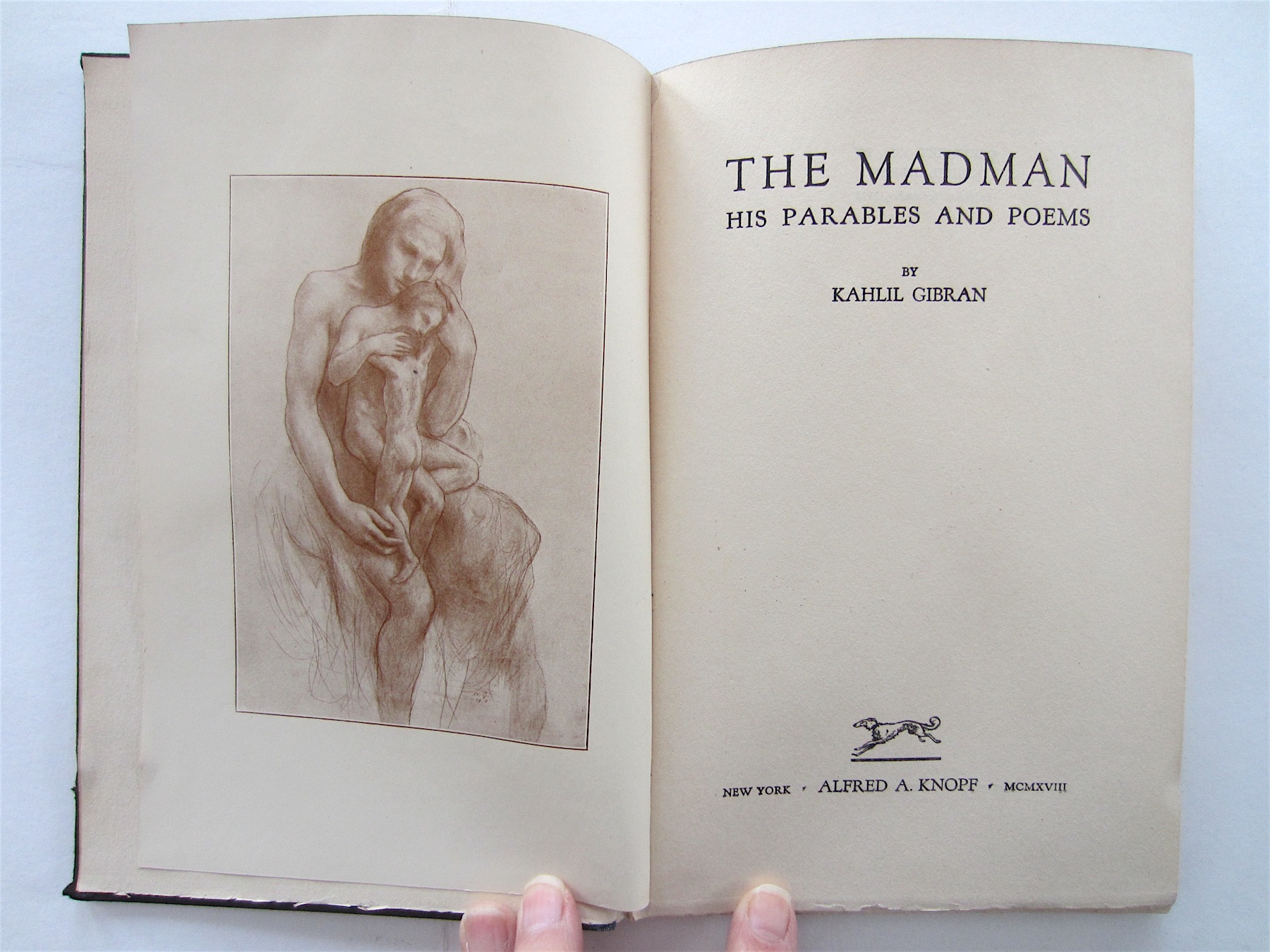
The Madman
Before The Prophet, before the book that would make him famous and define his reputation for a century, there was The Madman, published in 1918 by Alfred A. Knopf. It was Gibran’s first book in English — a collection of parables and prose poems that establishes his persona and his themes, but in a register that is darker, more paradoxical, and more willing to discomfort the reader than anything in The Prophet. It is consistently undervalued, and it deserves better.
The opening parable is one of the most original self-definitions in modern prose poetry. It is worth reading in full:
‘You ask me how I became a madman. It happened thus: One day, long before many gods were born, I woke from a deep sleep and found all my masks were stolen,—the seven masks I have fashioned and worn in seven lives,—I ran maskless through the crowded streets shouting, “Thieves, thieves, the cursed thieves.” Men and women laughed at me and some ran to their houses in fear of me. And when I reached the market place, a youth standing on a house-top cried, “He is a madman.” I looked up to behold him; the sun kissed my own naked face for the first time. For the first time the sun kissed my own naked face and my soul was inflamed with love for the sun, and I wanted my masks no more. And as if in a trance I cried, “Blessed, blessed are the thieves who stole my masks.” Thus I became a madman.”
— The Madman, Kahlil Gibran (1918)
The parable establishes the central proposition of Gibran’s entire project: that the condition the world calls madness — the loss of the social masks, the nakedness before the sun — is the condition of freedom, of genuine perception, of the soul alive to its own life. The madman is not mad. He is the only person in the story who has experienced the sun directly rather than through the protective filters of social conformity. And the laughter of the crowd is the sound of people who have mistaken their masks for their faces.
The parable can also be read as a parable about displacement — about what it means to arrive in a world where your previous identity has no currency, where you must either acquire new masks quickly or live, for a time, in the dangerous exposure of being seen as other. Gibran knew this exposure from his own schoolyard years in Boston. The parable transforms that experience into a spiritual gift: the masks were not lost, they were stolen by grace.
The parable of The Wise King — perhaps the finest single piece of writing in The Madman — takes the mask theme into its most concentrated territory:
“Once, there ruled in the distant city of Wirani a king who was both mighty and wise. And he was feared for his might and loved for his wisdom. Now, in the heart of that city was a well, whose water was cool and crystalline, from which all the inhabitants drank, even the king and his courtiers; for there was no other well. One night when all were asleep, a witch entered the city, and poured seven drops of strange liquid into the well, and said, “From this hour he who drinks this water shall become mad.” Next morning all the inhabitants, save the king and his lord chamberlain, drank from the well and became mad, even as the witch had foretold. And during that day the people in the narrow streets and in the market places did naught but whisper to one another, “The king is mad. Our king and his lord chamberlain have lost their reason. Surely we cannot be ruled by a mad king. We must dethrone him.” That evening, the king ordered a golden goblet to be filled from the well. And when it was brought to him, he drank deeply, and gave it to his lord chamberlain to drink. And there was great rejoicing in that distant city of Wirani, because its king and its lord chamberlain had regained their reason.”
— The Madman, Kahlil Gibran (1918)
The parable is a perfect construction: nothing wasted, the paradox resolved not through argument but through a story so economical it could be told to a child and understood by a philosopher. The king’s decision to drink from the poisoned well is an act of love — the choice to remain in communion with his people even at the cost of his own clarity. It is also a parable about what the artist risks in choosing to be understood: the writer who insists on seeing clearly in a world that has drunk from a different well will be called mad, and the only way to remain with that world is to accept the madness it requires. The king does not capitulate. He chooses solidarity over solitude. These are not the same thing.
The Madman also contains, in its aphoristic moments, Gibran’s earliest exercise in the form he would develop most fully in Sand and Foam: “I have found both freedom and safety in my madness; the freedom of loneliness and the safety from being understood, for those who understand us enslave something in us.” The observation is more uncomfortable than it first appears — an argument for the necessary privacy of the self, for the part of you that must remain unread.
New York
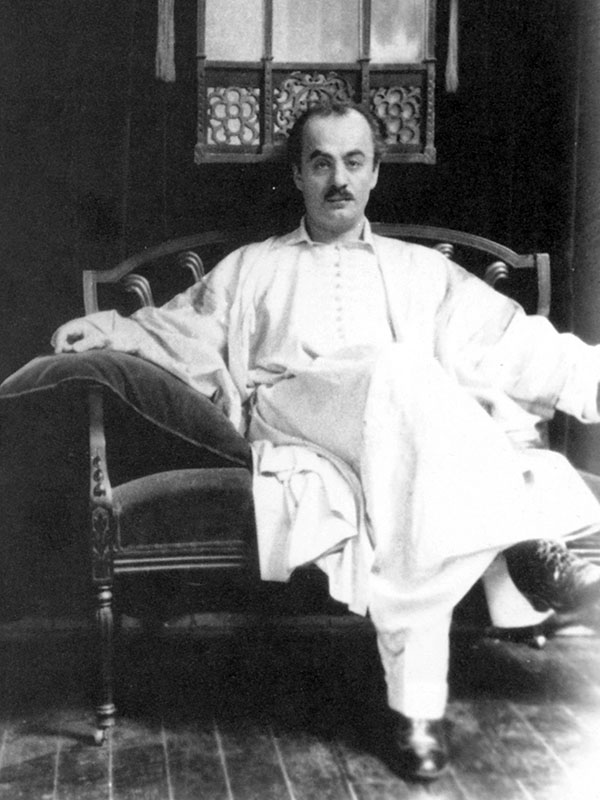
In 1911, Mary Haskell funded Gibran’s move to New York City. He settled in a one-room studio apartment in Greenwich Village that he called The Hermitage — his home, with various absences, until his death twenty years later. The Village gave him a literary world and the specific quality of urban solitude available only in a city large enough that one person can disappear into it. Both would feed The Prophet without appearing in it directly.
In 1918 The Madman appeared, published by Alfred A. Knopf. In 1920, The Forerunner. In those same years, Gibran was writing and rewriting the manuscript that would become The Prophet — submitting draft sections to Mary Haskell for her careful, honest response, revising in the light of her comments, putting the manuscript away and returning to it.
He had been carrying the book for over a decade before it was published. He described his relationship to the work not as composition but as reception — the book wrote me, he said. When it finally appeared in September 1923, priced at two dollars and twenty-five cents, he had been waiting so long that its arrival felt almost like someone else’s accomplishment.
The Prophet — The Architecture of a Vision
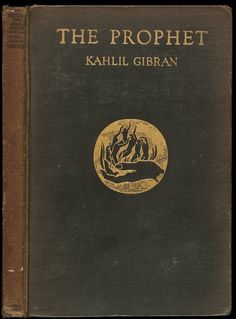
The Prophet is a small book — just under twenty thousand words — and its structure is deceptively simple. Almustafa, a holy man who has spent twelve years in the foreign city of Orphalese, sees his ship arrive in the harbour and prepares to depart for the island of his birth. The people of the city gather to beg him to stay, or failing that, to speak to them before he leaves. A seeress named Almitra asks him to speak of love. One by one, the citizens ask their questions, and he answers — twenty-six essays, moving from love and marriage through work and joy and crime and beauty to death. Then the prophet boards his ship and is gone.
The framing device borrows from ancient wisdom literature — the departing sage addressing his community for the last time — but Gibran makes it his own in ways that deserve attention. The book’s opening is not triumphant. Almustafa descends from the hill where he has spotted his ship and thinks:
How shall I go in peace and without sorrow? Nay, not without a wound in the spirit shall I leave this city. Long were the days of pain I have spent within its walls, and long were the nights of aloneness; and who can depart from his pain and his aloneness without regret? Too many fragments of the spirit have I scattered in these streets, and too many are the children of my longing that walk naked among these hills, and I cannot withdraw from them without a burden and an ache. It is not a garment I cast off this day, but a skin that I tear with my own hands.
— The Prophet, Kahlil Gibran (1923)
This passage can be read, among other things, as a meditation on what departure costs the person who leaves rather than the community that is left. Almustafa has become part of Orphalese in ways he cannot simply shed — has scattered fragments of his spirit in its streets, has left behind children of his longing that walk the hills without him. The twelve years of Almustafa in Orphalese echo Gibran’s own years in America, the immigrant who has given so much of himself to his adopted world that leaving it would require tearing off a skin. The book is not only a text of wisdom. It is also an elegy for a country the writer was not yet ready to leave.
The voice Gibran found for Almustafa draws its cadences from the King James Bible — he acknowledged this directly, once telling Mary Haskell that the Bible was Syriac literature in English words, the child of a marriage between two traditions that had produced something with no equivalent in any other tongue. But the Biblical rhythm is not mimicry. Gibran was deploying the cadences of the most widely known English prose in the Western world to give weight and depth to ideas drawn from an altogether different tradition — from Sufi mysticism, from Walt Whitman’s democratic spirituality, from Blake’s prophetic vision, from Nietzsche’s challenge to received morality. The voice sounds ancient. What it says is genuinely radical. The combination was what made the book impossible to categorise and, in the end, impossible to ignore.
The Prophet — On Love, Marriage, and Children
The book’s first and most famous essay addresses love. Almitra asks, and Almustafa answers with words that are at once more severe and more beautiful than the question anticipated:
“When love beckons to you, follow him, though his ways are hard and steep. And when his wings enfold you yield to him, though the sword hidden among his pinions may wound you. And when he speaks to you believe in him, though his voice may shatter your dreams as the north wind lays waste the garden. For even as love crowns you so shall he crucify you. Even as he is for your growth so is he for your pruning.”
— The Prophet, “On Love”
The movement from crowning to crucifying, from growth to pruning, from the caress of the tenderest branches to the shaking of the roots — this is love as the most radical force available to human experience: something that transforms by destruction as much as by gift, that requires the surrender of the self it crowns before it can complete its work. The agricultural metaphors — threshing, sifting, grinding, kneading, the sacred fire — draw from the same well as the Bible’s parables of wheat and tares, the ancient understanding that runs through the wisdom traditions of every culture: that what the fire purifies must first pass through the fire.
The essay on marriage is among the most quoted passages in the book, and for good reason. It says something about the nature of loving partnership that almost nothing else in the Western wisdom tradition has managed to say:
“You were born together, and together you shall be forevermore. You shall be together when the white wings of death scatter your days. Aye, you shall be together even in the silent memory of God. But let there be spaces in your togetherness, And let the winds of the heavens dance between you. Love one another, but make not a bond of love: Let it rather be a moving sea between the shores of your souls. Fill each other’s cup but drink not from one cup. Give one another of your bread but eat not from the same loaf. Sing and dance together and be joyous, but let each one of you be alone, Even as the strings of a lute are alone though they quiver with the same music. Give your hearts, but not into each other’s keeping. For only the hand of Life can contain your hearts. And stand together yet not too near together: For the pillars of the temple stand apart, And the oak tree and the cypress grow not in each other’s shadow.”
— The Prophet, “On Marriage”
The image of the pillars standing apart to support the same roof is Gibran’s own, drawn from architecture rather than sentiment. It says something about love that the language of romantic merging cannot say: that the best love is not the dissolution of two selves into one, but the arrangement by which two selves, remaining distinct, support something larger than either could support alone. The strength of the structure depends on the independence of each column. This is what Rilke had called, in his letters to Kappus, the love of two solitudes that protect and greet each other — two writers, from different traditions and different continents, arriving at the same architectural truth.
The essay on children is perhaps the most startling of all:
“Your children are not your children. They are the sons and daughters of Life’s longing for itself. They come through you but not from you, And though they are with you yet they belong not to you. You may give them your love but not your thoughts, For they have their own thoughts. You may house their bodies but not their souls, For their souls dwell in the house of tomorrow, which you cannot visit, not even in your dreams. You may strive to be like them, but seek not to make them like you. For life goes not backward nor tarries with yesterday. You are the bows from which your children as living arrows are sent forth.”
— The Prophet, “On Children”
The bow-and-arrow image reorganises the parent-child relationship entirely. The parents bending to the archer’s pull — the yielding, the giving of oneself to be the instrument of another’s flight — is not loss but purpose. The gladness Almustafa asks of the bending bow is not a comfortable demand. It is a true one.
The Prophet — On Work, Joy, Sorrow, and Death
The essay on work contains the most quoted single sentence in the book — a sentence that has appeared on office walls and coffee mugs and motivational posters for a century, and which in its original context carries considerably more weight than those contexts typically allow:
“And what is it to work with love? It is to weave the cloth with threads drawn from your heart, even as if your beloved were to wear that cloth. It is to build a house with affection, even as if your beloved were to dwell in that house. It is to sow seeds with tenderness and reap the harvest with joy, even as if your beloved were to eat the fruit. It is to charge all things you fashion with a breath of your own spirit, And to know that all the blessed dead are standing about you and watching. Work is love made visible.”
— The Prophet, “On Work”
Work is love made visible — five words that say in the fewest possible terms what Gibran had seen in Rodin’s studio. The old sculptor working at the clay surface with a concentration indistinguishable from devotion. The evidence of a maker’s hands pressed into the clay — the visible record of someone who gave himself to his work without reserve. Gibran had watched that, absorbed it, and found its literary equivalent. The sentence is a monument to what he had learned in Paris.
The essay on joy and sorrow turns on a single image that earns its place among the most precise things Gibran ever wrote:
“Your joy is your sorrow unmasked. And the selfsame well from which your laughter rises was oftentimes filled with your tears. And how else can it be? The deeper that sorrow carves into your being, the more joy you can contain. Is not the cup that holds your wine the very cup that was burned in the potter’s oven? And is not the lute that soothes your spirit, the very wood that was hollowed with knives?”
— The Prophet, “On Joy and Sorrow”
The cup burned in the potter’s oven is precise in a way that philosophical propositions about suffering and joy rarely manage to be. It says not merely that joy and sorrow coexist, but that the capacity for joy is structurally made by suffering — that the vessel is formed by fire. For a man who had lost his mother, his brother, and his sister before he was twenty-one, this was not a philosophical position. It was autobiography rendered as wisdom.
The book closes on death. Almustafa prepares to board his ship, and speaks for the last time:
“For what is it to die but to stand naked in the wind and to melt into the sun? And what is it to cease breathing, but to free the breath from its restless tides, that it may rise and expand and seek God unencumbered? Only when you drink from the river of silence shall you indeed sing. And when you have reached the mountain top, then you shall begin to climb. And when the earth shall claim your limbs, then shall you truly dance.”
— The Prophet, “On Death”
When the earth shall claim your limbs, then shall you truly dance. The willingness to affirm life’s most vital expression not in spite of death but through it — the body returning to earth as the condition of the spirit’s fullest movement. It is not consolation. It is something harder and more beautiful than consolation: the insistence that death is not the ending of the dance but its ultimate form.
Sand and Foam — The Aphorist
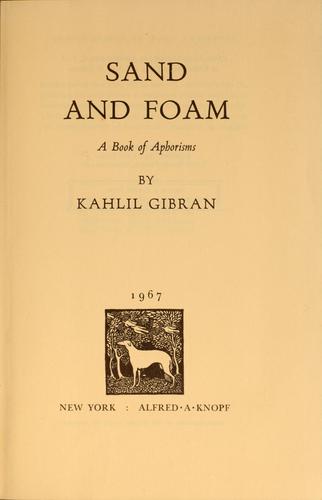
Three years after The Prophet, in 1926, Gibran published Sand and Foam — a collection of aphorisms and prose poems that operates in a different register from its predecessor. Where The Prophet moves through sustained essays in a single prophetic voice, Sand and Foam is fragmentary, paradoxical, epigrammatic — a gathering of observations that resist the systematic wisdom-dispensing that The Prophet‘s framing device makes possible. It is a more private book, and in some ways a more honest one about the conditions under which wisdom is actually acquired.
The title piece announces the book’s governing image:
“I am forever walking upon these shores, Betwixt the sand and the foam, The high tide will erase my footprints, And the wind will blow away the foam. But the sea and the shore will remain forever.”
— Sand and Foam, Kahlil Gibran (1926)
The footprints erased, the foam dissolved, the sea and the shore remaining. It is a description of the artist’s predicament taken further than the artist’s predicament — a description of any individual life against the permanence of what it briefly inhabits. The individual work dissolves. The creative impulse remains. The book is full of this doubled quality: saying two things at once without pretending to resolve the tension between them.
Several of the aphorisms in Sand and Foam have passed into the culture so completely that their source has been forgotten. The most famous is the one that John Lennon, in 1968, worked into the Beatles song Julia in a slightly altered form:
“Half of what I say is meaningless, but I say it so that the other half may reach you.”
— Sand and Foam
The aphorism is self-aware in a way Gibran’s critics rarely credit him for. It acknowledges the gap between intention and communication, between the fullness of what the writer means and the partiality of what arrives — and does so without apology, simply as a statement of the conditions under which language operates. The half that reaches you is worth the half that doesn’t.
Other aphorisms in Sand and Foam have the compressed precision of truths arrived at through specific personal experience:
Remembrance is a form of meeting. Forgetfulness is a form of freedom.
— Sand and Foam
Two sentences. A complete observation. The first is warm; the second is colder, more demanding. Together, they refuse the usual comfort that forgetfulness is loss and memory is the only form of fidelity to what has passed. For a man who had left Lebanon at twelve and would never return to live there, who had lost three family members before he was twenty-one, who had spent his adult life between two languages and two worlds — forgetfulness as freedom was not an abstraction. It was a hard-won permission.
The book’s most searching passages concern the nature of art and the conditions of creativity:
A poet is a dethroned king sitting among the ashes of his palace trying to fashion an image out of those ashes.
— Sand and Foam
Trees are poems that the earth writes upon the sky. We fell them down and turn them into paper that we may record our emptiness.
— Sand and Foam
Poetry is a deal of joy and pain and wonder, with a dash of the dictionary.
— Sand and Foam
These are not the words of the serene spiritual teacher that The Prophet‘s reputation has made of Gibran. The dethroned king among the ashes is a self-portrait as honest as anything in his private letters — the artist stripped of grandeur, working with what the fire has left, trying to make something out of ruin. It is the same image, approached from a different direction, as Rodin’s Gates of Hell still unfinished on the worktable after thirty years. The material of art is what survives destruction. The question is only what you do with it.
The Slow Burn — the Long Journey to the World
The Prophet sold 1,159 copies in its first year. Alfred Knopf, its publisher, would say in later life that he had never actually met anyone who read it — that it seemed to sell to people who remained invisible to him. The book was never reviewed by the New York Times. It found no place in the academic literary establishment’s map of significant American writing.
The critical dismissal had some basis. The Prophet has passages of genuine mystical inflation — moments where the cadences carry the meaning rather than the other way around, where the prophetic tone does more work than the prophetic content. Gibran’s tendency toward oracular generality is a real limitation, and it is not unfair to notice it. But the critics were measuring the wrong thing.
What they could not see was what Juan Cole, the translator and historian, later described as the book’s central offer: a dogma-free universal spiritualism, a vision of the sacred located in the ordinary rather than the institutional, offered without moral authority and without the requirement of submission to any particular creed. In the 1930s, when Americans were looking for meaning in the ruins of a confidence that had collapsed, The Prophet offered a framework for understanding love, work, suffering, and death that asked nothing in return but the reader’s attention. It spread by word of mouth, book to book, generation to generation, without reviews and without institutional endorsement — which, for the counterculture generation of the 1960s, became part of its appeal. A book that the English professors dismissed was precisely the kind of book they wanted to read.
During the height of the 1960s resurgence, The Prophet sold thousands of copies per week in the United States alone. Elvis Presley kept an annotated copy and gave copies as gifts throughout his life. John Lennon drew from Sand and Foam. The book had become, without anyone planning it, one of the most widely shared human documents of the twentieth century. It has now sold tens of millions of copies worldwide, been translated into more than a hundred languages, and has never gone out of print since September 1923. The academics who dismissed it as a cult book for the intellectually unsophisticated were not wrong about its weaknesses. They were comprehensively wrong about its staying power.
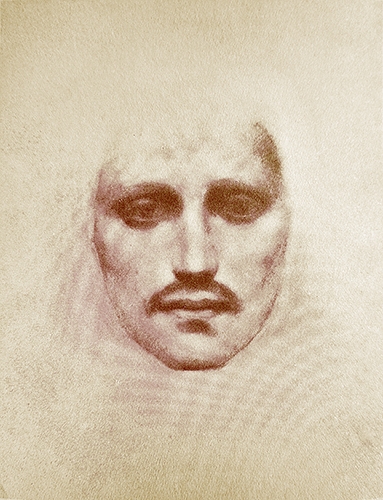
The Return Home
Gibran spent his last years in increasing isolation and declining health. By the late 1920s he was rarely leaving The Hermitage, spending longer periods away in the Massachusetts countryside or with Marianna in Boston. His liver was failing. He continued to work. He published Jesus, the Son of Man in 1928 — a reimagining of Christ’s life through the voices of seventy-seven contemporaries — which reflected his lifelong belief in the fundamental unity of all genuine spiritual experience across the boundaries of doctrine. He had said it most directly in one of his early Arabic poems: “You are my brother and I love you. I love you when you prostrate yourself in your mosque, and kneel in your church and pray in your synagogue. You and I are sons of one faith — the Spirit.”
In letters to Mary Haskell from his final years, he approached death with the same quality of attention he had brought to everything else — not with fear and not with false serenity, but with the alertness of a man who understood that the mystery he was approaching was the same mystery he had been writing about all his life. In 1924 he wrote: “I have been nothing but a root in the past, and now I do not know what to do with so much air and light and space… I feel as if it were the consciousness of a cloud before it becomes rain or snow.” The cloud becoming rain. The visible dissolving into something that reaches further.
He died on 10 April 1931 at St Vincent’s Hospital in Manhattan, aged forty-eight. He refused the last rites. His body was returned, at his request, to Bsharri — the mountain village where he had been born, where the cedars grew ancient on the hillside, where the Kadisha River ran cold in the gorge below.
He rests there now, in the Mar Sarkis Monastery, which has become the Gibran Museum. His epitaph, which he wrote himself, is carved at the entrance:
“I am alive, like you. And I am now standing beside you. Close your eyes and look around, you will see me in front of you.”
— Gibran’s epitaph, Gibran Museum, Bsharri
The Legacy
The question of Gibran’s literary standing is genuinely complicated, and it deserves honest engagement. His English prose, at its best, has a spare luminosity that is genuinely rare. At its worst, it tips into oracular inflation — the cadences doing more work than the content. The aphoristic mode is one he mastered more completely than the extended essay mode. These are real limitations, and they are not unfair to name.
But applying criteria developed for the Western secular literary tradition to a writer working at the intersection of Eastern and Western, sacred and secular, produces assessments that miss most of what matters about him. Salma Khadra Jayyusi, the Palestinian scholar of Arabic literature, called him the single most important influence on Arabic poetry and literature in the first half of the twentieth century. His innovations in Arabic prose were fundamental — his rejection of the classical qasida form, his use of colloquial language in place of classical Arabic, his fusion of the prose poem with the parable and the essay — and they shaped what Arabic writing became across the twentieth century in ways that Western critics, reading only his English work, could not register.
What he gave the English-speaking world is different, and it has proved more durable than his critics anticipated. He gave it a vocabulary for the sacred that required no institutional allegiance. He gave it images — the pillars of the temple standing apart, the bows and the living arrows, work as love made visible, the well that holds both laughter and tears — that have entered the common stock of human expression and continue to be reached for at the moments when language matters most: at weddings and funerals and births, at the passages that demand words adequate to what they are. He gave it The Wise King, who drinks from the well of madness to remain with his people. He gave it the madman who runs naked through the streets blessing the thieves who stole his masks.
— — —
Kahlil Gibran died in New York in April 1931, having given the English-speaking world a book it would read for a century. Rodin had been dead for fourteen years. Rilke had been dead for five. The world they had inhabited together — the Paris of the Belle Époque, the studios and salons, the Tuesday evenings and the plaster fauns on sideboards — was gone, dissolved in the catastrophe of the war that Chapter Three traced approaching with such terrible patience.
What remained was the work. Rilke’s elegies. Gibran’s prophet. And the question of what it meant to carry what these men had made into the century the war had created.
One more figure remains. He came to Rodin’s circle not as a student or a secretary but as an admirer from a distance — a brash, brilliant, infuriating American who understood that what Rodin had done to sculpture was precisely what modern poetry needed to do, and who became, in the years after the war, the most consequential single figure in the transformation of English-language poetry. He also supported Mussolini, was indicted for treason, and spent twelve years in a psychiatric institution. His legacy is as divided as the century he helped to make. In the next and final chapter we turn to Ezra Pound — and to the Lost Generation that gathered at the Closerie des Lilas in the years after the lamps went out.
Darren Gall
