
A Game of Rhônes – Act Four: Letters to the Dead
…though at first it is very bitter to the taste, it afterwards becomes sweet as it ripens.
—Cicero on the grape, On Old Age (trans. W. A. Falconer)
The Poet in Babylon
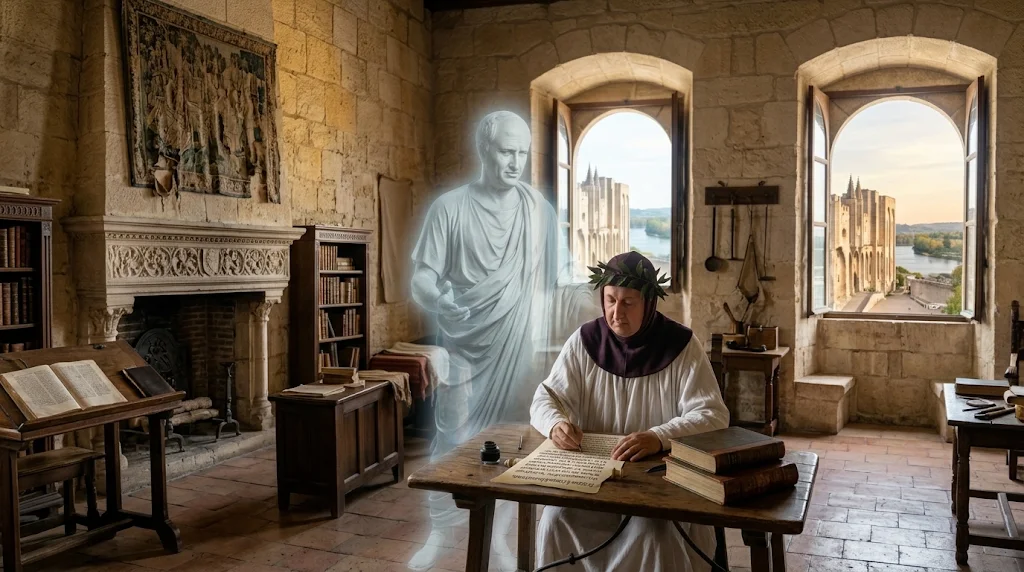
The fourth of our five courses brought the oldest red of the night to the table, and its highest score. It brings us, too, to the guest with the most to say. Our first two guests defied the pope, and ran. The poet stayed, took the papal court’s money, and despised it.
Francesco Petrarca was born in Arezzo on 20 July 1304. His father, Ser Petracco, was a Florentine notary who had been driven out of Florence in 1302, in the same purge as his friend Dante. The family followed the work, and the work followed the papacy: by 1312 the father was in Avignon and the family at nearby Carpentras. Petrarch was sent to study law at Montpellier and Bologna, years he later said he had wasted, and came back to Avignon in 1326, after his father’s death. On 6 April 1327, in the church of Sainte-Claire, he first saw the woman he called Laura. He wrote the date on the flyleaf of his copy of Virgil, and twenty-one years later he added another: Laura died in Avignon on the same day of the same month, in 1348, the year of the Black Death. The book is now in the Ambrosiana in Milan.
His protectors were the Colonna, the great Roman family. Stefano Colonna took him under his wing, and Stefano’s son, Cardinal Giovanni, employed him in Avignon. Stefano’s brother was Sciarra, the man who crowned Louis in Rome in Act Three. Avignon was a small world.
He loathed it. “Now I am living in France, in the Babylon of the West,” he wrote. “The sun in its travels sees nothing more hideous than this place on the shores of the wild Rhone.” And of the cardinals: “Here reign the successors of the poor fishermen of Galilee; they have strangely forgotten their origin.”
Which brings us to the scandal promised in Act One: the cardinals’ favourite wine was Burgundy. When Urban V tried to take the court back to Rome in 1367, the French cardinals who wanted to go home counted the health-giving wine of Beaune among their reasons, and Petrarch told the pope that anyone who could not live without Burgundy should come and taste Italy’s. John XXII, the pope at the centre of our story, drank closer to home: new wine from Tournon, across the river from the hill of Hermitage, and old wine from Malaucène, at the foot of Ventoux.
The Ascent
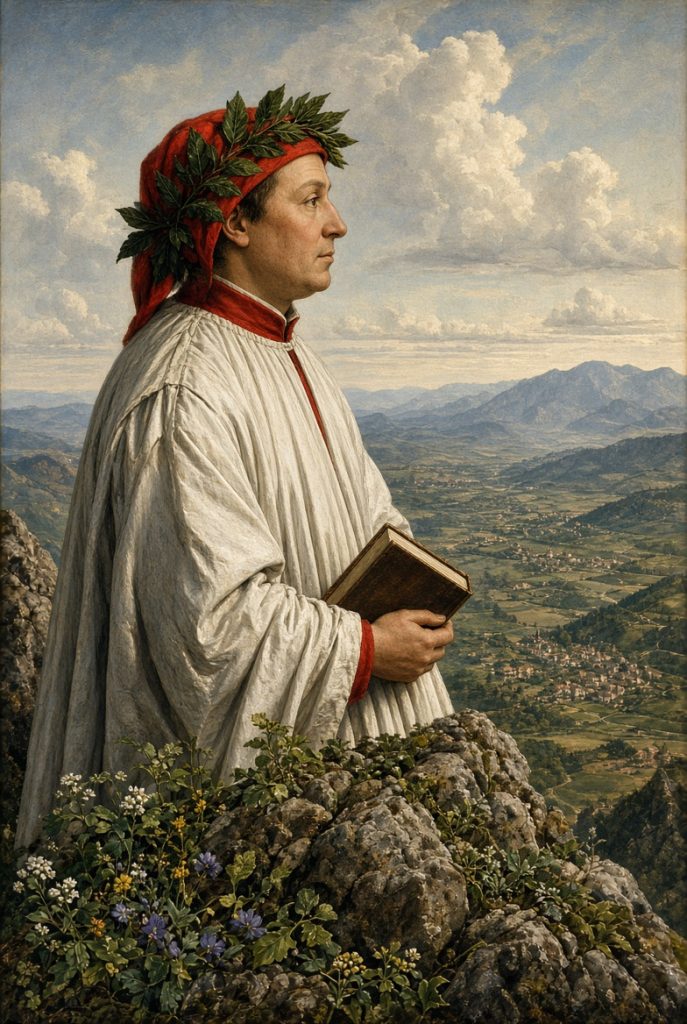
On 26 April 1336, by his own account, Petrarch climbed Mont Ventoux with his brother Gherardo and two servants. They set out from Malaucène, the village that supplied John XXII’s old wine, after resting there a day. He had grown up at Carpentras, beneath the mountain: “I have lived in this region from infancy,” he wrote, and “the mountain, which is visible from a great distance, was ever before my eyes.” At 1,910 metres it is the highest mountain in Provence, the Giant of Provence to the guidebooks and the Beast to the cyclists of the Tour de France. I have written about it twice before, for the wines of its foothills. On the way up, an old shepherd tried, “at great length”, to talk them out of it. “My only motive,” Petrarch wrote, “was the wish to see what so great an elevation had to offer.” At the summit he took out the pocket copy of Augustine’s Confessions he always carried, a gift from the friend he was writing to, and opened it at random. The page read: “And men go about to wonder at the heights of the mountains… but themselves they consider not.” He closed the book, abashed, and “from that time not a syllable fell from my lips until we reached the bottom again.”
A concession is due. The letter, to his old confessor Dionigi da Borgo San Sepolcro, has been hailed as the first account since antiquity of climbing a mountain for the view. Most scholars now think it was written around 1350, nearly fifteen years after the date it bears, and some doubt that the climb happened as told. The ascent of the mountain is also the ascent of a soul: it is literature, not a diary. Nor was Petrarch first. Jean Buridan, the Paris master we met in Act Two, had been up Ventoux before 1334, on his way to the papal court, to make observations of the weather. The philosopher climbed to look at the sky. The poet climbed to look at the view, and came down having looked at himself. He looked outward and was sent inward. That turn runs through everything that follows in this Act.
The Divided Self
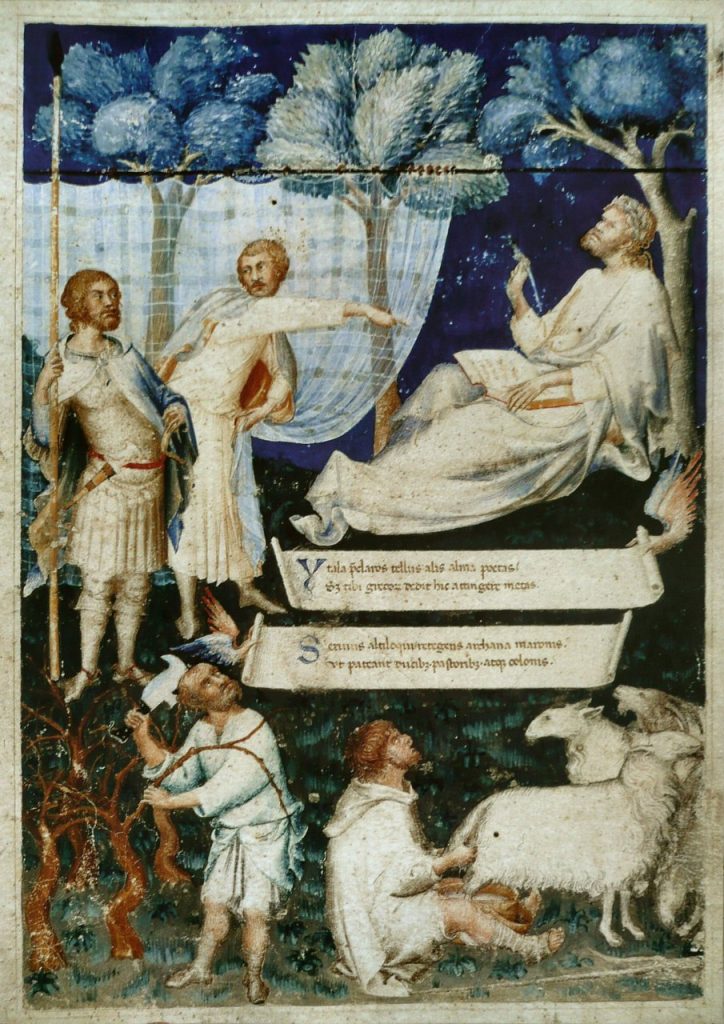
Petrarch’s most searching book was conceived as a private examination of conscience. The Secretum, his “secret book”, written and reworked between the early 1340s and 1353 and not circulated until after his death, is a dialogue in three parts between Petrarch and Saint Augustine, in the presence of a silent Lady Truth. Augustine does most of the talking, and none of it is flattering. Petrarch’s unhappiness, he says, is of Petrarch’s own making: he knows what he ought to want and cannot make himself want it. His love for Laura and his hunger for fame bind his will “in adamantine chains”. Petrarch concedes almost everything, and changes almost nothing. At the end he promises to attend to his soul, once he has finished his books.
Its models were Augustine’s Confessions and Boethius’s dialogue with Lady Philosophy, but its subject was new: not sin in general, but one particular man, divided against himself, examined without a happy ending. The Greeks had a word for his condition, akrasia, weakness of will: knowing the better and doing the worse. Petrarch did not solve it. He made it the subject of a book and left it open.
The same divided man wrote the poems. The Canzoniere, 366 poems in Italian, most of them for Laura, is a long study of wanting what cannot be had: absence, memory, jealousy, the fear of time, and the self that watches itself suffer. Whether Laura was quite the woman he made of her is still argued; what matters is what he made of the longing. The sonnet, as he shaped it, became Europe’s instrument for that kind of thinking. Chaucer adapted one of his sonnets into Troilus and Criseyde, though not as a sonnet. Wyatt and Surrey brought the form into English, and Ronsard, Spenser, Shakespeare, and Milton all wrote in its shadow. Shakespeare’s “My mistress’ eyes are nothing like the sun” is a joke at the expense of two centuries of Petrarch’s imitators.
Letters to a Dead Man
Petrarch’s Cicero began in a fire. As he told it in old age, his father, finding him reading the poets and orators when he should have been studying law, threw his books on the flames. Then, seeing the boy’s tears, he pulled two of them out again, a Virgil and a Cicero, and gave them back. Petrarch spent the rest of his life hunting for the books that had not survived.
He was good at it. In 1333, at Liège, he found Cicero’s speech in defence of the poet Archias, which is really a defence of literature itself. These studies, Cicero told the jury, nourish youth and delight old age; they adorn good fortune and give refuge and comfort in bad; they stay up all night with us, travel with us, and come with us to the country. Beside Cicero’s phrase “the light of letters”, Petrarch wrote it out again in the margin and drew a small lamp. In 1345, in the chapter library of Verona Cathedral, he found something better: Cicero’s private letters, to his friend Atticus, his brother Quintus, and Brutus.
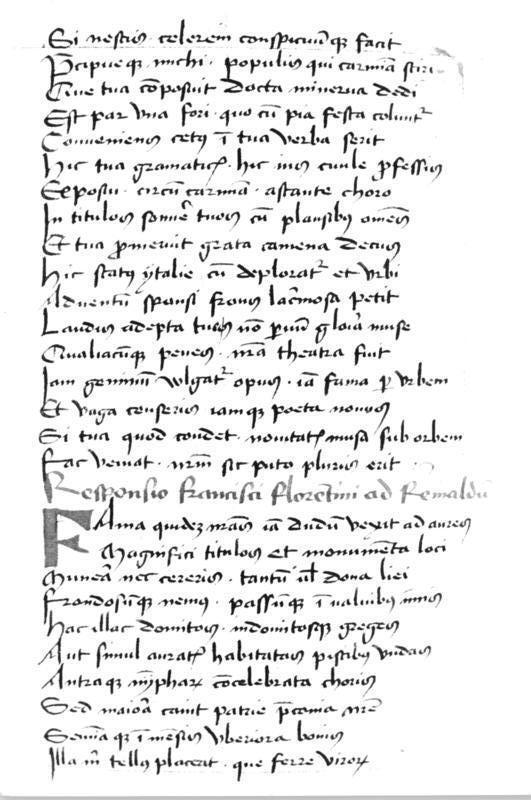
They were a shock. The Cicero of the speeches and treatises was a sage. The Cicero of the letters was anxious, vain, and ambitious, changing sides, complaining, and in old age throwing himself into the civil wars that would cost him his life. Petrarch answered at once, in a letter to the dead man. “Your letters I sought for long and diligently,” it begins, “and finally, where I least expected it, I found them.” Then the reproach: “You were like a traveller in the night, whose torch lights up for others the path where he himself has miserably fallen.” He signed off, “Farewell, forever, my Cicero,” and dated the letter 16 June 1345, “Written in the land of the living”, by the calendar of a God Cicero never knew.
He was not finished with him. In a second letter he made his peace with the writer, if not the politician: “Thou art the fountain-head from which we draw the vivifying waters for our meadows.” He went on to write to Seneca, Livy, Virgil, and Homer, but Cicero was the one he quarrelled with, and the one he could not give up. He had lost his illusions about the man and kept his love for the mind. That is a harder kind of friendship than worship, and a more useful one.
What Cicero Knew
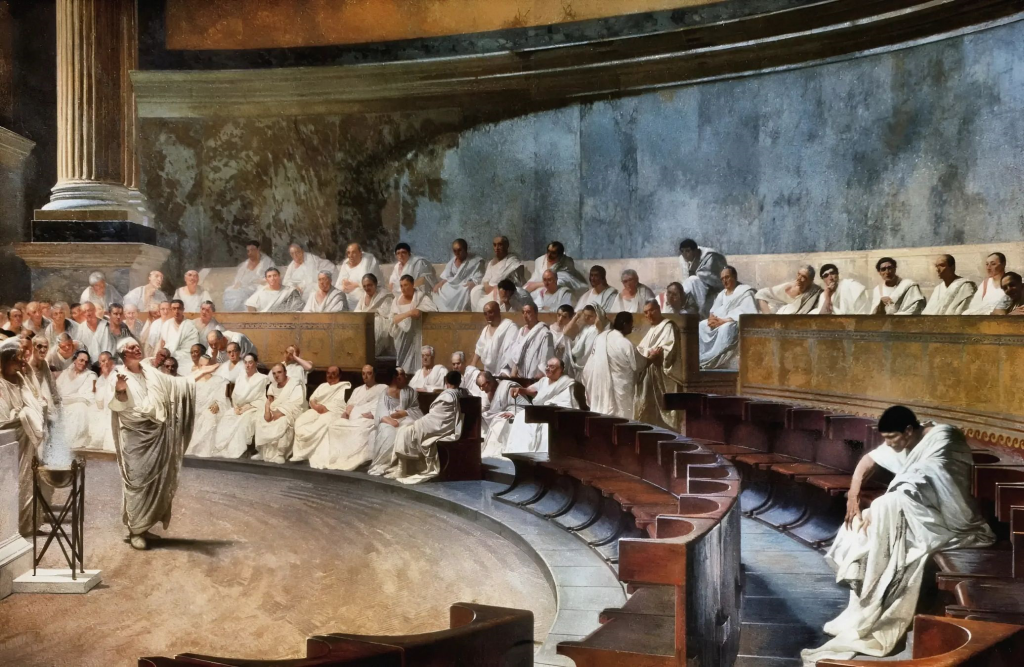
It is worth pausing on what Petrarch had found, because Cicero is easy to undersell. Modern philosophers have not always been kind; Bernard Williams called him third-rate. Cicero would not have claimed to be Plato. Of his own philosophical books he told Atticus, more or less, that they were transcripts: he supplied only the words, and of those he had plenty.
The words were the point. Cicero carried Greek philosophy into Latin, and to do it he had to invent a vocabulary. Qualitas, from which we have “quality”, is his. So is moralis: in 44 BC, needing a Latin word for the Greek ēthikos, he coined one, and every time we speak of moral philosophy we are speaking Cicero’s Latin. He wrote as an Academic sceptic, which meant setting out the strongest case on each side and leaving the reader to judge, holding conclusions as probable rather than certain. The concessions in this series are, in that sense, Ciceronian.
He left the classic Latin statement of natural law. “True law is right reason in agreement with nature,” he wrote in On the Republic; “it is of universal application, unchanging and everlasting”, and “one eternal and unchangeable law will be valid for all nations and all times”. Neither senate nor people, he added, can release anyone from it. The passage survives only because a Christian writer, Lactantius, quoted it. Set it beside Marsilius in Act Three. Marsilius grounded law in the people; Cicero put a law above the people, and above every state. The argument between those two ideas has not ended.
Most of the rest was written in the last three years of his life, with the republic falling around him. On Duties, written for his son in 44 BC, argues that the honourable and the useful never truly conflict: whatever is dishonourable only seems useful. On Friendship holds that “friendship cannot exist except among good men”, and that it “adds a brighter radiance to prosperity and lessens the burden of adversity by dividing and sharing it”. On Old Age gave us our epigraph. The Tusculan Disputations, written after the death of his daughter Tullia, treat philosophy as therapy: “Philosophy is certainly the medicine of the soul.” And a lost dialogue, the Hortensius, an invitation to philosophy, fell into the hands of a young student in Carthage named Augustine. “This book, in truth, changed my affections,” Augustine wrote, “and turned my prayers to Thyself, O Lord.” It was that Augustine whom Petrarch carried up Ventoux.
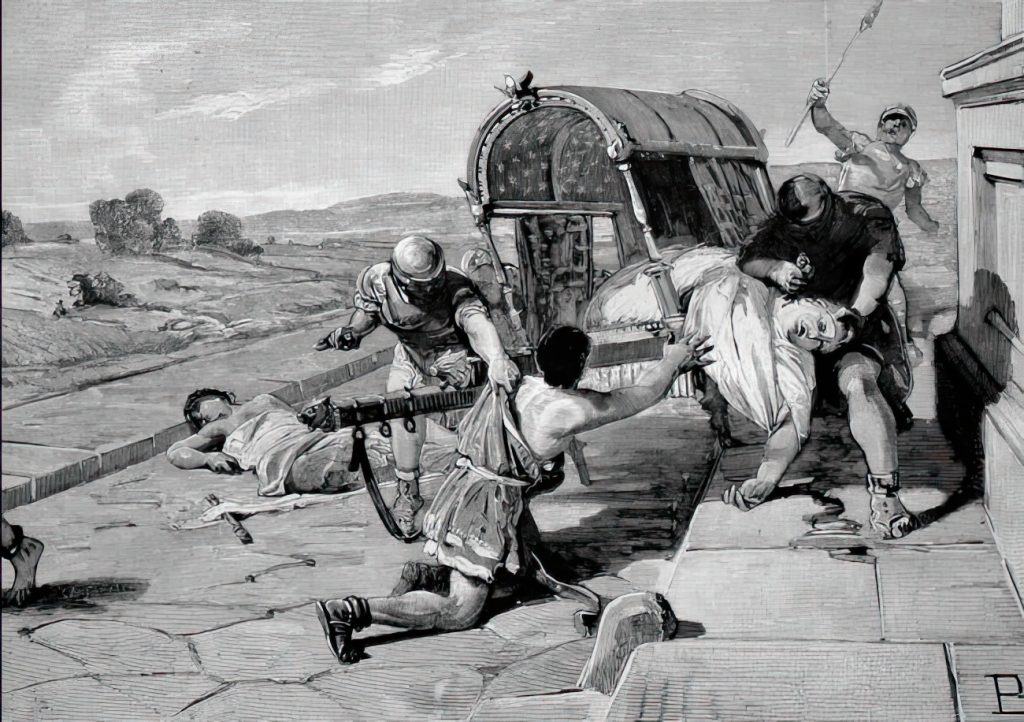
Then the theory met the world. In 44 and 43 BC Cicero attacked Mark Antony in the fourteen speeches known as the Philippics. When Antony, Octavian, and Lepidus divided Rome between them, Cicero’s name went on the list of the proscribed. He was killed on 7 December 43 BC, and his head and hands were displayed on the Rostra, the speakers’ platform in the Forum where he had made his name.
Better to Will the Good
Petrarch took from Cicero a conviction that ran against the universities of his day: philosophy exists to make us better, not merely cleverer. In the late 1360s four young Venetians, followers of Aristotle as read through his Arab commentator Averroes, decided among themselves that Petrarch was a good man but an ignorant one. His reply, On His Own Ignorance and That of Many Others, is the nearest thing he wrote to a manifesto. He had read Aristotle’s Ethics, he said, and been made more learned but not better. Aristotle defined virtue well, but “his lesson lacks the words that sting and set afire and urge toward love of virtue”. Cicero and the Latin writers, by contrast, “stamp and drive deep into the heart the sharpest and most ardent stings of speech”. And then the line that sums him up: “It is better to will the good than to know the truth.”
That is Cicero’s ideal, eloquence joined to wisdom, turned into a programme. It is also why one of Petrarch’s most widely read books in the two centuries after his death was not his poetry but a manual of consolation, Remedies for Fortune Fair and Foul, which works through the good and bad fortunes a life can bring and answers each in turn. It is the Tusculans’ medicine of the soul, made into a handbook.
A concession is due, and it points back to Act Two. The schoolmen Petrarch mocked were not all fools. The Paris masters of the generation after Ockham, Buridan and Oresme among them, were doing work that would one day become physics, and Petrarch had little patience with it. He cared more about the soul than the stars and said so. The humanists gave Europe a moral education; the schoolmen he scorned gave it a good part of its science. It needed both.
Light and Darkness
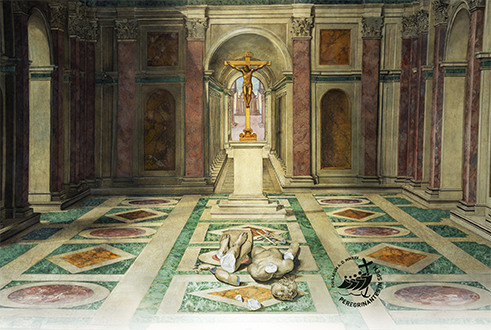
Petrarch helped give Europe one of its longest-lasting historical narratives. In the 1330s he took the old Christian imagery of light and darkness and turned it on history itself. Rome was the light. The centuries after its fall were darkness: bad Latin, lost books, forgotten authors. His task was to bring the light back. “This sleep of forgetfulness will not last forever,” he wrote in his epic Africa, around 1343. It was the first step towards the division of history into ancient, medieval, and modern that we still use.
A concession, and a large one. As a description of the Middle Ages it was wrong, and he had an interest in its being wrong: the darker the centuries behind him, the brighter his own revival. The age he dismissed built Chartres, founded the universities of Paris, Oxford, and Bologna, where he studied law, and produced the philosophers we have been dining with: Ockham, Marsilius, and, in the next Act, Eckhart. Most medieval historians now avoid the term ‘Dark Ages’. The phrase itself, saeculum obscurum, came later still, from Cardinal Baronius in 1602, and he meant only a stretch of the tenth and eleventh centuries.
What survives is the part that was true. Petrarch knew that a civilisation can forget: that books are lost, languages decay, and memory has to be worked for. In the Triumphs, the allegory he was still revising late in life, Love is overcome by Chastity, Chastity by Death, Death by Fame, Fame by Time, and Time only by Eternity. The man who had angled for a laurel crown on the Capitol knew that Time beats Fame. He worked as if it might not.
The Long Shadow
One of Petrarch’s most enduring gifts began with a phrase in that manuscript from Liège. In the speech for Archias, Cicero speaks of studia humanitatis ac litterarum, studies of humanity and of letters. Petrarch’s successors took the phrase as the name of their programme: grammar, rhetoric, poetry, history, and moral philosophy, read in the ancients and aimed at forming better people. Coluccio Salutati, chancellor of Florence, made the term current in the 1370s, and later found the rest of Cicero’s letters. We still call them the humanities.
Cicero went into print almost as soon as there was print: On Duties was among the first classical texts ever printed, at Mainz in 1465. Nearly five centuries after Verona, Thomas Jefferson, explaining where the ideas of the Declaration of Independence had come from, pointed to “the elementary books of public right, as Aristotle, Cicero, Locke, Sidney, &c.”
Two concessions are due. The first is Petrarch’s own: Cicero was no saint, and the man who revived him knew it before anyone. The second is about Petrarch. He was not the first humanist; in Padua, Lovato Lovati and Albertino Mussato had been reading the ancients this way a generation earlier. He took minor orders to qualify for church income, lived on church benefices and the patronage of the Colonna, and kept coming back to Provence until he was nearly fifty. Babylon paid his bills. Then he spent eight years in Milan as the guest of the Visconti, its ruling lords: the kind of entanglement with power he had scolded Cicero for. He was his own traveller in the night. The torch lit the way for others more steadily than for him.
He died at Arquà, in the Euganean Hills, in July 1374, and, so the story goes, was found the next morning at his desk with his head resting on a manuscript of Virgil. A life that began with a Virgil pulled from the fire ended with one under his head.
The Citizen and the Contemplative
The two men disagreed about the most important question either of them asked: what is learning for? Cicero’s answer was the city. The educated man owed his gifts to the republic, in the courts, the Senate, and the Forum, and Cicero paid that debt with his life. Petrarch admired the answer and could not live it. He kept stepping back from public life towards the study, the garden, and the page, and in 1346 he began a book in praise of the solitary life. The next generation in Florence took Cicero’s side and made the citizen-scholar their model.
Neither of them settled the question, and it has not been settled since. Cicero taught us how to be useful to the world. Petrarch taught us not to lose ourselves in the process. And between those two ideas lies much of what we still mean by a humanist education.
The Hermit on the Hill
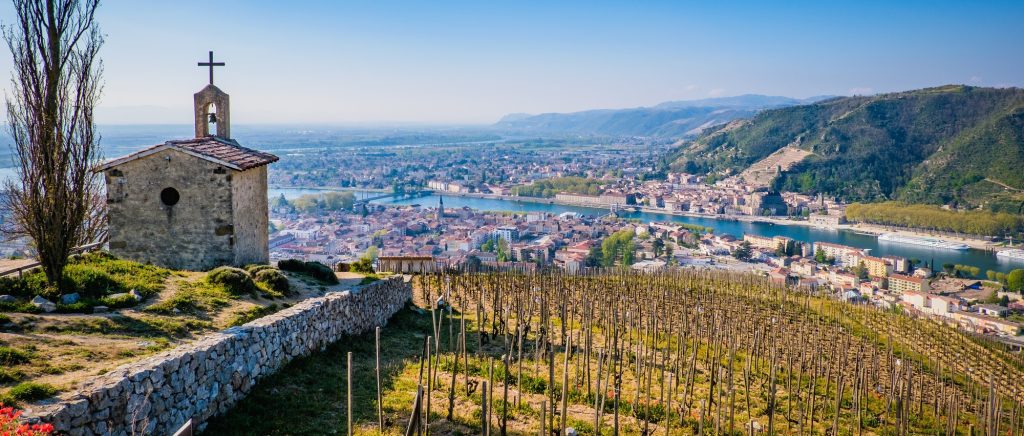
Petrarch’s own solitude had an address: a small house at Fontaine-de-Vaucluse, east of Avignon, where the Sorgue rises from beneath a cliff, which he kept through the 1340s and 1350s. More than a century earlier, a knight had made the same choice on a hill above the Rhône at Tain.
The invitation promised us the Hermit on the Hill, and the story goes like this. Around 1224 Gaspard de Stérimberg came home wounded from the Albigensian Crusade, the Church’s war on the Cathar heretics of the south, and with the queen’s leave built himself a refuge on the hill. He stayed, the hill took its name from him, and tradition has him planting its first vines. I have told the story before, in an earlier piece on Syrah. Here it is the meaning that matters: a man who had fought for orthodoxy laid down his sword and went up a hill to find God alone.
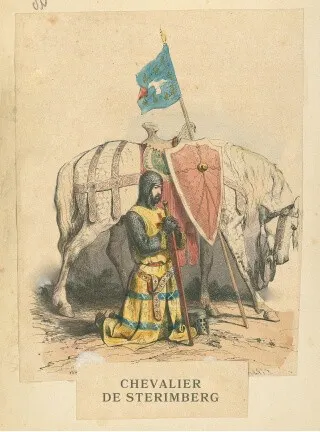
A religious building is said to have stood on the summit by about 1100, more than a century before the knight, and his story is a legend. But the chapel of Saint Christopher still stands among the vines, and the wine made below it found admirers enough. Louis XIII made it a wine of the court after tasting it in 1642; in the nineteenth century Bordeaux merchants “hermitaged” their clarets with it to sell them at a higher price. Thomas Jefferson, who named Cicero among the sources of the Declaration, was blunt about the colours: “The red is not very highly esteemed, but the White is the first wine in the world without a single exception.” On our table, it was the red that took the honours.
ACT FOUR
The Summit
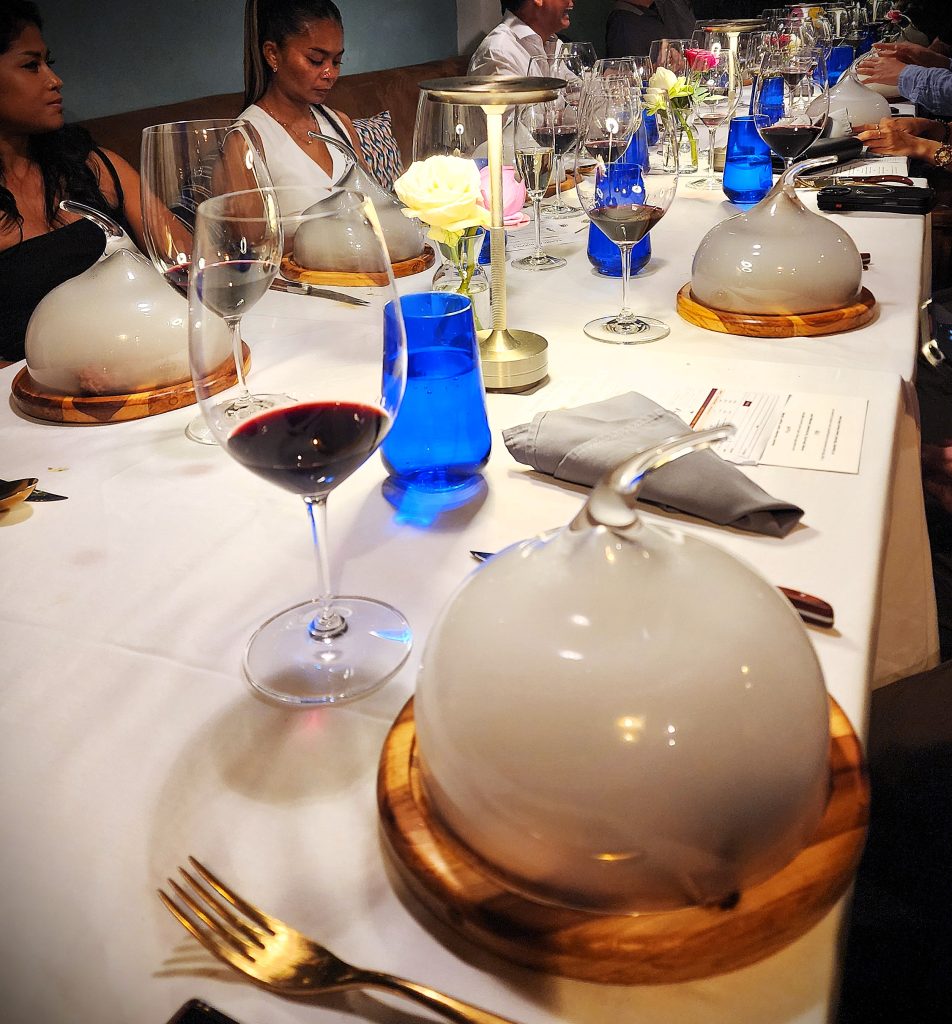
Coal-Smoked MB4 Australian Ribeye
Truffle mash and seasonal vegetables
The summit of the evening, in both senses: its highest-scoring wine, and its most direct plate. The Australian ribeye, graded MB4 for marbling on a scale that runs to 9+, was smoked over coal and seared to a dark, salty crust, with the fat beneath rendered to the point of melting. The truffle mash brought the forest floor, earthy and musky, and the vegetables, crisp and fresh, kept the whole from turning heavy. A steakhouse classic, without a wasted gesture.
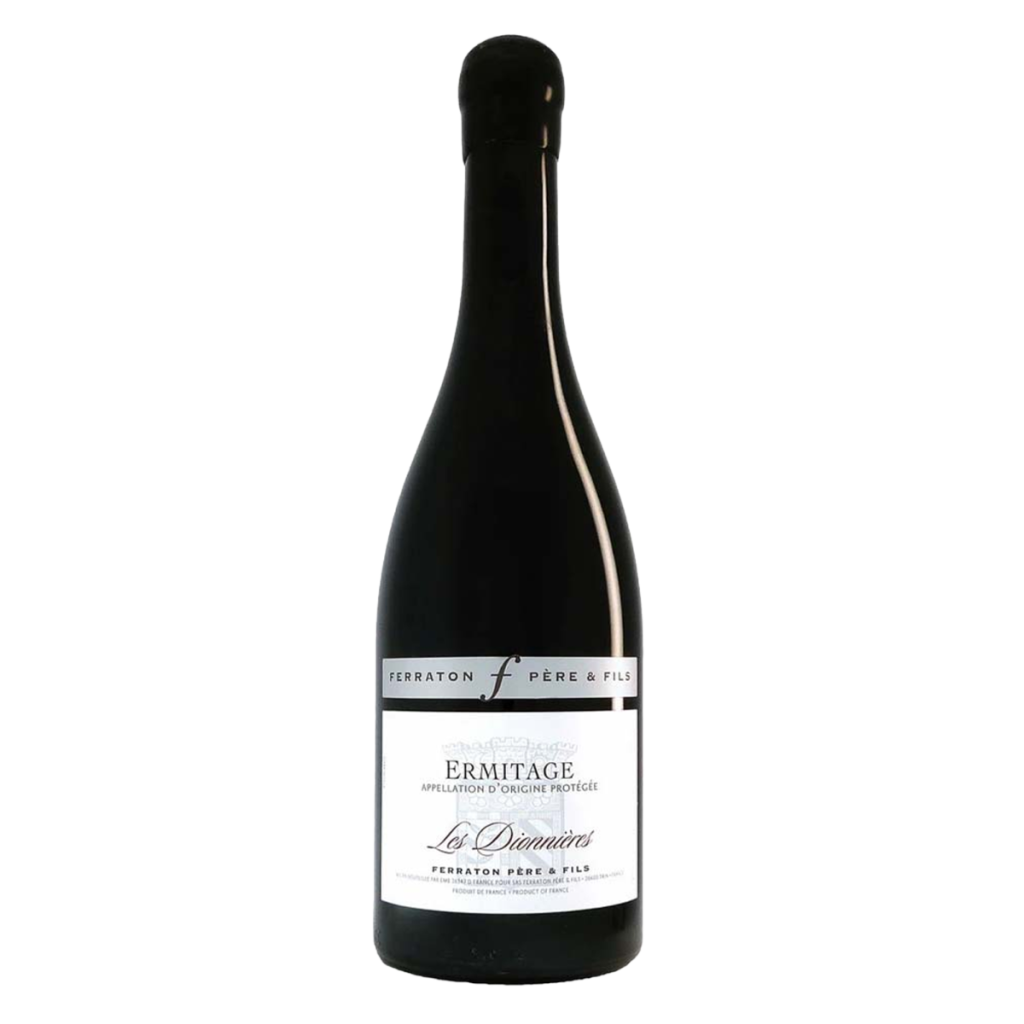
Ferraton Père et Fils, Les Dionnières, Hermitage, Rhône, France, 2020
Jean Orëns Ferraton founded the house at Tain in 1946 with a third of a hectare on the hill. In 1998 the family went into partnership with Michel Chapoutier, and by 2000 all its vineyards were farmed biodynamically. In 2004 Chapoutier took the house over, though it still runs as an independent estate. Like Chapoutier, Ferraton prints the older spelling on its labels: Ermitage. In French, a hermit is still an ermite.
Les Dionnières lies towards the eastern end of the hill, where the steep granite above Tain gives way to gentler slopes. The soils are clay and limestone, with rounded pebbles at the surface, and the vines face south. The wine is 100% Syrah from 30-year-old vines grafted in place, destemmed and macerated for about four weeks in concrete vats, then aged for 18 months in oak, 30% of it new.
2020 was a hot, dry vintage, the opposite of the frost-bitten, cool 2021 that gave us the Brune et Blonde in Act Two: northern Syrah from two contrary years on one night. Six years on, it was the oldest red of the evening, and it still needed time. Cicero’s grape, bitter at first and sweet as it ripens, might have been written for it.
An exceptional Hermitage. The colour is deep, dark, and opaque in the glass; aromas are of violets, dark plums, black fruits, liquorice, olive tapenade, and a whiff of thyme.
On the palate there is brooding depth and intensity. This is a powerful wine, impenetrable without a good hour in the decanter to coax out the charm amongst the brawn. Black fruits and forest berries are wrapped in pain d’épices and dark chocolate, underpinned by the most elegant of car crashes, complete with smoke, bramble, axle grease and iron filings. Yet the roll cage holds everything together: fine, persistent tannins; vibrant, bracing acidity; and a long aftertaste of ripe berries that lingers and leaves you wanting more.
This is a Hermitage that must be taken out and shared with friends. The wine had everyone at dinner reaching for their seat belts and strapping in. 98/100 DG

The Pairing
Big Syrah and marbled beef is no secret, but the match is rarely this complete. The wine’s tannins took hold of the sear and the fat, and the fat in turn softened them, drawing out the charm the brawn had been hiding. The coal smoke met the smoke and iron in the glass; the truffle met the tapenade and the wine’s darker, earthier side. Between mouthfuls, the vegetables kept the palate fresh. A knight’s hill and an Australian steak, in a dining room in Phnom Penh: the summit of the evening.
The knight laid down his sword and climbed a hill to find God alone. Our next guest looked for God further in still: Meister Eckhart, the German friar who preached that God is found in the ground of the soul, who once prayed to God to rid him of God, and who came to Avignon to defend himself. Five centuries later, Schopenhauer would read him beside the Buddha and decide they were teaching the same thing.
Plates cleared, and the last of the Hermitage in the glass, we were ready for dessert: a cigar, though not the kind you light. Châteauneuf’s flying cigars were coming in to land.
Next, Act Five: Meister Eckhart, the Buddha, and a chocolate cigar.
Darren Gall
