
CHAPTER FOUR
The Poet Who Learned to See
Rainer Maria Rilke
“Perhaps all the dragons in our lives are princesses who are only waiting to see us act, just once, with beauty and courage. Perhaps everything that frightens us is, in its deepest essence, something helpless that wants our love.”
― Rainer Maria Rilke, Letters to a Young Poet
Prague, 1875 — The Damaged Beginning
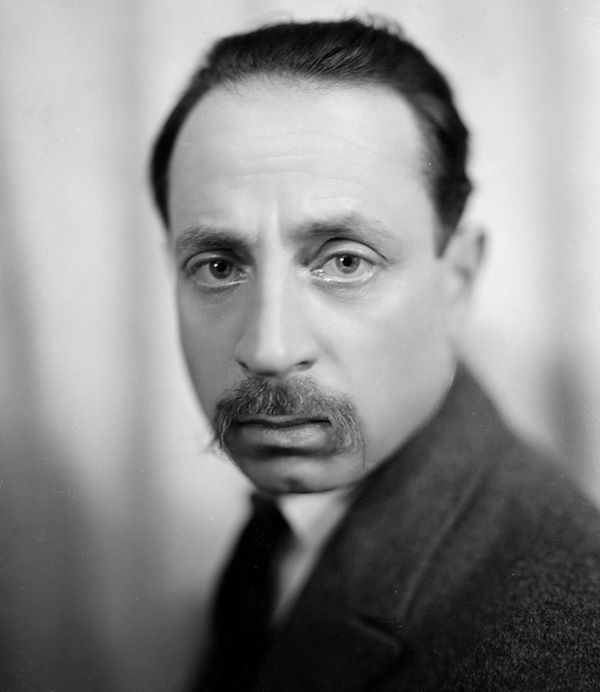
He was born on 4 December 1875 in Prague, then capital of the Kingdom of Bohemia under Austro-Hungarian rule, and his first name was not Rainer but René — a name chosen by a mother who had wanted a daughter. Sophie Rilke, known as Phia, had lost an infant girl before René was born, and the grief of that loss shaped her relationship with her surviving child in ways that would mark him for the rest of his life. She dressed him in fine clothes and treated him, as he later recalled, like a big doll. She called him René — a name holding within it a certain ambiguity, neither firmly one thing nor the other — and sometimes Sophie, the name of the daughter she had lost. They played with dolls together. They combed the dolls’ hair. His father watched with deepening unease.
Josef Rilke was a railway official, a man of modest means and frustrated ambitions — he had wanted a military career and failed to achieve it — who saw in his son a chance for the respectability that had eluded him. When René was old enough, Josef enrolled him in a military academy at Sankt Pölten. He was eleven years old. He would describe those years, for the rest of his life, as a primer of horror. The other boys found in him everything they had been trained to despise: sensitivity, inwardness, and an inability to perform the hardness the institution demanded. They punished him for it with the casual brutality boys reserve for anyone who reminds them of their own vulnerabilities. Rilke endured five years of this sustained damage — the kind that leaves its marks not on the body but deeper, in the place where the adult self is formed.
He left in 1891 because of poor health — his body doing what his will could not, extracting him from an environment that was destroying him — and spent several more years in various educational institutions before completing his gymnasium examinations in Prague in 1895. By then, he had already published a volume of poetry. He was nineteen years old, and the only life he could imagine was the literary one. His father had hoped for a military career. His mother had her own version of who he was supposed to be. Neither version was René Maria Rilke.
In 1896 he left Prague for Munich. The life of restless, deliberate self-reinvention began.
Lou and Russia — The First Transformation
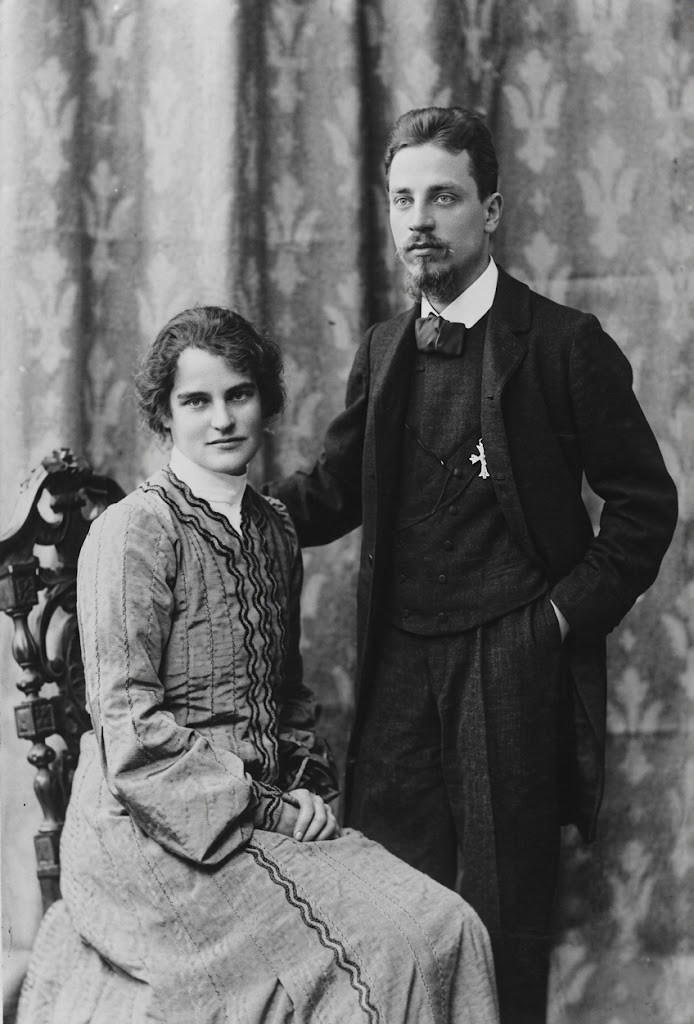
In May 1897, in Munich, he met Lou Andreas-Salomé. She was thirty-six years old to his twenty-one, Russian-born, the daughter of a St Petersburg general, a woman of formidable intellectual independence who had already, famously, declined a marriage proposal from Nietzsche and was later intimate with Freud. She was married when Rilke met her — in a union she appears, by most accounts, never to have consummated, preferring to take lovers while protecting the intellectual freedom that formal domestic life threatened. She became his lover. She became, more importantly, his first real teacher.
She told him to change his name. René, she felt, was too soft, too ambiguous in its resonance. She gave him Rainer instead — harder, more decisively German, more masculine in its sound. He accepted this without apparent resistance. A man who had been named for a dead sister, dressed as a girl, treated as a substitute, was perhaps not surprised to find that even his name required reconstruction. He became Rainer Maria Rilke — Rainer for the world outside, Maria retained in the middle as a private persistence of whatever he had been before.
Lou took him to Russia. Twice — in 1899 and again in 1900. The journeys proved transformative in ways the Munich literary world could not have produced. Russia for Rilke was an encounter with a vastness that matched something he felt inside himself: the Orthodox spirituality, the sense of a culture still rooted in elemental relationship with the earth and with death, the landscape’s enormous indifference. He met Tolstoy on the first journey. He immersed himself in the Russian language with the urgency of a man who feels he has found, in a foreign tongue, something closer to his actual native country. He would say later that Russia had been one of his two true homes — the other being Paris.
From the Russian journeys came the first major work: Das Stunden-Buch — The Book of Hours — a three-part cycle written between 1899 and 1903, in which a young monk circles God with prayers. The God here is not the divine sovereign of orthodox Christianity but the numinous quality buried in ordinary things, in the specific texture of lived experience. The voice found in these poems was genuinely new: musical, devotional, possessed of a rhythmic power that German poetry had not heard in quite that form. A poet of real stature had found his voice, and sensed it.
But Lou was already moving away. Their affair ended — she maintained, throughout her life, a careful management of distance from anyone who threatened to become too necessary. Rilke was left with what she had given him and the absence of the person who had given it. He continued to write to her for the rest of his life. She remained the person he could tell anything to, whose judgment he trusted above all others. He loved her, at the distance she required, until he died.
“I want to be with those who know secret things, or else alone.”
― Rainer Maria Rilke
Clara and the Decision That Was Not a Life
In 1900, after the second Russian journey, Rilke joined the artists’ colony at Worpswede, near Bremen — painters and sculptors working in the flat, atmospheric landscape of the North German moors. It was there he met Clara Westhoff, a sculptor from Bremen who had studied with Auguste Rodin in Paris. They married in April 1901. Their daughter Ruth was born in December of the same year.
The marriage was, from the beginning, an arrangement that suited neither of them for ordinary domestic life. Both were artists. Both required solitude. They separated by mutual agreement shortly after Ruth’s birth — Clara to pursue her sculptural career, Rilke to Paris. Ruth was sent to her maternal grandparents to be raised. He never lived with Clara again, never divorced her, wrote to her throughout their lives with a warmth and respect that genuine affection, differently expressed, can sometimes produce.
Ruth grew up without her father in any sustained sense. Rilke’s letters to his daughter, where they exist, are courteous and somewhat formal — the letters of a man who understood parenthood as an obligation he could not reconcile with the interior life that required everything he had. The biographical record here is not comfortable, and it would be dishonest to make it so. He was not the only artist of his century to make this choice. He made it, and its cost was borne by his daughter.
He went to Paris because Clara’s connection to Rodin had made a commission possible: a German publisher wanted a monograph on the sculptor, and Rilke was the natural choice. He arrived in the summer of 1902 with imperfect French, almost no money, and the specific hunger of a young artist who understands that the person he is going to meet may have something essential to teach him.
“Be happy about your growth, in which of course you can’t take anyone with you, and be gentle with those who stay behind.”
― Rainer Maria Rilke, Letters to a Young Poet
Paris and the Master — What Rodin Taught
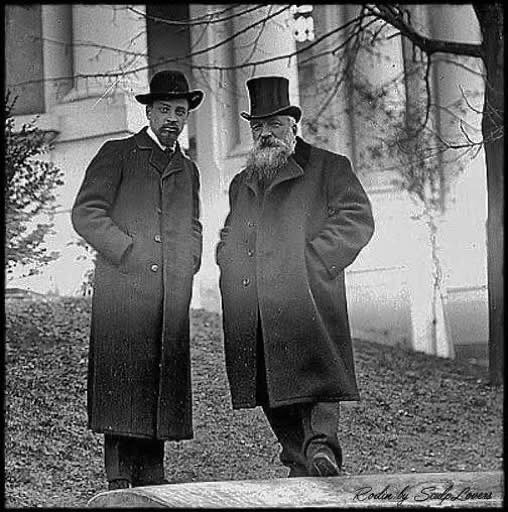
He was twenty-six when he first stood in Rodin’s studio at Meudon. The sculptor was sixty-two. What Rilke found there exceeded his expectations and unsettled him — which tends to be the quality of encounters that actually change you. The studio was a place of relentless work: dozens of figures in various states of completion, plaster casts stacked against the walls, the smell of wet clay and bronze, assistants moving between tasks with focused efficiency. At the centre of it the old man himself, working with a concentration that seemed to leave no room for anything outside the immediate problem of the clay surface in front of him.
This was not the image of artistic creation that Rilke had been raised on. There was no waiting for inspiration, no cultivation of the sensitive conditions under which the work might arrive. There was a craftsman at a bench, and the bench was the whole world. The lesson Rilke took from watching Rodin work can be stated simply — il faut travailler, toujours travailler, one must work, always work — though the simplicity conceals the difficulty. For a poet who had been waiting for lightning, the prescription amounted to a fundamental reorientation of what making art was.
Rodin also taught him a principle that Rilke would later call Einsehen — in-seeing. Not the imposition of the poet’s feelings onto a subject, but a quality of attention so patient and so selfless that the subject begins to yield its own inner truth. Rodin would say that he did not mould human forms but human gestures — that the goal was not to reproduce the body but to capture the specific charge of a body at a particular moment of feeling, the expression distributed not only in the face but in every muscle and surface. What emerges from the Rodin encounter in Rilke’s own writing is a shift from inward expression toward outward reception: less of the poet imposing his feeling on the world, more of the world’s feeling received into the poet with full and undefended attention.
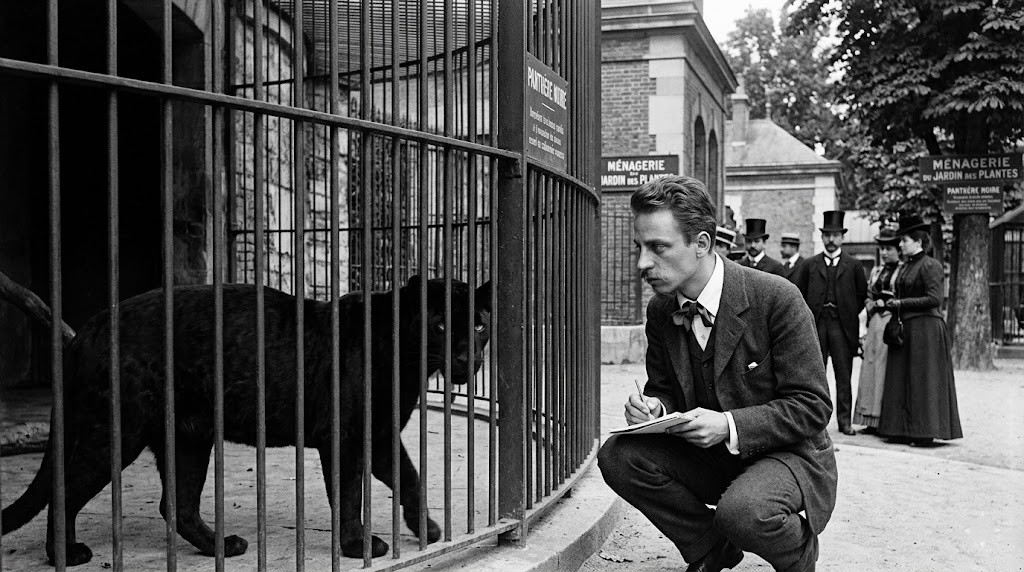
Rodin gave him a specific assignment that produced one of the century’s great poems. Rilke was struggling with a creative block — the transition from The Book of Hours to something harder and more objective had stalled. Rodin told him to go to the Jardin des Plantes and look at the animals. Not to feel something about them. Not to bring his own emotion to the encounter. To look, with full undefended attention, until he truly saw.
Rilke went. He spent hours in front of a caged panther — a large male, pacing in the repetitive circuit that captive big cats trace in small enclosures. He watched with the attention Rodin had demanded. What he seems to have found, looking that carefully and that long, was not what a poet looking for material usually finds. He saw the pacing as a system of imprisonment that had, over time, ceased to be experienced as imprisonment — had become, through sheer repetition, the animal’s entire world. He saw the particular quality of suffering that comes not from acute pain but from the slow extinction of possibility.
The result was Der Panther — The Panther — often considered among the most formally perfect poems in the German language. Twenty-four lines that hold the entire experience of captivity without sentimentalising the animal or using it as a vehicle for the poet’s own feelings. The poem does not look at the panther through the lens of what the poet brings to it. It looks at the panther. In German, the poem opens:
Sein Blick ist vom Vorübergehn der Stäbe so müd geworden, daß er nichts mehr hält.
His gaze has been so worn by the passing of the bars that it can hold nothing more. It seems to him there are a thousand bars and behind the thousand bars no world.
The economy belongs to Rodin. Each word placed with the same precision as clay pressed by a thumb that knows exactly how much pressure the surface requires. Rilke had learned to look, and then to say what he saw, with nothing left over.
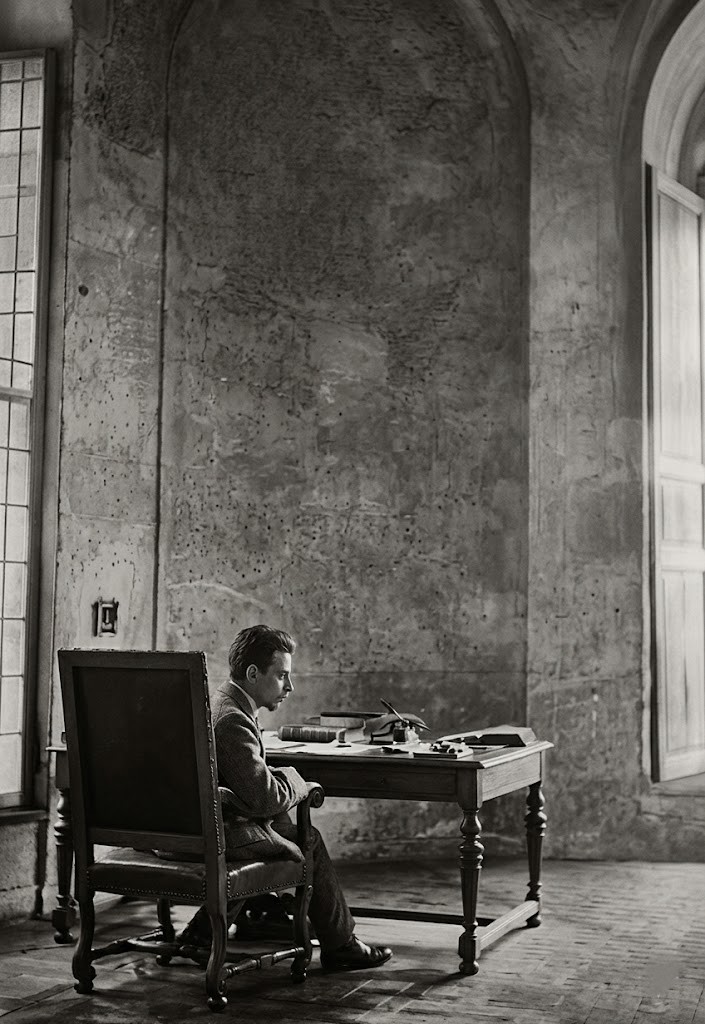
“We lead our lives so poorly because we arrive in the present always unprepared, incapable, and too distracted for everything.”
― Rainer Maria Rilke, Letters on Life
The Secretary — Living at Meudon
In September 1905, Rodin invited Rilke back to Meudon as his personal secretary. The role was ostensibly modest — managing correspondence with German-speaking admirers, maintaining files, acting as an interpreter of the sculptor’s work for the German and Austrian press. In practice, it was considerably more demanding. Rilke’s French, though improving, was not yet the instrument of precision that professional correspondence required, and the effort of drafting letters in an imperfectly mastered language consumed far more than the agreed two hours per day.
He lived at Meudon full-time, in the domestic atmosphere of the estate — its household staff, its stream of visitors, the organised chaos of a famous man’s home in which the famous man himself was present only in the concentrated, intermittent way that absolute commitment to work permits. The studio was the real centre of gravity. Everything else organised itself around it. Rilke was positioned somewhere between the studio and the household, belonging entirely to neither.
The evenings, when Rodin permitted himself to stop working, were what Rilke had come for. Instead of saying good night, Rodin would tell him bon courage — show courage — the parting words of two men who understood that the creative act requires a specific form of bravery. He told Rilke that work and patience — travail et patience — were the only answers to artistic blockage, financial anxiety, doubt about whether the work was worth making. Rilke relayed these formulations to Clara in letters that have the particular energy of a man who has found, in someone else’s certainty, a confirmation of convictions he had held less firmly in himself.
In a letter to Rodin written in 1902, before the secretaryship, Rilke had already articulated what the relationship meant to him: “It was not only to do a study that I came to be with you. It was to ask you: how must one live? And you replied: by working.” The answer dismantled the romantic framework Rilke had grown up inside — the poet waiting for inspiration, protecting his sensitivity from the world’s roughness. In its place was something older and less flattering: the craftsman at the bench, the daily obligation, the work that continues whether the lightning comes or not.
The secretaryship ended abruptly in April 1906. Rodin — who could be imperious, suspicious, prone to rages that those who depended on him had no reliable means of anticipating — fired Rilke in a fit of anger over a letter Rilke had sent without explicit permission. The dismissal was immediate and total. Rodin’s trust, once withdrawn, did not diminish incrementally. It vanished.
Rilke was devastated. He had found in Rodin something he had never been able to hold onto for long — a figure of authority whose power came from making rather than from demanding, whose certainty was the product of sixty years of daily work rather than of institutional position. The loss felt like the loss of the lesson itself.
It was not. The lesson had already been absorbed.
What Rodin had given him in three years of proximity — the doctrine of patient observation, the insistence on daily labour, the understanding that the poem is a made thing rather than a visited state — had entered his working practice so completely that Rodin’s departure from his life could not remove it. These were, by April 1906, part of how he saw.
They eventually reconciled. In 1908, Rodin visited Rilke at an artists’ commune in Paris. The meeting was cordial. What had happened between them settled into the past where all the things that change you irrevocably eventually settle — present in everything that follows but no longer requiring to be spoken of directly.
There is a small irony attached to this reconciliation. It was Rilke who suggested to Rodin that he might want to take rooms in the Hôtel Biron — a beautiful eighteenth-century mansion in the seventh arrondissement, subdivided and available at modest rents to artists and writers. Rodin took the rooms. He loved the garden. He eventually occupied the entire building and bequeathed it, with his work, to the French state. It is now the Musée Rodin. The building that houses the definitive collection of the sculptor’s work was brought to his attention by the secretary he had dismissed in a rage.
“The work of the eyes is done. Go now and do the heart-work on the images imprisoned within you.”
― Rainer Maria Rilke
The New Poems — A Revolution in German Poetry
The Neue Gedichte — New Poems — appeared in two volumes in 1907 and 1908, and they represented something genuinely new in German poetry. The departure from The Book of Hours was fundamental: from musical, devotional inwardness toward a harder, more objective mode of attention. The Dinggedichte — the thing-poems — were the heart of the collection: poems that attempt to capture the physical essence of an object with the same precision Rodin applied to clay, working the surface of the language until the language holds the truth of the thing.
The distinction is easy to misstate. The ‘thing-poems’ are not emotionally cold. They are what happens when emotion is placed entirely at the service of attention — when the poet’s feeling for a subject is so complete that it ceases to be between the poet and the subject and becomes, instead, a quality of the subject itself, transmitted to the reader through the precision of the seeing. Rodin had shown Rilke that a surface holds everything. The thing-poems can be read as language doing what Rodin’s surfaces do — holding everything, letting the observer discover it through sustained looking.
The most celebrated of these poems — the one that has crossed most decisively from German into the consciousness of readers in other languages — is Archaischer Torso Apollos: Archaic Torso of Apollo. It is a poem about a headless ancient torso, a fragment, and it works through a reversal: the poem argues, through the quality of its seeing, that the headless torso sees the viewer more completely than the viewer sees it. The poem describes the torso’s surfaces with the concentrated attention of a man who has learned from a sculptor how light lives in stone. Then, without preparation, it ends:
Du mußt dein Leben ändern.
You must change your life.
The command arrives without argument or transition. What precedes it is a description of carved stone. What follows it is silence. The effect — and it can be read as one of the most quietly devastating endings in twentieth-century poetry — depends entirely on the quality of attention the poem has built. The reader comes to the torso expecting to look and discovers they are being looked at. The stone has issued a verdict. The poem is a message from the ancient to the living, demanding a response.
This poem can be traced directly to Rodin’s studio. It was Rodin who insisted that a torso without a head is not incomplete — who demonstrated through sculpture after sculpture that the body’s truth is distributed throughout its entire surface, not concentrated in the face. Rilke received that lesson and turned it into a poem that enacts the lesson on its reader: the thing that seems merely to be observed turns out to be observing back.
“Have patience with everything that remains unsolved in your heart.…live in the question.”
― Rainer Maria Rilke, Letters to a Young Poet
Letters to a Young Poet
Between 1902 and 1908, while he was moving through the Rodin encounter, the secretaryship, and the thing-poems, Rilke conducted a correspondence that would become, after his death, one of the most widely read documents in literary history. Franz Xaver Kappus was a nineteen-year-old cadet at the Theresian Military Academy in Wiener Neustadt — the same kind of institution that had nearly broken Rilke himself a decade earlier. Kappus had learned that Rilke had attended a military school, and wrote to him asking for advice about whether to pursue poetry or the military career his family expected.
Rilke’s reply was the first of ten letters written over six years. He was twenty-seven when he wrote the first — barely older than the young man he was advising, and considerably less certain of his own position in the world than the letters’ authority suggests. What he wrote to Kappus was also, as the best teaching tends to be, a working out of what he himself was learning from Rodin, from Paris, from the demanding business of becoming a serious artist rather than merely a person with the temperament for it.
The letters address solitude — not loneliness but the productive state of being with one’s own experience fully and honestly enough to receive what it has to offer. They address sadness — not as affliction to be managed but as a process through which something new enters the self, arriving before the self can recognise it and leaving only after it has become part of the blood. They address love — not the merging of two people into one but the discipline of remaining oneself while fully present to another, each person the guardian of the other’s solitude.
The most quoted passage in all the correspondence appears in the fourth letter, written in August 1904. In the German Rilke advises Kappus to love the questions themselves — lieben Sie die Fragen — as if they were locked rooms, or books written in a foreign language. Do not seek the answers that cannot yet be lived. Perhaps some distant day, living the questions, you will find that you have lived your way into the answer without noticing.
The letters are not without their complications. He was advising a nineteen-year-old on the deepest matters of the creative and emotional life from a position of authority he had not yet fully earned, while simultaneously failing to maintain the relationships his own letters celebrated. The gap between what he could articulate and how he actually lived is real. But the letters, which were never written for publication, carry the quality of genuine wrestling with genuine difficulty. He was not performing wisdom. He was reaching toward it, in the only way he knew how to work — through the patient construction of sentences truer than the circumstances that produced them.
“Often, a star was waiting for you to notice it. A wave rolled toward you out of the distant path, or as you walked under an open window, a violin yielded itself to your hearing. All this was a mission.”
― Rainer Maria Rilke, the Duino Elegies
Duino — The Voice in the Storm
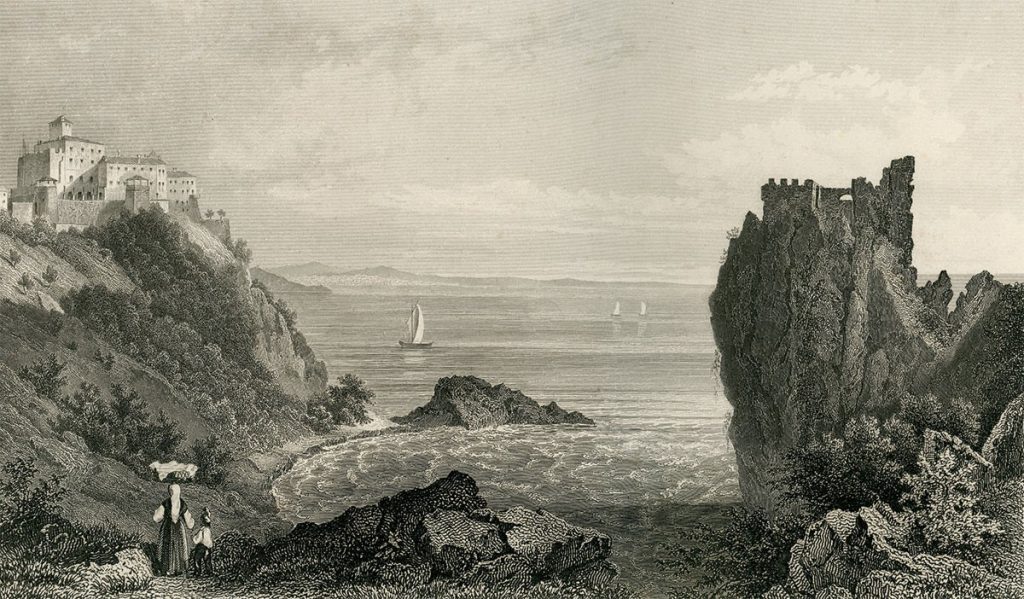
Between October 1911 and May 1912, Rilke stayed at Duino Castle — a medieval fortress perched on limestone cliffs two hundred feet above the Adriatic Sea near Trieste, the property of Princess Marie von Thurn und Taxis-Hohenlohe. The princess was among the most discerning patrons of European literary life in the early twentieth century, and Rilke was one of her most treasured guests — a poet whose work she understood and whose fragility she accommodated with the generous patience of someone who recognised what she was protecting.
He arrived in a state of deep creative depression. The writing block that had descended after The Notebooks of Malte Laurids Brigge — the great semi-autobiographical prose work completed in 1910 — had proved tenacious. He had written little of significance in two years. He feared, in his darker hours, that he might not write it again.
The castle sat above the sea in the way of a place that has always understood its own drama — the cliffs dropping sheer to the water, the Adriatic stretching flat and immense, the cold northern wind called the bora arriving in winter with a violence that shook the limestone walls. It was on a morning in January 1912, with the bora blowing at full force, that Rilke was attending to a piece of tedious correspondence — a financial matter, requiring a careful letter, entirely at odds with the quality of the day and the landscape around him. He set the letter aside and went out along the cliff path.
The wind was enormous. And into it — or from it, or through it, the accounts preserved by Princess Marie do not quite resolve the question — something arrived. A voice, or the sensation of a voice, or the sudden surfacing into consciousness of something that had been forming below it for months. What he heard, or what came, were the words that would become the opening of the ten-poem cycle:
Wer, wenn ich schriee, hörte mich denn aus der Engel Ordnungen?
Who, if I cried out, would hear me among the orders of angels?
He pulled out the small notebook he always carried. He wrote the line down. He returned to his room, finished the tedious business letter with apparent calm, and stayed late into the night completing what became the First Elegy — an opening movement of such philosophical concentration and formal power that it stands as one of the great beginnings in the poetry of the twentieth century.
The angel Rilke addresses is not the comforting figure of Christian tradition. It is, in his conception, a being of such absolute and overwhelming perfection that its beauty would destroy a human who encountered it. The poet cries out, knowing the cry will not be heard and that hearing it would be fatal. The First Elegy can be read as a meditation on radical human loneliness — the loneliness of a consciousness that senses a beauty it cannot reach, and must find ways of living within that distance.
He wrote two complete elegies at Duino and began several others. Then the silence descended again. He left the castle in May 1912 carrying two completed poems and the beginning of a cycle that would take a decade to finish — moving through years of travel, through the war and its aftermath and his military service and the paralysis that followed, like a man who has been given a key to a door he cannot yet find.
“You are also the physician who must watch over yourself. But in the course of every illness, there are many days in which the physician can do nothing but wait.”
― Rainer Maria Rilke
The Long Wait
The decade between Duino and Muzot was the hardest of Rilke’s life. The silence had the quality not of preparation but of blockage — of a faculty that had ceased to operate. He tried. He wrote Das Marien-Leben in 1913, devotional and beautiful, but on a scale that felt to him like a detour from the main work. He completed two more elegies in Munich in 1915 — brief resurgences before the silence closed again.
Then the war came.
He was in Munich when war was declared in August 1914. He could not return to Paris, where his property was confiscated and auctioned. He watched what the world was doing to itself, unable to find the register in which his poetry could address it. The Elegies required a quality of sustained inwardness that the war’s noise made impossible to maintain. He wrote almost nothing of substance for years.
In December 1915, he was called up for military service in Vienna. Influential friends interceded, and by June 1916, he had been transferred to the War Records Office and discharged — the army having concluded, with uncharacteristic wisdom, that a poet of Rilke’s constitution was unlikely to add value to its enterprise. But the experience had returned him to the institutional world that had first damaged him at eleven, and the trauma was real. He had only one productive phase in those years: the autumn of 1915, when he wrote the Fourth Elegy.
After the war ended in 1918, he moved to Switzerland, hoping the distance from Munich’s post-war chaos would restore the conditions for work. He lived in borrowed houses, in the generosity of people who understood what they were housing, a nomad without the creative energy that had made his nomadism purposeful. The Duino Elegies were still unfinished after nine years. He did not know if they would ever be completed.
“But when they spread their wings
They awaken the winds…”
― Rainer Maria Rilke, The Angels
Muzot — The Savage Creative Storm
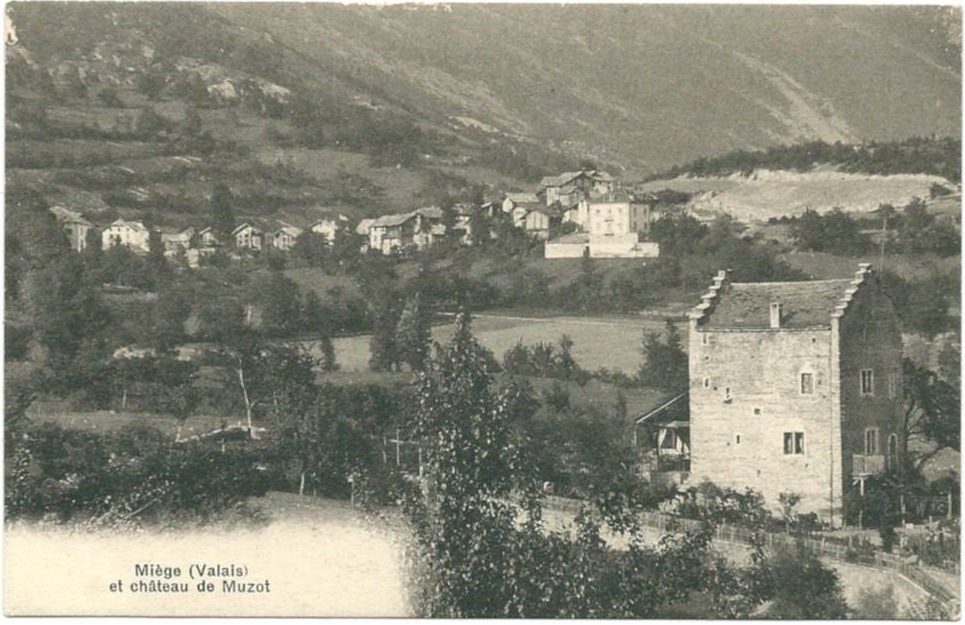
In the summer of 1921, Rilke took up residence at the Château de Muzot — a small medieval tower in the Rhône Valley of Switzerland, near the town of Sierre in Valais. His patron Werner Reinhart had bought and renovated the property so that Rilke could live there at no cost. The tower was modest, old, slightly damp in the manner of old stone buildings in mountain valleys. It had no particular fame. But it had solitude, and the silence that the years since Duino had failed to provide.
He worked through the autumn and winter of 1921 into early 1922, feeling the Elegies present but somehow inaccessible — like a room he could sense beyond a wall but could not enter. Six poems remained to be written or substantially revised. The two completed at Duino needed to be brought into alignment with whatever the cycle had become across a decade.
Then, in February 1922, the door opened.
What happened at Muzot in those weeks is one of the most remarkable events in the history of European poetry. In the space of a few days — in what Rilke himself described as a wilder Sturm, a savage creative storm — he completed the remaining six elegies, revised the earlier ones into their final forms, and simultaneously, almost as an overflow of the same creative energy, wrote the entire fifty-five poems of the Sonnets to Orpheus.
He wrote to his publisher Anton Kippenberg on 9 February, barely able to hold the pen. He had climbed the mountain, he said. At last. The Elegies were here. They existed. He described what had happened as a vast obedience in the spirit — not something he had done but something done through him, a surrender to a force that had been waiting a decade for the conditions of its completion.
To Lou Andreas-Salomé, on 11 February, he wrote the most intimate account of the experience. A hurricane, a boundless storm — everything that was fibre and framework in him cracking and bending under the force of it. And then, when the last poem was written and the cycle complete, he went outside into the cold valley night and stroked the walls of the small tower, as a man strokes a great old animal that has sheltered him through a storm. Du kleines Muzot — little Muzot — that had at last given him back what he had lost.
Three years later, in a letter to his Polish translator Witold Hulewicz, he offered his own account of what the Elegies had been trying to do. Our task, he wrote, is to print this temporary, perishable earth into ourselves so deeply, so painfully and passionately, that its essence can rise again — invisible, inside us. We are, he said, die Bienen des Unsichtbaren: the bees of the invisible. Gathering what the world offers in its visible, perishable forms. Transforming it into something that survives.
“If my devils are to leave me, I am afraid my angels will take flight as well.”
―
The Duino Elegies
The ten elegies completed at Muzot in February 1922 — begun at Duino in January 1912, carried through a decade of war and silence and paralysis — are widely regarded as the summit of Rilke’s achievement, and among the supreme works of poetry in the German language. They are also among the most demanding poems in the canon: not deliberately obscure in the modernist manner, but requiring the same quality of patient attention that Rodin had taught Rilke to bring to a clay surface or a caged panther — the willingness to look and keep looking until the thing yields its meaning.
The cycle opens with the famous cry into the wind — the poet addressing the angelic orders, knowing the cry will not be heard, understanding that to be heard by such beings would be destruction rather than consolation. The angel in Rilke’s cosmology is not a comforting presence. It is a being of such absolute perfection that its encounter with the human would not illuminate but annihilate. The elegies can be read, in part, as a sustained meditation on the distance between what we are and what we sense ourselves capable of becoming — and on how to live inside that distance without either collapsing it into false comfort or being destroyed by its clarity.
The Ninth Elegy makes the cycle’s central argument most directly. It asks why — when we might have been anything else in the universe — we are specifically this: human, conscious, mortal, capable of language. And it answers: because the earth needs us. Because only through us can the things of the world — a tree, a house, a jug, the particular quality of light in a particular season — be seen and named and carried into the dimension of the invisible where they persist beyond their own destruction. We are here to praise. We are here to bear witness to the existence of things before they vanish. To carry the earth into language and give it a second life.
What emerges from tracing the line from Rodin’s studio to the New Poems to the Elegies is a single sustained argument about what art is for. Look at the thing. Look at it with patience and love that does not distort. Then say what you saw, as precisely as language permits. This is why Rodin pressed his thumb into the clay. This is why Rilke spent hours in front of a panther. This is why the Elegies took ten years and were worth the waiting.
“Amid these fading and decaying things, be the glass that rings out as it’s breaking.”
― Rainer Maria Rilke, Sonnets to Orpheus
The Sonnets to Orpheus and the Last Years
The fifty-five Sonnets to Orpheus, written in the same weeks as the completion of the Elegies, arrived uninvited — an overflow of the creative storm that had completed the primary cycle. Rilke had not planned them. They came of themselves, in the frantic days between 2 and 5 February 1922, before he returned to the Elegies that had been waiting a decade.
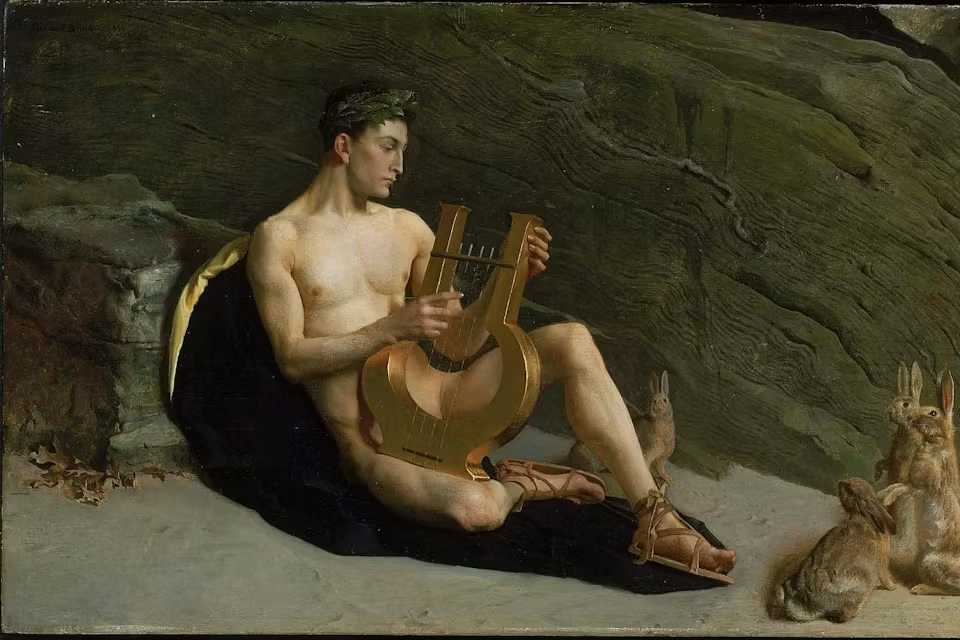
Their subject is Orpheus — the Greek poet-musician who descended into the underworld to retrieve his dead wife Eurydice, failed, and was torn apart by maenads for his subsequent refusal to love any mortal woman. In Rilke’s interpretation, Orpheus becomes the poet as transformer: the figure who moves between the worlds of the living and the dead, the visible and the invisible, and whose singing is the act of transformation itself. The sonnets are a celebration of this movement — the song that continues even in the face of loss, even in the knowledge that what is loved will be lost.
Their inspiration was the death, in 1919, of Wera Knoop — a young dancer, the daughter of friends, who had died of a blood disorder at nineteen. The image of a girl who had given her body entirely to movement and expression, and then died young, became the figure through which the sonnets could be written. Wera governs them as a presence felt throughout, even when she is not named.
After the February storm at Muzot, Rilke’s health declined steadily. The cause — a rare form of leukemia — was not diagnosed until weeks before his death. He spent long periods at a sanatorium near Montreux. He made a last visit to Paris in 1925, received by old friends with the warmth due a poet who had become, quietly and without fanfare, one of the most important figures in European literature. He found it exhausting.
He died on 29 December 1926, at the Valmont Sanatorium above Lake Geneva. He was fifty-one years old. The manner of his death has its own legend: a rose thorn, a small wound, an infection his compromised immune system could not manage. The medical facts are more prosaic — the leukemia was already fatal — but the legend persists because it has the quality of a closing line. A man who had spent his life finding the spiritual truth of the physical world dying from a wound inflicted by the most symbolically loaded flower in the Western tradition.
He had written his own epitaph years before:
Rose, oh reiner Widerspruch, Lust, Niemandes Schlaf zu sein unter soviel Lidern.
Rose, oh pure contradiction, delight of being no one’s sleep beneath so many lids.
The epitaph is itself a last poem — compressed, paradoxical, yielding its meaning only to the patient attention it demands. He is buried in the churchyard at Raron, in the Rhône Valley, not far from Muzot.
“The only sadnesses that are dangerous and unhealthy are the ones that we carry around in public in order to drown them out with the noise…”
― Rainer Maria Rilke, Letters to a Young Poet
The Legacy — What Rilke Gave
Since his death, Rilke’s reputation has followed a remarkable arc. Among non-English-language poets, he is among the most widely read in the United States — read not only by poets but by anyone in a difficult passage of life, by people in grief, in uncertainty, in the condition of carrying questions that have no available answers. Letters to a Young Poet has never gone out of print. The Duino Elegies are read by philosophers, theologians, and psychologists as well as by poets. The thing-poems have shaped a century of writers in ways that are not always traceable to their source.
What he gave to literature is easier to state than to fully measure. He changed what a lyric poem was permitted to do. Before Rilke, the German lyric was largely an instrument of feeling — the poet’s inner world given outward form. After Rilke, it was also an instrument of seeing — the outer world received into consciousness with such precision that the act of looking itself became a form of transformation. The emotion was not absent from the thing-poems. It was fully present, but in service to the thing rather than displaying itself.
He arrived in Paris in 1902, a young poet with imperfect French and the hunger of a man who knows he has not yet found what he is looking for. He found it in Rodin’s studio — not the specific answer to any specific question, but the method. The daily labour. The discipline of sustained looking brought to the surface of a thing. The understanding that the work does not wait for the artist. The artist works, and the work arrives in the working.
He carried that method through everything that followed. Through the thing-poems and the letters and the Elegies and the Sonnets. Through the decade of silence and the savage creative storm at Muzot. Through the rose thorn and the small wound that would not heal.
Il faut travailler, toujours travailler.
He did.
— — —
Rilke died in December 1926, three years after the Duino Elegies were published and the world began to understand what he had made. Rodin had died nine years before him, in November 1917, the Gates of Hell still unfinished on his worktable. The conversation between them — between the sculptor who taught the poet to see and the poet who gave the sculptor’s lesson its fullest literary expression — lasted, in its direct form, only a few years. But what passed between them in those years moved outward through Rilke’s work into everything that came after: into the poetry of a century, into the philosophy of attention, into the understanding of what it means to look at the world long enough and carefully enough to find, in its ordinary surfaces, the extraordinary thing that was always there.
In the next chapter, we turn to another young man who came to Rodin’s studio from another country and another tradition, who received a different lesson and carried it into a different kind of work. Kahlil Gibran arrived in Paris from Boston in 1908, carrying drawings and an ambition that had not yet found its form. What he found in Rodin — and what Rodin found in him — would lead, eventually, to the most widely read book of spiritual poetry of the twentieth century.
Darren Gall
