Domaine Robert Groffier Père & Fils
Darren Gall · Vindochine
There is a small Burgundian irony in Morey-Saint-Denis. The Groffier cellars sit in the middle of the village, next door to Clos de Tart, yet the family owns almost no Morey vineyard: some Bourgogne Passetoutgrains and a sliver of village land that disappears into the same humble blend. The wines that made the Domaine are grown in Chambolle-Musigny and Gevrey-Chambertin.
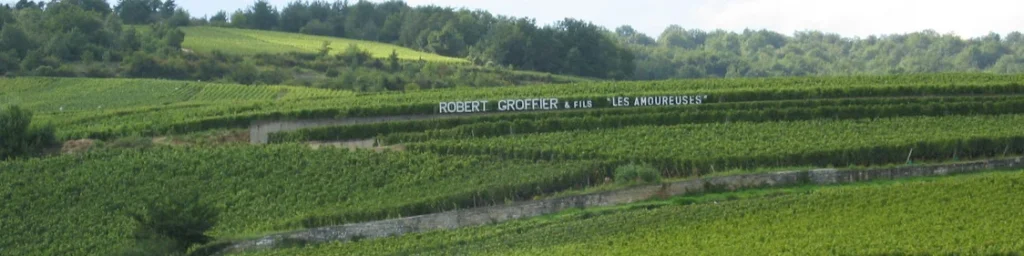
It may be why Groffier is revered by those who know it and passed over by many who should. It is not a domaine that announces itself. It is, however, the largest single owner of Les Amoureuses, and that is announcement enough.
Five names, one label
The story begins with Frédéric Groffier, who planted vines in Morey in the nineteenth century. His son Jules, a professional cyclist in his youth, left the road for the vineyard and, across the middle of the twentieth century, assembled the Chambolle and Gevrey parcels that define the estate today.
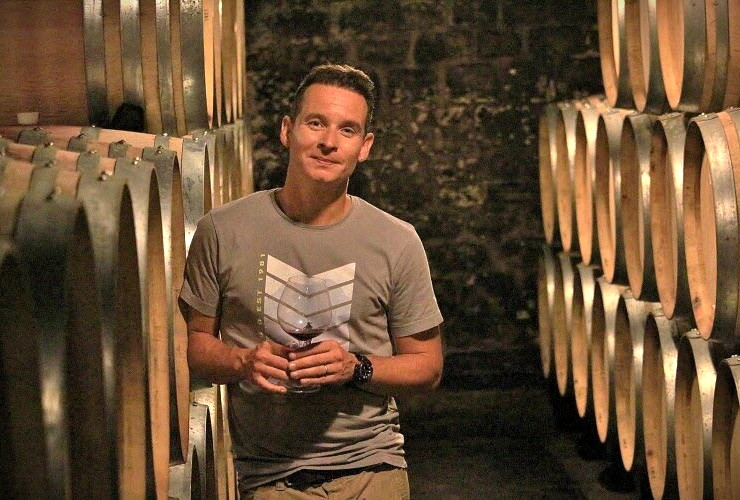
Robert, his son, took charge in the 1950s and made the decisive move: he bottled the wine at the domaine rather than selling it on. That is what turned a good grower into a name abroad. Robert’s son Serge ran the cellar from 1980 to 2005. Serge’s son Nicolas has run it since, with his wife Céline.
The label still carries Robert’s name. Nicolas and Céline’s daughters, Marie and Léa, have already given theirs to one of the wines.
Chambolle, parcel by parcel
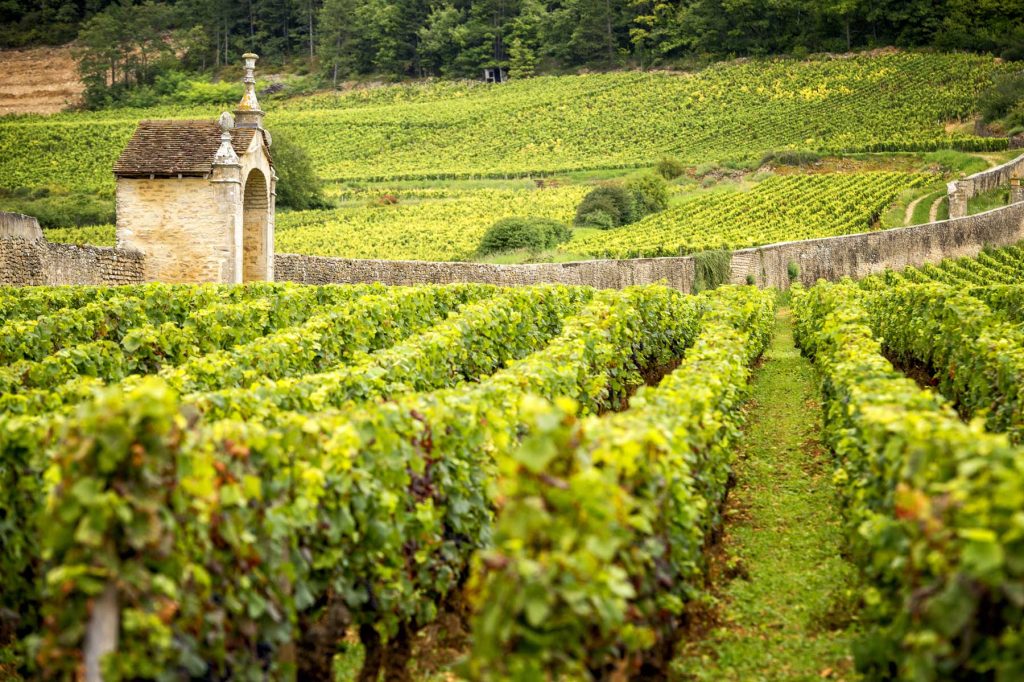
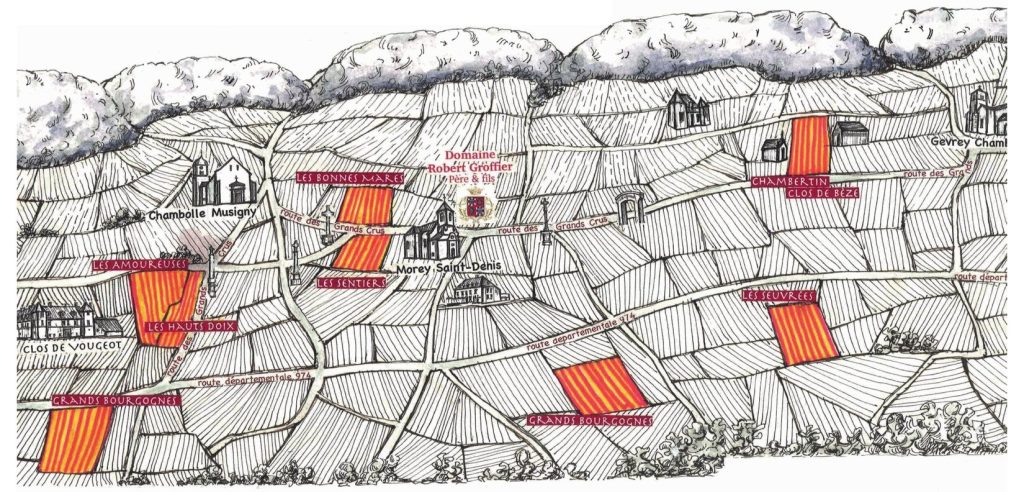
Eight hectares, all Pinot Noir. The core is three Chambolle premiers crus. Les Sentiers sits directly below Bonnes-Mares, on clay, iron, and sand. Les Hauts-Doix lies alongside Les Amoureuses, on deeper sandy soil, its vines around eighty years old.
Then Les Amoureuses itself: 5.40 hectares beneath Le Musigny, a Premier Cru whose reputation rivals that of many Grand Crus. Groffier owns a little over a hectare, more than anyone else. Since 2022 Nicolas has vinified it in two lots, following the soil: La Grâce des Argiles from the clay on the Vougeot side, La Délicatesse des Sables from the sand and gravel towards Musigny. It is a very Burgundian decision. A climat famous under one name is divided because the ground beneath it is not one thing.
The grands crus follow the same logic. Just under a hectare of Bonnes-Mares spans the pale terres blanches, marl set with fossil oysters, and the heavier terres rouges below; a single barrel of the former is bottled as Les Terres Blanches. In Gevrey, 0.42 hectares of Chambertin-Clos de Bèze carry vines more than a century old, the upper rows now bottled as Chambertin. A village Gevrey from the sandy lieu-dit Les Seuvrées completes the range.
In the cellar
Fruit is picked by hand, sorted twice, and held cold for four or five days before native yeasts begin the ferment. Maceration runs 17 to 20 days.
Stems are the family argument. Robert worked with whole bunches. Serge largely destemmed. Nicolas has brought them back selectively, around 20 per cent in a typical year and one hundred per cent for the Clos de Bèze. Soil decides as much as vintage. “The more clay we have,” he has said, “the more whole cluster we use to keep the perfume.”
New oak follows the hierarchy: none for the Bourgogne, 15 to 25 per cent for the premiers crus, about half for Bonnes-Mares, up to one hundred per cent for Clos de Bèze. The wines are racked once and bottled without fining or filtration.
Patience as policy
The domaine’s own line is concentration through the grapes, not in the cellar. That means old vines, Cordon de Royat pruning, low yields and no herbicides since 2005. It does not mean certification; the estate has never sought organic or biodynamic status.
The more unusual discipline is commercial. Since the 2014 vintage Groffier has released only half of each vintage on arrival, holding the rest until the domaine judges it ready. That is expensive patience and remarkable commitment.
Under Nicolas, the wines have gained finesse and perfume, with a lighter hand on new wood, achieved without losing the Domaine’s reputation for concentration.
Tasting note
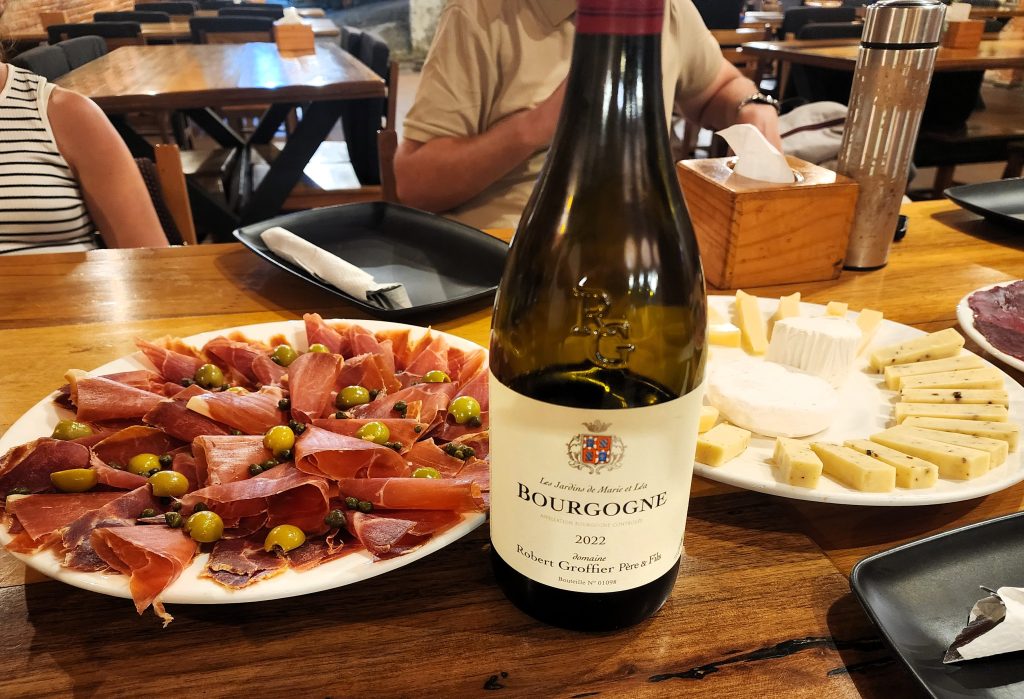
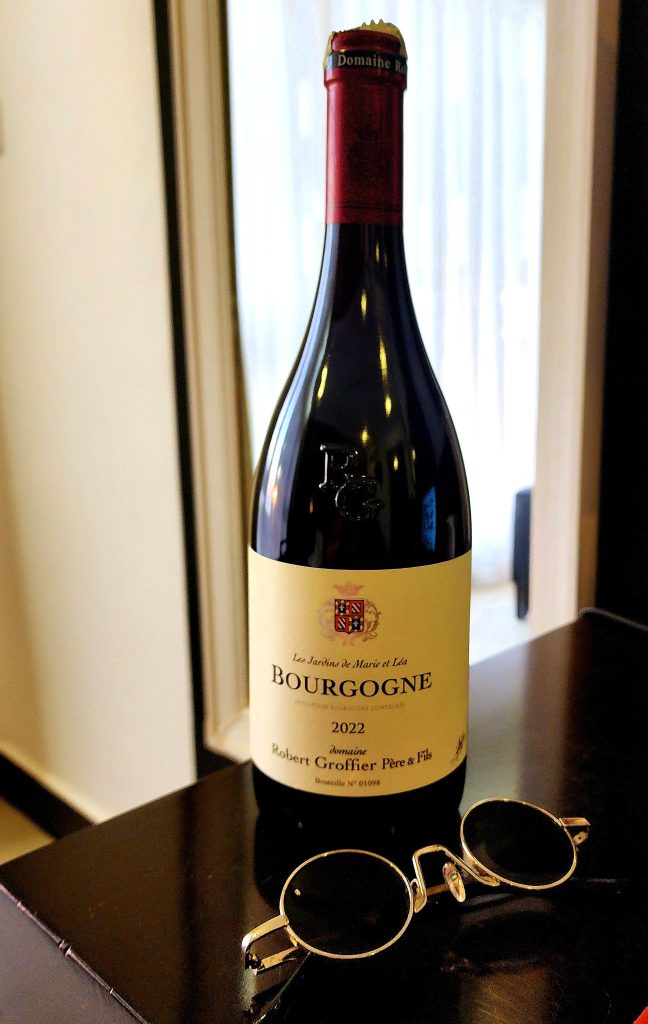
Domaine Robert Groffier Père & Fils Bourgogne Côte d’Or ‘Les Jardins de Marie & Léa’ 2022
The fruit comes from vines just below the Clos de Vougeot, cropped exceptionally low and matured in seasoned, mostly one-year-old barrels.
A glowing ruby, edged with purple.
A good swirl in the glass reveals aromas of cherry-ripe slice, raspberry, a little rose, a thread of liquorice, coffee grinds and a whiff of the forest floor.
The wine is denser than a typical Bourgogne, the weight of a good village wine, and yet it maintains its grace and poise. On the palate ripe, juicy fruit is framed by fine-grained tannins, leading to a perfumed finish that lingers longer than it should have any right to.
An exceptional Bourgogne, with remarkable concentration, wonderful depth of fruit and complexity well beyond its station. It is not cheap, but the wine is unmistakably Groffier, the house style leaving an indelible imprint as its structure builds across the palate.
Give it an hour in a decanter and serve at 14–16°C, with roast duck.
89/100
Darren Gall