
Elsewhere
In Search of Lost Attention
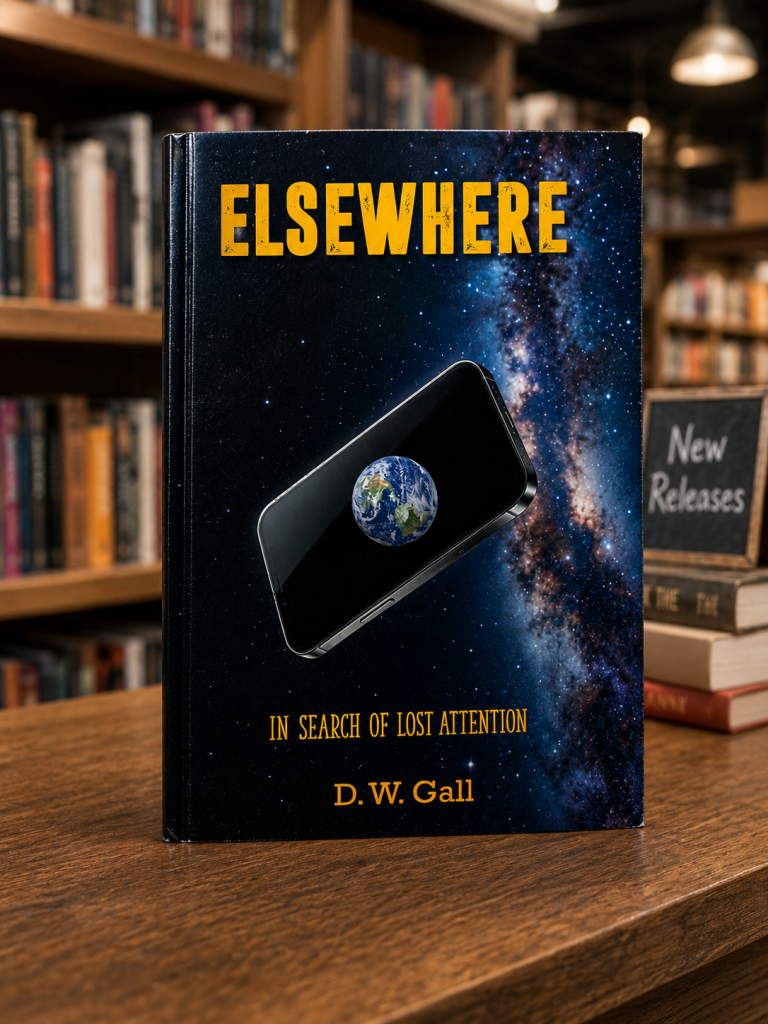
Part One — The View from Out Here
At that moment I seem somehow to understand the extraordinary saying that there shall be no more time.
— Prince Myshkin, in Fyodor Dostoevsky, The Idiot, trans. Constance Garnett
Chapter One: In Search of God
On 12 April 1961, the twenty-seven-year-old Soviet cosmonaut and Air Force test pilot Yuri Gagarin became the first human being to go into space. The flight lasted one hour and forty-eight minutes. It was a turning point in history — and, at the height of the Cold War, a propaganda triumph for the Soviet Union, which had beaten the United States to it.
“I see no god up here.”
Almost at once he began to be quoted saying things he had not said. The most durable of them is that he went up to space and did not find God there. It appears in no transcript of the flight. The line belongs to Nikita Khrushchev, who used it at a Central Committee plenum during an anti-religious campaign — why are you clinging to God? Here Gagarin flew into space and didn’t see God — and it was moved onto Gagarin afterwards for the reason a friend of his gave decades later: the public trusted the cosmonaut and did not trust the premier.
There is one further complication, and it is the reason the story has held up for sixty years.
A cosmonaut did say something remarkably close to it. In 1962, at a World’s Fair press conference in Seattle, United States, Gherman Titov — who had flown the second Soviet manned mission, and who was an atheist by conviction rather than by instruction — told American reporters that he had seen no angels and no God up there.
So the line exists. It was said in a cosmonaut’s own voice, in public, and meant. It simply belonged to a different man, and the state gave it to the one who was much more famous.
⁂
There is a second quotation.
Облетая Землю в корабле-спутнике, я увидел, как прекрасна наша планета. Люди, будем хранить и приумножать эту красоту, а не разрушать её!
Orbiting Earth, I saw how beautiful our planet is. People, let us preserve and increase this beauty, not destroy it.
It survives as handwriting. A facsimile, signed, reproduced in a Soviet chronicle of the cosmonauts published two decades after the flight, and printed in 1975 by the state publishing house as a poster, laid out to reproduce his own handwriting and his signature, distributed across a country whose planners were at that moment draining the Aral Sea to grow cotton.
The Soviets did not hide it. They made a poster out of it. They put it on a wall, in the handwriting of one of their most famous living heroes; and then they went on with the cotton and the canals and the diverted rivers. The Aral was the fourth largest lake on Earth when the poster was printed. It is now, for practical purposes, a desert with a few pools in it.
The message, profound as it was, did not serve the motivations of his masters.
It was not that this was a message they did not care to hear; they simply had no use for it.
Chapter Two: The First Earthrise
All human suffering concerns every other human being.
— Václav Havel, New Year’s Address to the Nation, 1 January 1990
The photograph that changed how the human race understood itself was taken almost by accident, in a hurry, by a man whose commander had just reminded him that it was not on the schedule.
It was Christmas Eve, 1968. The three astronauts of Apollo 8 — Frank Borman, the commander; James Lovell, the navigator; and William Anders, the lunar module pilot, though the lunar module was not yet ready to fly and, on this mission, he was, more honestly, the photographer — were on their fourth orbit of the Moon. They were on the far side, where no human being had ever been, and where the radio could not reach them. They had gone behind it for the first time the previous evening, and that first pass is worth a moment.
The whole mission turned on it. To enter lunar orbit the engine had to fire for four minutes while they were out of contact — and it had to fire exactly. Too little and they would come round the far side and continue home, having flown a quarter of a million miles to look at the Moon through a window. Too much and they would not come round at all.
Loss of signal at sixty-eight hours, fifty-eight minutes and forty-five seconds into the flight. Then nothing.
For thirty-three minutes and fifty seconds, three men were behind the Moon with an engine that had either worked or had not, and nobody on Earth could know which. Mission control counted down to the second at which the signal should return, and waited.
It returned on schedule, with Lovell reading out the orbital numbers.
After that they settled into a circular orbit a hundred and eleven kilometres up and went round every two hours. For forty-five minutes of each of those orbits the Moon stood between them and every other living thing in the universe, and they passed through perhaps the deepest silence any human had ever inhabited.
⁂
The year is part of what the image meant.
Nineteen sixty-eight had been a catalogue of catastrophe. The Tet Offensive in January had shaken what remained of American confidence in the war in Vietnam. Martin Luther King had been killed in April, Robert Kennedy in June. The Prague Spring had been ground under Soviet tank treads in August; days later, the Democratic Convention in Chicago had collapsed into police riots. The cities of the United States had burned through the long hot summers of half a decade of unrest by then, and it had shown no sign of stopping.
The year had been, by almost every measure available to those who lived through it, an argument for despair. And then, in its last week, into all that wreckage, came a photograph of the Earth taken from the Moon.
The mission itself had not intended to deliver any such thing. Apollo 8 had been hurriedly redirected from Earth orbit to lunar orbit because the intelligence community suspected the Soviets were preparing a similar flight, and NASA, over the objections of its more cautious voices, had decided to send three men to the Moon in a spacecraft whose lunar module was not yet ready, on a rocket that had flown only twice.
The mission was a wager. Its purpose was geopolitical: to get there first. The photograph was not in the flight plan.
⁂
Then the spacecraft began to rotate.
Borman was turning Apollo 8 to a new position for a series of photographs of the lunar surface. The Moon, until that instant, had filled their windows entirely: grey, cratered, harsh in the unfiltered light.
The crew had been describing it in the language of mortuaries and battlefields. Lovell, on the air, said it looked like plaster of Paris, or a sort of greyish beach sand. Anders, just hours earlier, had described the long view of the lunar surface from orbit as a stark, lonely, foreboding place. Not somewhere one would wish to linger.
And then the windows rotated past the horizon.
What happened next was preserved by the open microphone. Anders saw it first.
“Oh my God!” he said. “Look at that picture over there. Here’s the Earth coming up. Wow, is that pretty!”
Borman, the commander, with the dry humour of a man whose mission profile did not include this item: “Hey, don’t take that, it’s not scheduled.”
Anders, already reaching for the Hasselblad: “You got a colour film, Jim? Hand me that roll of colour, quick, would you —”
He took the picture. Frame 2383 of magazine 14, Apollo 8, taken by William Anders on 24 December 1968, at a distance of approximately 240,000 miles from the subject. It was the first widely reproduced colour photograph of the Earth ever taken by a human being from the vicinity of another world.
⁂
The image is so familiar by now that it requires an act of imagination to see it again with the eyes of someone who had never seen anything like it.
The Earth hangs, suspended, partial — half-lit, half in shadow — against the absolute black of space. In the foreground, the lifeless grey of the lunar surface curves away. The Earth itself is small. Smaller, somehow, than one would expect: a blue and white marble against an infinite dark. The eye searches it for the familiar shapes of continents and finds them only faintly, half-dissolved under the swirling cloud — but the continents are not what one looks at.
What one looks at is the wholeness. The fact that it is one thing.
The photograph would be released to the world a few days later, in the last week of 1968, and reproduced more often, in more languages, in more places, than perhaps any other photograph in the history of photography. The nature photographer Galen Rowell would later call it “the most influential environmental photograph ever taken”.
Life put it on the cover of its year-in-review issue on 10 January 1969 and printed it across two pages beside a poem by James Dickey. It ran in newspapers in cities that had spent the year burning.
The American poet Archibald MacLeish, writing in the New York Times on Christmas Day, found the language before almost anyone else. To see the planet in its true proportion, he argued — small, blue, beautiful, floating in a silence without end — was to be obliged to see ourselves differently: not as populations divided by the lines we had drawn across it, but as “riders on the earth together”, a single company of passengers on one bright thing in the cold.
A photograph taken almost as an afterthought, against the instruction of the mission commander, by a man who had three seconds to ask his crewmate for a colour roll, became — within a week — the visual symbol of a new way of conceiving the human species.
⁂
Later that same Christmas Eve, on their ninth orbit, the astronauts opened a live television broadcast and read from the Book of Genesis.
They took it in turns. Anders read the first four verses — In the beginning God created the heaven and the earth — Lovell the next four, and Borman the last two, closing with a blessing on all of us, all of us on the good Earth. They read to an audience of perhaps a billion people, the largest in the history of broadcasting at that moment, and they read slowly.
The three men were a Catholic, a Presbyterian and an Episcopalian; their audience contained every religion and none.
The passage had been suggested to them before the flight, by a friend of a friend, when the crew found they could think of nothing adequate to say. Lovell would explain the choice decades later: those verses were the foundation of many of the world’s religions, and nothing smaller would do for what the three of them had been looking at.
⁂
When the astronauts came home — when they were debriefed and decorated and asked, again and again, in the years that followed, what it had been like — they began to say something that no one had quite said before, and that they had not quite expected to say themselves.
They had gone to the Moon. But what they had seen, what had changed them, was their view of Earth.
This is the observation that the writer Frank White, almost twenty years later, would name. In a 1987 book, The Overview Effect, he called it exactly that.
He had interviewed astronaut after astronaut — men and women of different temperaments, different politics, different faiths or none. What he heard in their answers was something so consistent that he came to believe it was not a psychological coincidence but the report of a real phenomenon.
They described borders that were not there. They described the thinness of the air. And they reached, almost all of them, for a register of language that nothing in their training had given them.
⁂
The astronauts were not a random sample of the species. They had been chosen, in the first instance, for psychological steadiness and emotional containment — qualities that probably overlap, more than coincidentally, with the kind of person who comes home from the orbital window and reaches for a language of unity rather than a language of indifference.
One cannot fully separate what the experience produced from what the cohort brought to it.
What can be said is that the testimony has been too consistent, across too many temperaments and too many languages, to be reduced to the demographics of the programme. Pilots and scientists and engineers, drawn from competitive militaries and rival superpowers, have come back saying versions of the same thing for almost sixty years.
They are not the same kind of people. The view is what they have in common.
⁂
They had gone up knowing, in the way one knows things one has not seen, that the Earth was one planet and that humanity was one species.
They came back knowing it in a different way. A way they could no longer not know.
The view had not informed them; it had reformed them.
Chapter Three: What Perspective Does
To boldly go where no man has gone before.
— Star Trek, opening narration, 1966–1969
It is one thing to know a fact and another to see it.
The distinction is so commonplace it has become almost invisible. It is also the operation on which the overview effect depends.
Every human being on the planet has known, since at least the time of the Greeks, that the Earth is a sphere. By the third century before Christ, Eratosthenes had measured it, and the figure he arrived at was within a few per cent of the correct circumference. Every child of the post-Copernican world is taught, also, that the Earth is one of several planets, and that what we call the world is one small object among very many, surrounded by an unimaginable quantity of empty space.
This is known. It has been known, in the sense in which a fact can be known, for the greater part of recorded history.
And yet, when the photograph from Apollo 8 reached the front pages of the newspapers across the planet, the response was not yes, of course, this is what we have known all along. The response was a kind of shock — a tonal shock, an inward shock — as if something that had been a fact had suddenly become a truth, and the difference between the two had revealed itself to be enormous.
⁂
Perspective converts knowledge into experience.
It is the operation by which a proposition one has held in the abstract is delivered, all at once, to the senses. To know that the Earth is small in the larger scheme of things is one sort of knowing. To see it as small — suspended in the dark, with one’s own hands cold on the camera — is another kind of knowing entirely.
Which is why the overview effect does not yield to argument. One cannot, by reasoning, persuade somebody to feel what the astronauts felt. You can give them the data, the photographs, the testimony — but the feeling that arises in the orbital window is not produced by data and is not transmitted by photographs. It is produced by the position.
Frank White understood this, and it is what makes his framing of the phenomenon so careful. He did not argue for it. He gathered testimony. The astronauts had not been to a lecture on planetary unity. They had been to a vantage point, and the vantage point did the rest.
⁂
What did they report?
First, and most often, the dissolution of borders.
The lines on the maps they had grown up with were not on the planet. The countries did not have edges. What had edges, from up there, were the things they had been taught to consider features of nature rather than features of civilisation: shorelines, weather systems, the ragged line where vegetation gives way to desert. The cities, where they could be seen at all, were specks.
The borders that had shaped so many of the great conflicts of the twentieth century were not visible. They were not even small. They were absent. They had only ever been lines drawn on maps.
To see, all at once, that the lines around which humanity has organised its enmities for two thousand years are not features of the world is a profoundly destabilising experience. It does not undo the lines — they are still there, in some other sense, when one returns — but it removes from them the priority they had previously enjoyed. They are no longer first. The planet is first. The lines are operations on the planet, conventions, things we drew. They were not there to be discovered.
⁂
Second, the atmosphere.
Almost without exception, the thing that struck them hardest after the borders was the thinness of the layer of air. Seen from orbit at sunset it is a single bright line at the edge of the planet — and only the lowest few miles of it, the troposphere, will support human life.
Everything that has ever happened to anyone who has ever lived has happened inside that line. Every word spoken, every breath drawn, every fire lit. All of it contained within a film of gas so thin that, from a hundred miles up, the eye registers it as an edge rather than a volume.
Michael Collins, the command module pilot of Apollo 11, circled the Moon alone while Armstrong and Aldrin walked on it. He wrote afterwards that what had struck him most was not the grandeur of the Moon but the fragility of the Earth. Fragile was the word that recurred, and he had felt, with surprising sharpness, that one ought to handle it with more care than we had previously thought to.
There is one report in the Artemis testimony that describes the effect happening to the eye rather than to the mind. What kept catching Jeremy Hansen’s attention, he said afterwards, was not the Moon or the Earth but the depth — that when the lighting was right he could see the galaxy had a third dimension, and that the Moon and the Earth sat inside it at different distances rather than on it.
Everybody knows the stars are not equidistant. From the ground, nobody has ever seen it. The night sky is a flat surface with lights on it and no matter how much astronomy you have read, it remains that way.
He was not shown a new fact about distance. He was shown distance.
⁂
Third, and slowest to articulate itself, came the reach for a register nobody had trained them in.
The astronauts of Apollo 8 read from Genesis. Edgar Mitchell, on Apollo 14, described something on the long ride home that he could only put in terms borrowed from Hindu and Buddhist thought — a sense that he and the spacecraft and the stars outside were not separate things but a single continuum, an experience he spent the rest of his life trying to account for. James Irwin, of Apollo 15, came home and gave the remainder of his life to evangelical work, founding a ministry and returning repeatedly to what he had felt on the lunar surface.
Their faiths and traditions varied enormously. What recurred was not a shared belief but a shared insufficiency: the languages they had been given did not reach.
These were not, as a population, mystics. They were test pilots, engineers and military officers — people selected, in part, for their lack of metaphysical excitability. Not the sort of people one expects to come back from a flight talking about consciousness or grace.
And yet they did. They had seen the thing they had seen, the available languages were not equal to it, and so they did what human beings have always done when they encounter something their language cannot hold.
They reached upward.
⁂
Notice what those three have in common.
Borders are not visible from orbit because a border is a relation between two things, and from far enough away the two things are one thing. The atmosphere becomes terrifying only when it is seen as the edge of everything rather than as the sky. And the reach for a higher register happens because the astronauts were seeing a set of relations, all at once, that no available vocabulary was built to hold.
They were not shown new facts. They were shown how the facts stood to one another.
That is what perspective does. It does not add information. It makes the relations between things visible — and once they are visible, the things themselves stop being separate items and become parts of something.
⁂
In October 2021, William Shatner went to space.
He had spent six decades playing a starship captain on a television programme that had done more, perhaps, than any other piece of popular culture to make going to space feel like something the species was owed. He was ninety years old. He flew on a Blue Origin rocket, a brief suborbital hop, above the Kármán line for approximately three minutes and about ten minutes from launch to landing. He had spent the whole of his adult life imagining what he would feel when he finally got there.
What he felt was not what he had imagined.
⁂
The first thing to notice is that he did not know what it was.
There is footage of him on the landing pad in west Texas, minutes after the capsule came down, trying to explain himself to Jeff Bezos while the other passengers spray champagne behind him. He is not celebrating. He is struggling. He says he hopes he never recovers from it. He says that what he has just seen has to do with “the enormity and the quickness and the suddenness of life and death” — which is not a sentence anybody has prepared.
He was weeping, and he could not say why.
It took hours. He has described going off somewhere to sit down and work out what was the matter with him, and finding, when he got there, that the answer was grief. He told CNN afterwards that he had been “grieving for the destruction of the Earth”.
⁂
That delay is the most interesting thing in the whole account.
He had not been given information. He had been given a position — and the position did something to him that his own mind then had to catch up with, hours later, on the ground, in a chair, with the rocket already cooling on the pad behind him.
From his vantage point, he did not see a pale blue dot in a vast black space, what he saw was a curved horizon. By his own description, he noticed two things at once. Out one way, blackness — palpable, absolute, and in his account not empty but dead. Back the other way, the beige and the blue and the white of the planet he had left ten minutes before. He has said he saw death and he saw life, and that the whole distance between them was the thickness of an atmosphere.
He has since described the Earth as a small rock with a skin of air around it, and said that we hang by a thread — and then, in the same breath, that we are dangling together.
He had gone up at the end of a long life of pretending to be among the stars, and come back with the first honest measurement of the distance between the dream and the thing itself.
The measurement turned out to be grief.
Shatner’s response is not an outlier in the testimony. It is its completion.
The astronauts of Apollo 8 reached upward toward Genesis. Mitchell reached toward the East. Irwin reached toward Christ. Shatner, alone among them and yet not alone at all, reached toward mourning.
All of them were responding to a view that fitted nothing their training had prepared them for, and reaching for the nearest register that could hold it. Some of those registers were exalted. One of them was a funeral. The phenomenon is robust enough to produce both, and in both cases the response is a moral one.
That Shatner is the figure who delivers this should not pass unremarked.
The other astronauts arrive in the prose as strangers. Shatner arrives already familiar. The world had spent six decades watching him pretend to be in space, and when he actually went, the pretence collapsed into something neither he nor anybody else had quite expected.
What collapsed with it was the assumption that the view, once delivered, would be a consolation.
It might be. It might also be the beginning of grief.
The two responses turn out to be the same, looked at from different angles, in different temperaments, by people standing at the same window.
⁂
A natural question follows. Does the change last, or does it fade, the way intense experiences fade once a person has returned to an ordinary life?
The honest answer is that it does both, in different ways, in different people.
Some astronauts have spent the remainder of their lives in environmental advocacy, in foundation work, in long quiet careers of giving talks at schools about the planet they once orbited. Others returned to military or commercial careers and did not speak of it much.
But almost none, when pressed, have described the experience as having receded the way other intense experiences recede. The view did not become a memory. It became part of the apparatus by which they went on seeing. They could not, years later, look at a photograph of the Earth without feeling again what they had felt the first time.
They had not retained the view. They had been altered by it, and the alteration was the durable thing.
Shatner, in the years since, has said much the same. The grief did not pass. He has not been able to stop seeing what he saw. The grief became a way of looking.
⁂
We tend to speak of perspective as though it were a position — a place from which one looks, a point of view, an angle.
But the perspective the astronauts describe is not a position. It is something the world does to the person who sees.
To stand at that window is not merely to receive updated content. It is to undergo a reordering of the structures by which any content becomes visible at all. The astronaut does not return with new information. The astronaut returns as a different sort of seeing creature.
The overview effect, where it occurs, is not optional, not optical, and not finally about the Earth at all. It is about what happens to a human being when their attention is forced, by the position they are in, into a frame that exceeds them.
The astronauts of Apollo went up to look at the Moon and came back having looked at themselves. Shatner went up at the end of a long life of imagining what he would feel and came back with feelings he had not imagined.
All of them had been the object of the experience, not its subject.
The view had used them.
Chapter Four: The View from Down Here
Small and powerless, but yet powerful together.
— Jeremy Hansen, Artemis II post-mission news conference, NASA Johnson Space Center,
16 April 2026
There is a detail in the astronaut testimony that is easy to pass over, and it is the one that matters most.
They do not all react the same way. Some weep. Some pray. Some describe a calm so complete it frightened them. Others come back angry, and stay angry, and spend the rest of their working lives on committees and campaigns and documentaries, trying to make a case that will not quite go into words. Shatner came back grieving. Mitchell came back with a conviction he could never persuade the scientific establishment to accept.
The responses look, at first, like different experiences. They are not. They are different temperaments meeting the same recognition.
A man who sees his own house on fire may run straight towards it or fall to his knees. We do not conclude from the difference that one of them has misunderstood the situation. The despair and the desperation are both correct. What produces them is the same fact, arriving whole: that the thing is one thing, that it is the only one, and that nothing outside it is coming to help.
This is worth dwelling on, because it tells us something about the nature of what happens up there. It is not an aesthetic event. Beauty does not work this way. People do not come back from a mountain or a cathedral or a great painting and reorganise their politics around it. They come back moved, and the being-moved fades, and they show the photographs to friends who are politely interested.
What the astronauts describe is not being moved. It is being informed — in the old sense of the word, the sense that means having a form imparted. Something in the arrangement of what they took to be true was altered by looking and did not revert.
They were not remarkable people. That is not a slight; several of them were remarkable, in the ordinary ways that test pilots and physicists and career officers are remarkable. But they were not mystics. They were not selected for spiritual aptitude. Nobody screened them for a capacity to apprehend the unity of being. They were screened, if anything, for the opposite: for steadiness, for the ability to keep working while something is going wrong, for a temperament that does not reach for large meanings under pressure.
They were, in the relevant respect, us.
Which means the capacity was already there. It did not have to be installed. It had simply never been given the conditions in which it could operate.
⁂
Consider what the astronauts were not given.
They were not given an argument. Nobody handed them a treatise on planetary interdependence and asked them to consider it on the way up. They were not given new information: every one of them already knew, in the flat way that educated people know things, that the Earth is a sphere, that it is finite, that its atmosphere is thin, that national borders are conventions rather than features of the terrain. A schoolchild knows this. It is not knowledge that anyone has to travel to acquire.
They were not given a religion, though some of them found one waiting when they got back.
What they were given was a position. Nothing else changed. The facts stayed exactly where they had been. The men were the same men, with the same educations and the same politics and the same marriages waiting for them at the other end. All that altered was where they were standing when they looked.
And that turned out to be sufficient.
The recognition that the Earth is one thing, and that we are one species inside it, does not appear to be an achievement of moral development. It is not the reward of a discipline, and it does not seem to require a particular sort of soul. Again and again, when the whole has been placed in front of an ordinary human being, something in them has turned out to be capable of receiving it.
The simplest explanation is that the capacity was already there.
What is rare — vanishingly, catastrophically rare — is the vantage.
⁂
So let us count.
Seven hundred and eighty-one people have left the atmosphere; the number moves each year and the exact figure changes nothing.
Twenty-eight have travelled far enough to see the Earth whole, as a disc, with the blackness around it. Twenty-four of them went between 1968 and 1972, in a period of forty-eight months, and then nobody went for fifty-three years. The other four came back in April 2026.
The population of the Earth is roughly eight billion.
Seven hundred and eighty-one into eight billion is one in ten million. Twenty-four into eight billion does not want expressing as a ratio. It wants expressing as a fact: that the experience which reorganises a person’s understanding of the planet has been available, in its complete form, to fewer people than can sit in a suburban cinema.
It is tempting to treat this as a bottleneck. A queue. A problem of supply that time and engineering will eventually solve.
It is not.
Suppose commercial spaceflight succeeds beyond anything currently projected. Suppose a thousand people a year reach orbit — fifty times the present rate, sustained for a century. That is a hundred thousand people. It is one in eighty thousand of a single generation, and they will be, without exception, people who could afford the ticket.
The door does not open wider. It was never a door. It is a wall with a window in it, and the window is the size it is.
Anyone who proposes that the human species will come to see itself whole by going and looking is proposing something arithmetically impossible. Not difficult. Impossible.
⁂
If the capacity is already there, and the vantage is unreachable, then whether our species is able to see itself whole depends entirely on one thing: whether the vantage can be delivered by other means.
Not travelled to. Delivered.
And the moment the question is put that way, it stops being a question about spaceflight and becomes a question about media — in the oldest sense of that word, the sense that means the thing in the middle, the substance through which something is carried from one place to another.
Because a photograph here is not a picture of a window. For the eight billion, the photograph is the window.
Anders did not bring back a souvenir of an experience that remained his. He brought back the conditions of the experience itself, encoded in silver halide, capable of being reproduced and distributed and looked at by anyone. The frame contains the same information his eye received: the Earth, entire, small, unbordered, alone. What it cannot contain is the looking.
That has to be supplied at the other end. By the viewer. Out of his own resources.
And this is the whole of it:
What the astronaut buys with distance, everyone else must buy with attention.
He pays two hundred and forty thousand miles. We pay by dwelling on the thing until it stops being an image and becomes a place we are standing. The currencies differ. The purchase is identical. And ours is the only one available to more than twenty-four people.
Attention is the poor man’s orbit.
It is not a lesser version of the astronaut’s experience, or a consolation prize for those who could not go. It is the same operation conducted by other means — the deliberate placing of a mind at sufficient remove from its own local circumstances that the whole becomes visible as a whole. The astronaut achieves this with a rocket. Everyone else has to achieve it by holding still.
Which sounds, put like that, considerably easier.
It is not.
⁂
Anders released the shutter on 24 December 1968. The first Earth Day was held on 22 April 1970. Sixteen months.
In that interval the modern environmental movement acquired something it had not previously possessed: a subject that could be seen. There had been conservation before — a long, serious, largely local tradition of protecting particular rivers and particular forests from particular harms. What there had not been was the environment, singular, an object of concern in its own right, the sort of thing about which a person might hold a general position. Twenty million Americans came out for Earth Day. The Environmental Protection Agency was established in December of the same year. The Clean Air Act followed weeks later.
Something moved, and it moved fast, and it moved in the direction of the whole.
I cannot prove the photograph did it.
The late sixties were full of causes. Rachel Carson had published Silent Spring six years earlier and it had already changed a great many minds. Santa Barbara’s oil spill fouled thirty-seven miles of Californian coast in January 1969, on television, in colour. The Cuyahoga River caught fire that June. There were reasons enough for a country to become alarmed about its own poisoning without any assistance from a photograph taken near the Moon.
What can be said is that those events supplied alarm. Alarm is local: this river, this coast, this bird. What Earthrise supplied was the frame in which local alarms could be understood as instances of a single thing. It gave the movement its object. You can watch it happen in the iconography — the image on the mastheads, the posters, the first Earth Day flag, on the cover of the Whole Earth Catalog (using the 1967 ATS-3 full-disc image). This, because Stewart Brand had spent 1966 handing out badges asking why we had not seen one yet.
He had understood, before the picture was taken, that the picture would do something. That is not a small thing to have understood.
⁂
And one man understood it well enough to build the second one on purpose.
Carl Sagan is remembered, when he is remembered outside his field, as a populariser — a man with a talent for saying true things beautifully on television. This is accurate and it is a serious underestimate. What Sagan did in 1990 was engineering.
Voyager 1 had finished its work. It was leaving. Sagan had been arguing for years, against sustained institutional resistance, that before it went the cameras should be turned around to photograph the planet it had come from. There was no scientific case. At that distance the Earth would be less than a pixel; nothing would be learned about it that was not already known to several decimal places. The imaging team had reasonable objections about pointing sensitive optics back towards the Sun. The proposal was refused, and refused again, for the better part of a decade.
He kept pushing because he had made a calculation.
The calculation was this: that an image taken from far enough away would deliver, to a person standing on the ground with no prospect of ever leaving it, some attenuated fraction of what the astronauts had received in person. Not the whole thing. A fraction. But a fraction distributed to hundreds of millions of people is a different quantity of recognition than the complete experience delivered to twenty-four.
On 14 February 1990, six billion kilometres out, Voyager turned and took sixty frames. In one of them, the Earth occupied 0.12 of a pixel, caught in a band of scattered sunlight.
Sagan was not being poetic when he wrote about that dot four years later. He was reporting the result of an experiment he had designed, on a hypothesis he had held for over ten years: that the vantage could be manufactured, and that manufacturing it was worth a decade of arguing with people who thought he was wasting an instrument.
He died in 1996. The commercial web did not yet have a business model. He never saw what happened to the delivery system.
⁂
It does not happen by itself.
Here is the part Sagan could not calculate for, because it does not take place at the transmitting end. An image delivered is not an image received. The photograph arrives on the retina in a fortieth of a second and does nothing whatever. The recognition is not in the frame. The recognition is what a mind does to the frame when it stays with it.
Anders’ photograph has been reproduced more times than almost any image in history. It is on tea towels. It is a screensaver. There is a version of it on the wall of an airport lounge in Frankfurt, backlit, above a charging station. It has been seen, by now, by nearly everybody alive — and seen, in the overwhelming majority of those encounters, for something under two seconds, on the way to something else.
Two seconds is not the route. Two seconds is the image passing through a person without touching the sides.
What the route requires is dwelling: enough time in front of the thing that it stops being data about a planet and becomes a place one is standing. That is not a poetic flourish. It is a description of a cognitive process with a duration, and the duration is not short. Something has to be held still long enough for its parts to come into relation, and for the relations to become the thing one is looking at rather than the parts.
Everyone has had this happen. It is not exotic. It is what occurs in the twentieth minute in front of a painting rather than the first, what happens on the third reading of a poem that did nothing on the first two, why a piece of music that seemed merely pleasant becomes, on the tenth hearing, something you would defend in an argument. In each case nothing was added. Nothing new came in. What changed was that a mind stayed put.
⁂
And there is a second requirement, harder to see, which the astronauts stumbled into without noticing.
What is striking in the testimony is how little of it is acquisitive.
It is not that they came back satisfied, exactly, or content. Several came back badly unsettled. But the view is almost never described as having made anybody want something, and across a great deal of testimony the language of acquisition barely appears at all. Nobody seems to have looked at the Earth from two hundred and forty thousand miles and felt the familiar forward-lean — the sense of something just out of reach that would complete the picture if only it could be got.
This is remarkable, and it is not a small detail. Wanting is the ordinary condition. It is the water we swim in.
Desire, in the old philosophical sense, points at what is absent — the moment a thing is possessed the wanting must move on, or it stops being wanting at all. But the overview is an experience that points the other way. At what is present. At what is already, entirely, here.
Which is why it stops the mechanism. Not by satisfying the appetite — nothing satisfies the appetite — but by momentarily removing its object. There is nothing beyond the frame. The frame contains everything anyone has ever wanted anything for.
Attention, then, is not merely duration. It is the interval in which the shifting stops.
⁂
Every previous age had those intervals and had them without trying.
Not as a discipline. Not as a practice anyone had to be taught. As a property of the world: the meal that ended, the season that could not be hurried, the sabbath, the walk between one place and another, the film that finished and turned the lights on, the dark that came down at seven and stayed until six. Nobody built these to protect human attention. They were simply the shape of a life lived among physical things, and inside them the other faculties — the slow ones, the ones that need a mind that has stopped moving — could operate.
Television was a building one walked into in the evening. The smartphone is the building one cannot walk out of.
In the same decades that Sagan was arguing for his camera, an industry was assembling itself around a discovery of exactly the opposite kind: that if the intervals were removed, the shifting could be made continuous, and that continuous shifting could be sold. Not to the person doing the shifting. About him.
⁂
Concentration narrows the field. It is what you do to a spreadsheet, or a knot, or a difficult paragraph: you shut everything else out in order to get one thing done. It is useful. It is not what those men were doing at that window.
Attention widens it. It is what allows a field to become visible at all — the relations between things, then the shape those relations make, then the fact that the shape is one thing.
So before anything else: attention is the capacity to remain with something long enough for it to become whole.
Long enough for the parts to come into relation. Long enough for the thing in front of you to stop being an item and start being a place you are standing.
⁂
The view has not been hidden from us. Nobody suppressed the photograph. It is more available now, in higher resolution, on more surfaces, than at any moment since it was taken. Almost everyone can summon it in under three seconds.
The second route was not blocked. Nobody destroyed the faculty either. What was dismantled were the conditions under which the faculty could be exercised — which is a great deal easier to do, and a great deal harder to notice.
⁂
Jim Lovell, interviewed nearly forty years afterwards, put it plainly.
“We learned a lot about the Moon, but what we really learned was about the Earth. The fact that just from the distance of the Moon, you can put your thumb up, and you can hide the Earth behind your thumb. Everything that you have ever known, your loved ones, your business, the problems of the Earth itself, all behind your thumb. And how insignificant we really all are.”
A child sits on a bus with a screen held at the same distance from the same eye, and the screen blots out the world in exactly the same way, and teaches her nothing at all.
Same gesture. Opposite result. The difference is not in the hand.
Darren Gall
