
CHAPTER TWO
Flowers of Evil
Charles Baudelaire — The Poet Who Made Darkness Beautiful
Before the Beautiful Era
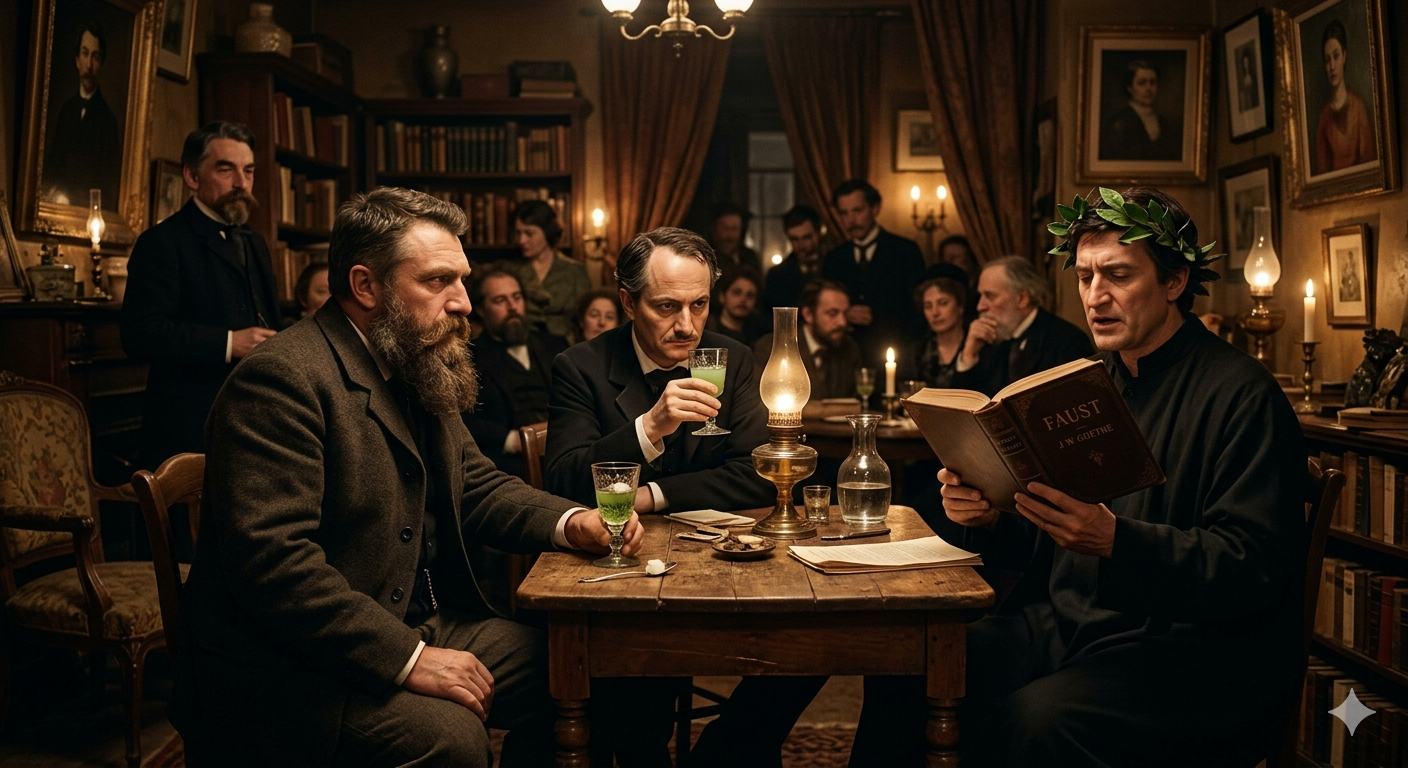
Paris in the first half of the nineteenth century was a medieval city undergoing violent modernisation. Its streets were narrow, dark and irregular. It held two million souls in a space designed for a fraction of that number. It smelled of detritus and human refuse. And then, from the early 1850s, Baron Georges-Eugène Haussmann began taking it apart.
Appointed Prefect of the Seine by Napoleon III, Haussmann demolished tens of thousands of medieval buildings over two decades, cutting broad boulevards through the old warrens and creating the grand axes that give modern Paris its character. The poor were driven to the periphery. The bourgeoisie inherited a new city of wide pavements and gas-lit shop fronts, uniform and imposing in its Haussmannian regularity.
Baudelaire watched this transformation with the attention of someone who loved what was being lost but was honest enough to acknowledge what was being gained. The new city — its crowds, its anonymous encounters, its compression of the human and the industrial — offered the artist something unprecedented: a subject matter as vast as the soul itself. But the cost was real. The complex texture of lived neighbourhood, the old Paris of memory and proximity, was being smoothed into the exchangeable surface of commerce. In his poem Le Cygne — The Swan — he wrote what is perhaps his most personal observation on the matter: “The form of a city changes faster, alas, than the human heart.” It was a single line. It contained everything.
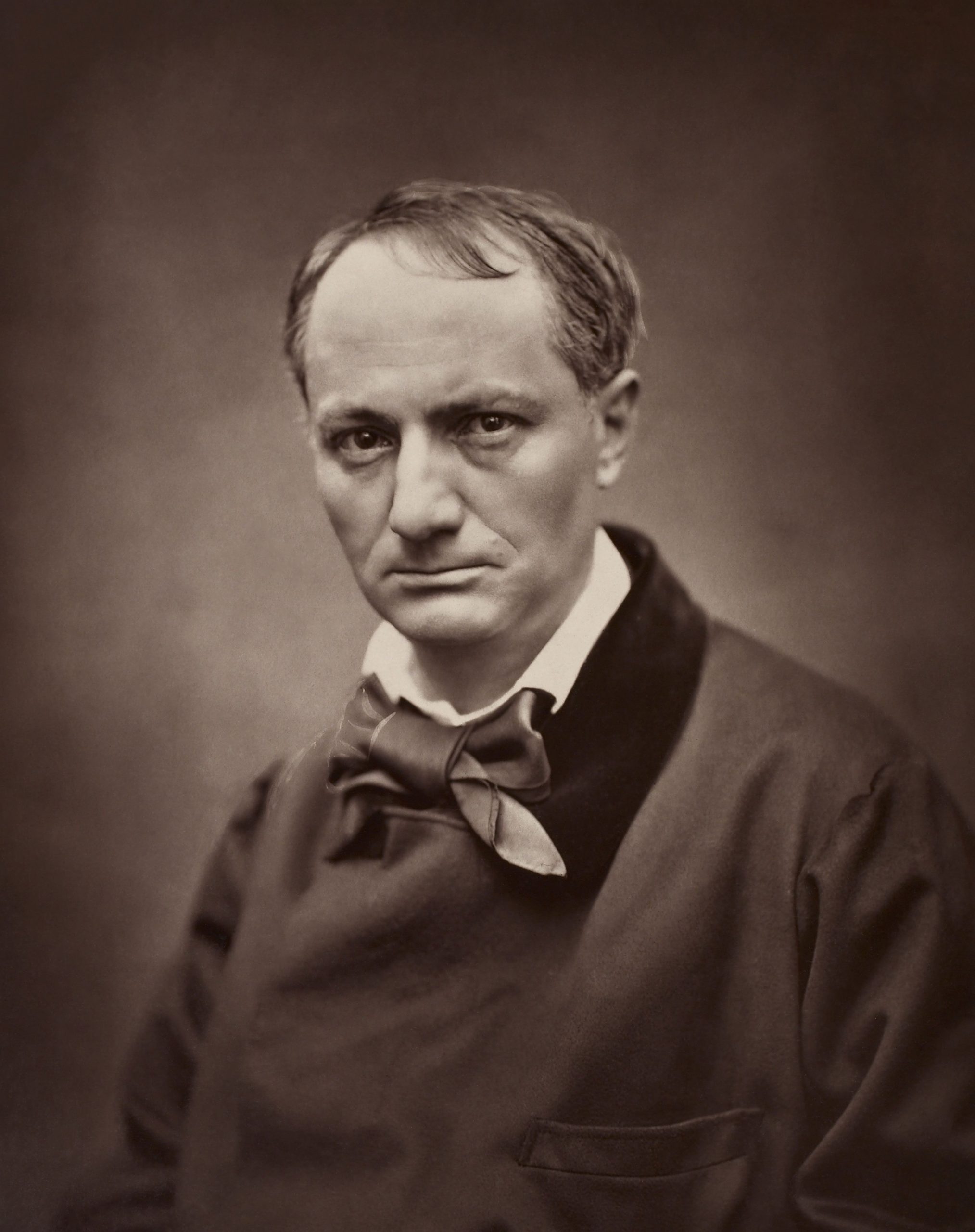
Charles-Pierre Baudelaire was born into this transforming city on 9 April 1821. His father, Joseph-François, was a senior civil servant of sixty, an amateur painter, a man of the old France who had lived through the Revolution and the Terror. His mother, Caroline Dufaÿs, was twenty-six. When Joseph-François died in 1827, Charles was six years old. His mother remarried the following year. Her new husband was Lieutenant Colonel Jacques Aupick — decorated soldier, future ambassador, future senator, and a representative of almost every value the young Baudelaire would eventually oppose. The arrival of Aupick was, by most accounts, the defining injury of his childhood. In a letter to his mother decades later, Baudelaire wrote of the period before the remarriage as one of “passionate love” between the two of them — a world made sufficient by just two people, now gone.
The Rebel
He was educated in Lyon and later at the Lycée Louis-le-Grand in Paris, a school of considerable distinction that had also produced Robespierre, Victor Hugo, and Molière. At fourteen, he was described by a classmate as refined, marked by a precocious love of fine literature. His academic path was erratic — periods of real brilliance, periods of studied idleness. He passed his baccalaureate in 1839 and told his brother with uncomfortable honesty: “I don’t feel I have a vocation for anything.”
His stepfather pushed law or diplomacy. Baudelaire chose bohemia. He began to frequent the cafés and studios around the Île Saint-Louis. He accumulated debts — for clothes, for books, for the elaborate self-presentation of a dandy. The dandy persona was, in his view, a philosophical position rather than a vanity. To dress with absolute care in a society that valued people for their productivity was to assert the supreme importance of the individual sensibility — a small but deliberate act of refusal.
In 1841, his family sent him to Calcutta in the hope that travel would cure his dissolute habits. He was miserable almost immediately and refused to complete the journey, spending time in Mauritius and Réunion Island before returning to Paris. He would exaggerate these experiences for the rest of his life — the riding of elephants, the penetration of the exotic East — building, as many self-mythologising artists do, a legend slightly larger than the reality. What the voyage actually gave him was more modest and more durable: the sea, the ship’s rigging, tropical islands at the edge of a vast ocean. These impressions entered his poetry with the permanence of obsession.
On returning to Paris he received his inheritance. Within two years he had spent roughly half of it. In 1844, his family obtained a legal decree placing his remaining assets in trust, with a notary appointed to manage them. Baudelaire was twenty-three. He would be financially dependent on this arrangement for the rest of his life, receiving a quarterly allowance and writing desperate letters to his mother for supplementary funds throughout his entire literary career.
The guardianship was undoubtedly restrictive, and Baudelaire resented it bitterly. Whether it constituted the cruelty he described is more complicated. His own spending habits had been genuinely reckless — scholars have noted that without the intervention, total ruin was probable within months. There is also evidence that the arrangement, for all his rage against it, provided a perverse stability: however inadequate the allowance, it meant that some income was guaranteed, and that the debts he continued to accumulate throughout his life could not entirely overwhelm him. He would not have agreed with this analysis. But the guardianship was both a constraint and, in ways he never acknowledged, a partial rescue.
It was during these years that he met Jeanne Duval — a French-Haitian actress, older than him, his mistress for more than twenty years. He called her his “Black Venus”. His mother despised her. The relationship endured, with long interruptions and painful returns, alongside the spectacular dysfunction one would expect. Their finances were perpetually entangled; Baudelaire’s letters describe her by turns with tenderness and with a cruelty that biographers have found difficult to set aside. In one letter, he calls her a creature drained of intelligence by a life of excess. In the poems addressed to her — among them La Chevelure, Parfum exotique, Le Serpent qui danse — she appears transformed by art into something mythological. The gap between the mythology of the poems and the messier reality of the letters is one of the most instructive tensions in Baudelaire’s life: a man who believed in absolute honesty in art was not always honest about the people he made art from.
The Doctrine of Correspondences — A Philosophy of Art
Before he published any of the poems that would make him famous, Baudelaire had already established himself as a critic of unusual precision and independence. His first major publication, the Salon de 1845, appeared when he was twenty-three. It attracted immediate attention. Many of his views were novel: his sustained championing of Eugène Delacroix, for instance, at a time when academic opinion was still suspicious of the painter’s romantic intensity, required a willingness to argue against the grain of received taste.
He called Delacroix “a poet in painting” — and in doing so articulated something he was working toward in his own poems: the expression of an inner state through the management of colour and form, rather than through the illustration of a story. Delacroix, privately, found Baudelaire’s insistence on “melancholy” and “feverishness” wearing, and said so in correspondence. He appreciated the support; he was less certain he recognised himself in the portrait. This small friction is worth noting. Baudelaire’s critical enthusiasms, however perceptive, were also projections — he saw in Delacroix, in Manet, in Wagner, aspects of his own artistic programme, and his admiration was never entirely separable from this self-identification.
The philosophical centre of his aesthetic was the doctrine of correspondances — articulated most fully in the sonnet of that name, one of the opening poems of Les Fleurs du Mal. The poem posits that nature is a temple whose living pillars sometimes utter confused words, that the senses are not separate channels of experience but a unified faculty, that perfumes, colours and sounds correspond to one another. A scent can be “green as meadows, soft as oboes, and others, corrupt, rich and triumphant.” It is a theory of synesthesia and a theory of the symbol simultaneously: the visible world points toward something beneath itself that the poet’s heightened perception can read.
Walter Benjamin, reading Baudelaire in the 1930s, would find in these ideas an anticipation of his own analysis of commodity culture — the flattening of experience, the loss of the aura of authentic presence under modernity’s conditions. It is worth noting that this reading is an interpretive lens applied by a twentieth-century theorist to a nineteenth-century poet. Baudelaire did not experience modernity in Benjamin’s terms. He experienced it as a Parisian of the 1850s, with no theory of commodity fetishism to hand, working from instinct and observation rather than from any systematic social analysis. Benjamin’s framework illuminates Baudelaire. It should not be mistaken for a description of how Baudelaire understood himself.
What Baudelaire did understand, with great clarity, was the concept he introduced in his 1863 essay Le Peintre de la vie moderne — The Painter of Modern Life. He named it modernité: the transitory, the fugitive, the contingent — one half of art, the other being the eternal and the immutable. The artist’s task was to extract the eternal from the transient. To find in the fashion of a coat, the gesture of a passer-by, the specific atmosphere of a particular street at a particular hour of the day, the permanent human truth that animated it. This was not a modest claim. It was the founding manifesto of what we now call modernist aesthetics, and it was made by a man sitting in a café in Haussmann’s Paris, in debt, in failing health, carrying a worn copy of Dante in his coat pocket.
Les Fleurs du Mal
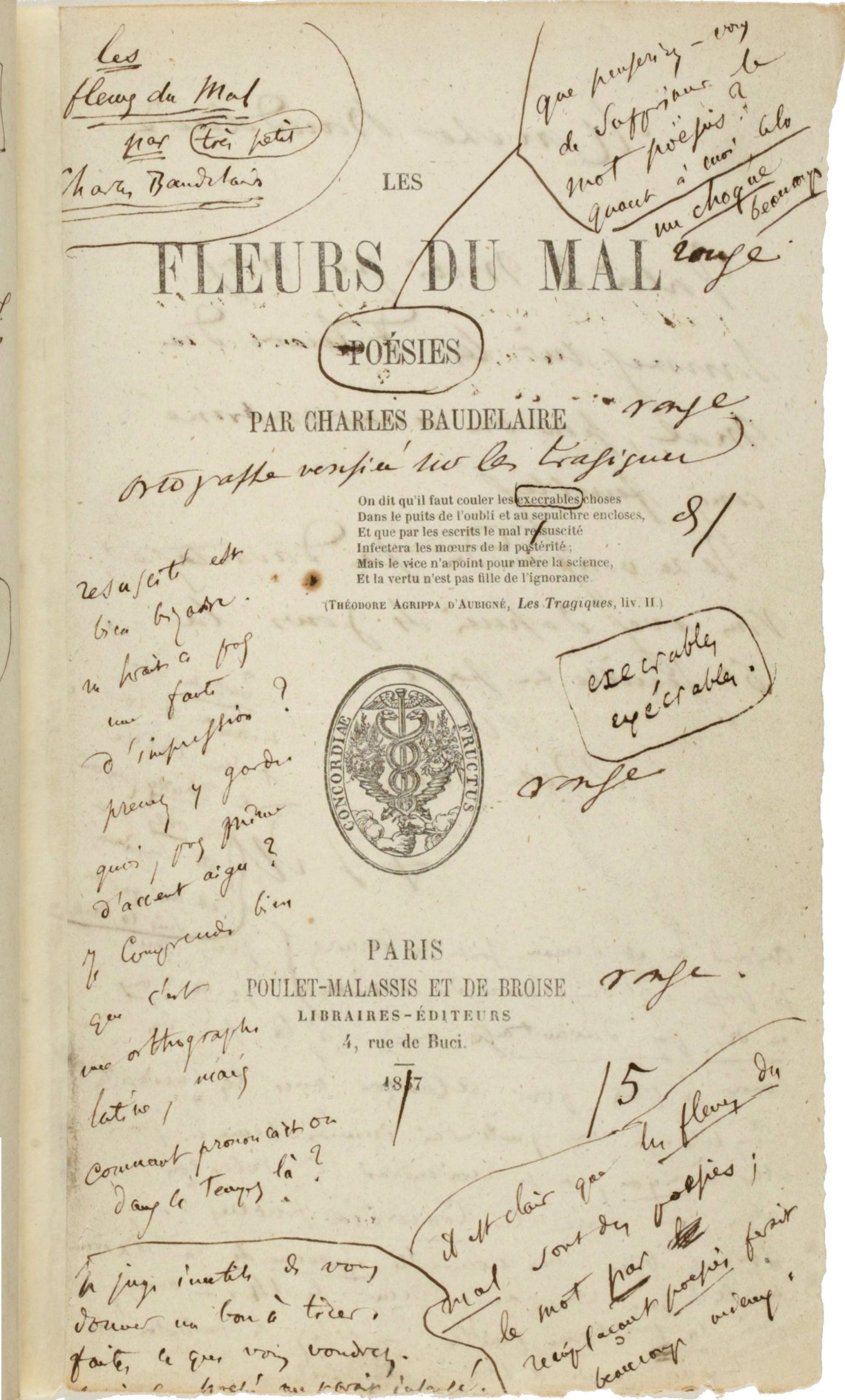
It was not until 1857, when Baudelaire was thirty-six, that he published the book he had been assembling for over a decade. He had worked on it with the slow, exacting attention of a craftsman who understood that what he was making was not a collection of poems but a structured argument — an account of modern consciousness that refused the consolations available to it.
The title was a precise description of the project. To extract from evil — from sin, suffering, the body’s darkness, the city’s corruption — something worthy of being called beautiful. Not to celebrate evil, not to endorse it, but to insist that the poet who looked away from it was failing at the primary duty of his art. The book was organised into six sections: Spleen et Idéal, Tableaux Parisiens, Le Vin, Fleurs du Mal, Révolte, La Mort. Moving from the individual’s interior struggle between aspiration and despair, through the landscapes of the modern city, through erotic obsession and revolt, to a final confrontation with death. It was a journey without the redemption that Dante’s journey offered. It descended and stayed down, finding in the darkness not transcendence but a hard-won clarity.
The response from fellow artists was immediate and generous. Théodore de Banville described the effect as immense and prodigious, mingled with admiration and an indefinable anxious fear. Gustave Flaubert, recently acquitted in his own prosecution for Madame Bovary, wrote to Baudelaire directly: “You have found a way to rejuvenate Romanticism. You are as unyielding as marble, and as penetrating as an English mist.” Victor Hugo, from his exile on Guernsey, sent his own tribute: “Your Fleurs du Mal shine and dazzle like stars.”
The public response was different. The Figaro led the attack with a review describing the book as either hideous or incomprehensible, and what one understood as putrid. The state prosecutor brought charges of offence against public decency. Baudelaire, his publisher and his printer were convicted and fined. Six poems were ordered removed: Lesbos, Femmes Damnées, Le Léthé, À Celle Qui Est Trop Gaie, Les Bijoux, and Les Métamorphoses du Vampire. The court’s reasoning was revealing. Poems exploring violence and spiritual despair were left entirely untouched. It was the frank treatment of female desire and sexuality that the censors found intolerable. The body, rather than the soul, remained the most dangerous territory.
Baudelaire did not appeal. In a letter to his mother written in the aftermath of the conviction, he defended the book with the particular calm of a man who had long expected to be misunderstood: “This book, whose title says everything, is clad, as you will see, in a cold and sinister beauty. It was created with rage and patience. The proof of its positive worth is in all the ill they speak of it.” He added that he did not care a rap for the imbeciles, and that the book would make its way in the memory of the lettered public beside the best poems of Hugo and Byron. He was right. The six suppressed poems were not legally reinstated in France until 31 May 1949 — nearly a century after the conviction. By that point the vindication was almost beside the point. The book had already made its way.
The Poète Maudit
The prosecution of Les Fleurs du Mal placed Baudelaire firmly within a tradition that the French literary world had been developing — and that the poets who followed him would inherit and intensify. The poète maudit: the cursed poet. The figure of the artist condemned by society precisely for the gifts that make him an artist — condemned for seeing too clearly, speaking too honestly, refusing the comforts of the approved and the respectable.
The term was codified by Paul Verlaine, who in 1884 published a series of essays under that title on Tristan Corbière, Arthur Rimbaud, Stéphane Mallarmé and others. But the type was older than the label. It ran back through Edgar Allan Poe and Thomas De Quincey and the English Romantics, and it found in Baudelaire its most fully realised and most culturally resonant embodiment. He had not merely written about suffering and transgression. He had organised his life around them, performed the role of the cursed poet with a consistency that suggested it was less a role than a conviction.
This needs to be said carefully, because it can too easily tip into myth. Baudelaire was not simply a tragic genius destroyed by a cruel world. He made choices — spending choices, relationship choices, professional choices — that compounded his difficulties considerably. His procrastination was genuine and damaging. He described it himself as acedia, the malady of monks — a spiritual torpor that paralysed the will even as the intelligence remained fully active. He could diagnose his own condition with devastating precision and change nothing about it. He even wrote an essay titled “How to Pay Your Debts When You Are a Genius” while remaining chronically unable to pay his own. The irony was not lost on him. Whether it amuses or saddens the reader depends on where one stands on the question of how much artists are owed by the world that cannot understand them.
The poète maudit tradition, with all its glamour and all its wreckage, ran directly from Baudelaire to the poets who came after him. Verlaine would drink himself to ruin. Rimbaud would abandon poetry entirely at nineteen, having written some of the most explosive verse in the language, and spend the rest of his life as a gun-runner in Africa. The cursed poet was not a myth. It was a pattern, and Baudelaire set it.
Baudelaire and the Arts of His Time
He was an active and opinionated participant in the artistic life of Paris, with associations across painting, music and literature. His friendships were numerous and his critical judgements usually perceptive. His manner, however, was blunt to the point of provocation. He rarely took the diplomatic approach and sometimes responded to criticism with a verbal violence that undermined his own cause. He was frank with friends and enemies alike.
The friendship with Édouard Manet was perhaps the most genuinely equal of his artistic relationships. They met regularly from around 1855, Baudelaire accompanying Manet on his daily sketching trips around Paris. Manet included Baudelaire in Music in the Tuileries Gardens, placing him in a crowd that also included Théophile Gautier and Jacques Offenbach — a small act of artistic solidarity that amounted, in its context, to a statement. When Manet’s Olympia — a nude portrait of a prostitute gazing directly out at the viewer with unapologetic self-possession — caused a scandal at the 1865 Salon, Baudelaire worked privately to support his friend. He offered no public defence; he was ill at the time and had retreated to Belgium. But the parallel between the two scandals was clear enough. Olympia had done in paint what Les Fleurs du Mal had done in verse: looked at the female body with honesty, and refused to clothe it in either moral condemnation or idealisation.
His relationship with Wagner was stranger. He had no musical training. He barely knew the repertoire beyond Beethoven and Weber. But after attending three Wagner concerts in Paris in 1860, he was overwhelmed. He wrote to the composer:
“I had a feeling of pride and joy in understanding, in being possessed, in being overwhelmed, a truly sensual pleasure like that of rising in the air.”
The subsequent essay — Richard Wagner et Tannhäuser à Paris — was widely regarded as one of the most penetrating non-technical analyses of Wagner’s work produced by any contemporary. What drew Baudelaire to Wagner was what he had found in Delacroix and Poe: the capacity to produce, through the management of a formal medium, an overwhelming direct experience of an inner state. Art that bypassed argument and struck straight into the emotional core. His contribution to the elevation of Wagner and the spread of Wagnerism across Europe in the following decades was considerable, though it is rarely acknowledged in accounts of that cultural phenomenon.
The American Brother
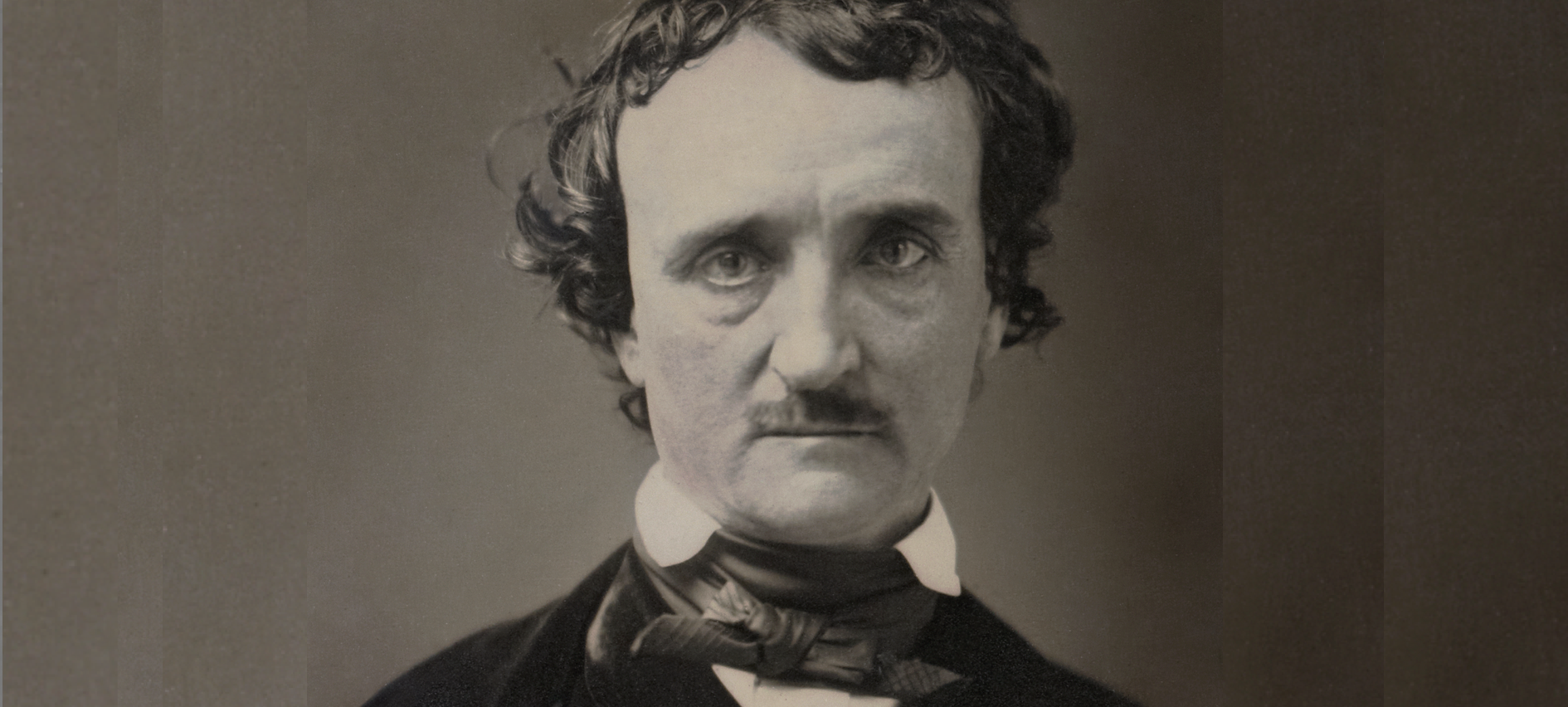
In 1847, Baudelaire encountered the work of Edgar Allan Poe for the first time and experienced something he described in terms worth quoting in full, because nothing else captures the quality of the recognition: he found in Poe’s tales and poems works that had, he claimed, “long existed in my own brain but had never taken shape.” He felt, reading Poe, the shock of meeting the writer he himself might have been had he been born American — or the writer who might have been him, had Poe been born French.
He spent the better part of two decades translating Poe’s prose into French. This was not a mechanical task. It was, as his most sympathetic biographers have noted, one of the most sustained acts of literary discipleship in the history of nineteenth-century letters. Baudelaire consulted English-speaking sailors for nautical terminology. He agonised over individual word choices. The translations, published between 1856 and 1865 as five volumes under the collective title Histoires extraordinaires and its successors, were widely regarded as masterful — and, by some French readers at the time, as superior in their French to Poe’s own English originals.
The transatlantic irony is considerable. Poe died in 1849, largely unrecognised in America, seen by the American literary establishment as a gifted but disreputable sensationalist. Baudelaire’s translations made him, in Europe, one of the most admired American writers of the century. The French Symbolists read him as a philosopher of the imagination. The Decadents found in his tales the perfect expression of the mind turned against itself. T. S. Eliot, Stéphane Mallarmé, Paul Valéry — all of them came to Poe through Baudelaire’s French. In a very real sense, it was Baudelaire who made Poe’s reputation, not in the country that produced him but in the continent that was ready to receive him. He gave Europe an American writer. He gave that writer a second life that his first country had denied him.
There was a further dimension to this kinship. Baudelaire saw in Poe not only a literary model but a mirror. Both had been orphaned in childhood by the death of a father. Both had struggled against the financial indifference of a society that did not value what they were doing. Both had turned to intoxicants as a means of managing the gap between the vividness of their inner lives and the deadness of the external world. Both had been simultaneously celebrated and marginalised. When Baudelaire championed Poe, he was also, unavoidably, championing himself — making the argument, through the example of this American precursor, that the artist condemned by his society was not thereby proved wrong.
Children of the Flowers
The debt that the generation following Baudelaire owed him was stated plainly and without qualification. Four years after his death, Arthur Rimbaud, eighteen years old and already in possession of an extraordinary early talent, wrote in a letter that Baudelaire was “the king of poets, a true God.” In 1895, Mallarmé published a memorial sonnet. Proust, in 1922, placed Baudelaire alongside Alfred de Vigny as the greatest poet of the nineteenth century.
The Symbolist movement that dominated French poetry in the 1880s and 1890s was built directly on the foundations of Baudelaire’s correspondances: the conviction that art should suggest a mood or spiritual state rather than describe a scene, that the symbol was more powerful than the statement, that the poem should be a sensory experience before it was an argument. These ideas, which Baudelaire had worked out in the particular conditions of his own vision, became the shared intellectual property of the Belle Époque’s most vital artistic community.
At the most famous salon of the era — Mallarmé’s gatherings at 89, rue de Rome — came Paul Verlaine, W. B. Yeats, the painter James McNeill Whistler, and the young Debussy, alongside others from the wider Symbolist circle. Baudelaire’s ideas circulated through every conversation held in that drawing room. Debussy’s adaptation of Mallarmé’s Prélude à l’après-midi d’un faune, which marks the beginning of musical modernism, drew on Symbolist aesthetics that were Baudelairean in their origins: the dissolution of the hard outlines of received form in pursuit of something more immediately alive to experience. He arrived at this through Mallarmé. Mallarmé had arrived at it, in part, through Baudelaire.
In England, Baudelaire’s influence fed into the aestheticism of Swinburne and Wilde, into the Decadent movement’s insistence that beauty was a sufficient justification for human existence. The influence filtered further east: into the early work of a young Prague poet who would later find his way to Rodin’s studio. And it looped back across the Atlantic through T. S. Eliot, who stated in 1948 that he was an English poet of American origin who had learned his art “under the aegis of Baudelaire and the Baudelairean lineage of poets” — and who had demonstrated this debt most concretely in The Waste Land, where the “Unreal City” of the opening section draws directly on Baudelaire’s Tableaux Parisiens, his paintings of Paris as an infernal landscape of the modern soul.
The Belle Époque
Baudelaire died on 31 August 1867. He was forty-six. The city moved on.
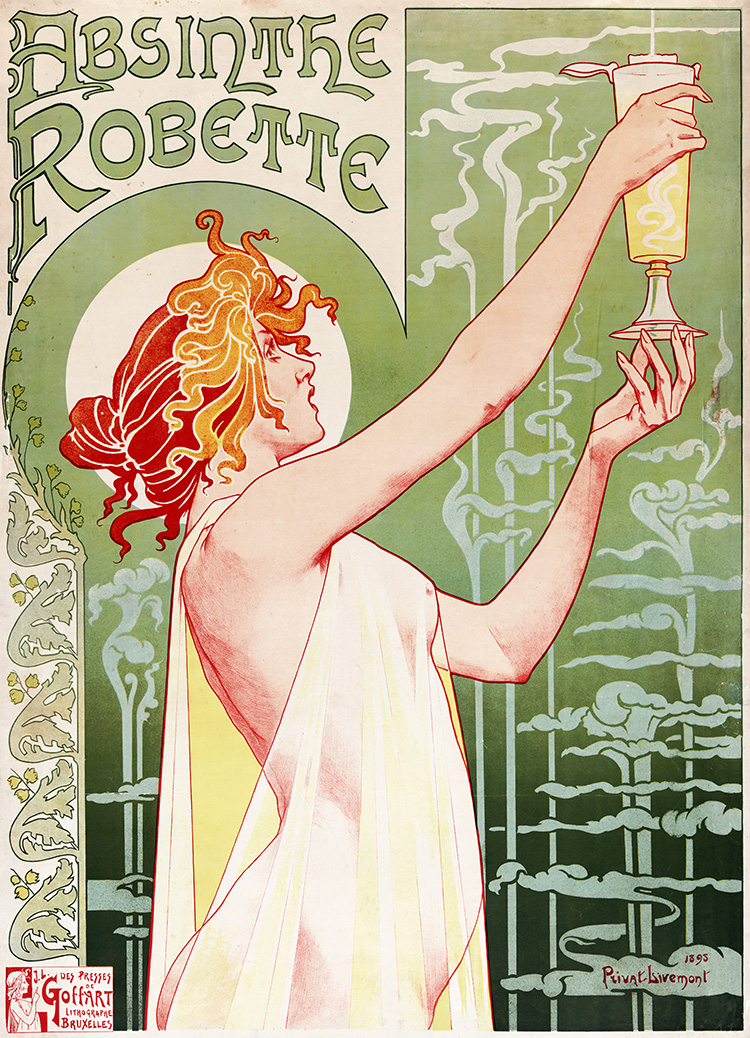
Four years after his death, the Franco-Prussian War ended with France’s humiliating defeat and the bloody suppression of the Paris Commune. Then, from the ruins and the shame, something unexpected emerged. The period that followed — stretching from 1871 to the outbreak of the First World War in 1914, retrospectively named la Belle Époque by those who survived what came after — was remarkable. The Eiffel Tower rose. The Moulin Rouge opened in Montmartre. The Impressionists, Symbolists, Decadents, Naturalists and early Modernists all produced defining work within these forty-three years. Paris became, in a way it had never quite been before, the centre of the world’s artistic imagination.
Baudelaire had not lived to see any of it. To say that he made the Belle Époque possible would be to overstate the case — the era was shaped by industrial growth, political stabilisation after the disasters of 1870-71, technological change, and the rise of a prosperous bourgeoisie with the leisure and appetite for culture. These were forces beyond any poet’s reach. What Baudelaire had done was something more specific: he had helped shape the aesthetic sensibility of the movement, had anticipated many of its defining preoccupations, and had provided the vocabulary of feeling — the beauty found in the transgressive and the dark, the city as a site of both pleasure and spiritual desolation — that its most vital artists would go on to explore.
The Belle Époque was, from one angle, everything Baudelaire had both celebrated and distrusted: a culture of pleasure and performance and dazzling surface, a city intoxicated by its own beauty. The cafés of Montmartre, the salons of the Rive Gauche, the galleries and concert halls — this was the world as joie de vivre, as expansive creative freedom. But it was also, running beneath its glittering surface, an era of gathering contradictions. The political tensions that would produce the First World War were forming throughout those gilded decades. The beautiful era was simultaneously a threatened era. Baudelaire would not have been surprised. He had always understood that beauty and darkness were not opposites but companions. His flowers had always grown from difficult soil.
Hell Relocated
A critic once observed, with economical precision, that while Dante had visited Hell, Baudelaire hailed from it. The observation is too neat to be entirely true — but it points at something real about the difference in the two poets’ relationships to suffering.
Dante’s Inferno is a pilgrimage. It has direction and destination. It moves from darkness toward light, from punishment toward transcendence, the whole edifice animated by the conviction that suffering is meaningful within a divine order. Hell for Dante is structured, purposeful, every circle of suffering precisely calibrated to the sin it punishes.
Baudelaire’s hell has none of that structure. It is the hell of the modern city, dispersed across the surface of everyday life — not a place visited by the poet with a guide but the element in which the poet permanently lives. Paris is the inferno. The crowds on the boulevards are already the shades of the damned. The spiritual atmosphere is not fire but fog. And there is no Virgil. No upward path. No eventual emergence into starlight. The poet stands in his hell alone, without a rational cosmic order, without the guarantee that suffering serves any purpose beyond itself.
This was the quality that served Rodin’s vision most directly. T. S. Eliot identified it precisely: Baudelaire taught him how to treat the sordid aspects of the modern metropolis with the same moral weight that Dante gave to the circles of Hell. Eliot drew both poets into The Waste Land, fusing Baudelaire’s “Unreal City” imagery with Dante’s crowds of the damned to create the hellish landscape of his opening section. The line of inheritance was unbroken: from Dante’s medieval theology, through Baudelaire’s modern urban despair, to Eliot’s twentieth-century secular anguish. Rodin stands within this same line of descent. The Gates of Hell is its sculptural expression.
The Sculptor’s Poet
Rodin kept a copy of Les Fleurs du Mal at his worktable throughout his working life. Multiple studio visitors confirmed it as a consistent presence, like the copy of Dante nearby. Both books were worn and annotated. Both had been read until the words were indistinguishable from the texture of the sculptor’s own thinking.
The specific creative debts are documented. In 1887 and 1888, Rodin made a series of drawings to illustrate a special edition of Les Fleurs du Mal — intimate, swirling ink-wash images that translated the poems’ emotional content into line and shadow. He was not illustrating the poems in the sense of depicting their content. He was responding to them — finding the sculptural equivalent of what Baudelaire had made in language.
The sculpture Je suis belle — I Am Beautiful — takes its title from Baudelaire’s poem La Beauté, in which Beauty speaks in the first person. The opening line reads:
“Je suis belle, ô mortels! comme un rêve de pierre.” — I am beautiful, O mortals, as a dream of stone.
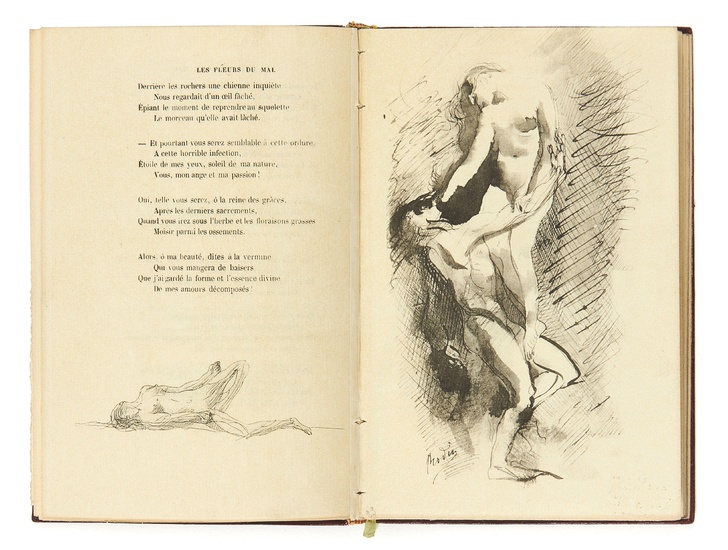
Rodin’s sculpture gives this a specific physical form: a crouching male figure clutching a female who arches away from him in an embrace that holds within it simultaneously desire and its impossibility. The resonance between poem and sculpture is deep and unmistakable. Whether one goes so far as to call them the same work in different materials is a matter of critical taste — there is a real interpretive leap involved. What is beyond dispute is that the sculpture would not exist in the form it does without the poem, and that the feeling they share — beauty experienced as something that wounds — belongs to both of them equally.
The sculpture Femmes Damnées drew directly from the banned Baudelaire poem of that name, one of the six suppressed by the court in 1857. The poem explored lesbian desire with a sympathy and psychological curiosity that the official world found intolerable. Rodin’s treatment of the two female figures carries the same refusal of both condemnation and titillation, the same insistence on emotional truth over social comfort. The connection was deliberate and, given the poem’s censored status, carried a certain charge of its own.
Everywhere in The Gates of Hell — in its atmosphere of beautiful, unresolvable suffering, in the way its figures express states of consciousness rather than specific sins, in the tension between the body’s beauty and its anguish — the presence of Les Fleurs du Mal is felt alongside Dante’s Inferno. The two sources pull in different directions and the tension between them is part of the work’s power. Dante provides architecture: structure, narrative, a sense of moral order, even in damnation. Baudelaire provides atmosphere: the feeling of suffering that has no resolution, desire that cannot be satisfied, beauty that cannot be held. Without Baudelaire, the Gates would be a more medieval work. His presence is what makes it contemporary.
The Three Muses
Three women shaped the emotional material of Les Fleurs du Mal, and the way Baudelaire related to each of them tells us something about the architecture of the book.
Jeanne Duval — the Black Venus — was the muse of erotic and carnal experience. The poems addressed to her are among the most sensually intense in the French language: La Chevelure, Parfum exotique, Le Serpent qui danse. They are also, in their private counterpart — the letters — accompanied by passages of real unkindness toward her, descriptions of her decline that are clinical to the point of coldness. Baudelaire supported her financially to the end of his life, which is one kind of testimony. His letters tell a more complicated story. The Duval of the poems is a mythological creature. The Duval of the correspondence is a woman trapped in a difficult relationship with a man who needed her and resented needing her. Both versions are true. The art and the life were not, in this case, telling the same story.
Apollonie Sabatier — the White Venus — was the muse of idealised devotion. A salon hostess of beauty and intelligence, she received anonymous letters containing poems of extraordinary reverence for years before Baudelaire revealed his identity. The game sustained a fiction that physical contact would have destroyed, and in 1857 it was destroyed. Their brief physical encounter shattered the ideal, as such encounters invariably do when the ideal has been maintained at a sufficient distance from reality. Baudelaire retreated immediately. The poems he had addressed to her became, in retrospect, documents of the impossibility of idealisation rather than its achievement.
Marie Daubrun — the Green-eyed Venus — occupied the middle ground: the muse of melancholy and wistful longing, the inspiration for L’Invitation au voyage, perhaps the most purely beautiful poem in the collection, with its vision of a world elsewhere where everything would at last be “luxe, calme et volupté” — luxury, calm and pleasure. A place that does not exist and has never existed, but which the imagination insists on, because the alternative is to accept that the world as it is constitutes the totality of what is available.
These three women, and the three registers they represent, give the book its depth and its range. Les Fleurs du Mal is not a record of a single feeling. It is a map of a complete interior world — one that refuses to simplify its own contradictions, that holds together the erotic and the spiritual, the ideal and the carnal, the beautiful and the damned. This refusal of simplification is its greatest strength and, in Baudelaire’s life, was part of what made him so difficult to live near.
Decline and Vindication
The last decade of Baudelaire’s life was one of accelerating physical and financial decline. His debts grew without ceasing. His health deteriorated under the combined pressure of syphilis, a long-standing addiction to laudanum and alcohol, and the sustained physical toll of decades of poverty and anxiety. He left Paris for Brussels in 1864, hoping to sell the rights to his works and deliver a series of lectures. The lectures were poorly attended. The publishers were uninterested. His private notebooks from this period — the Fusées and Mon coeur mis à nu, published posthumously — are among the most remarkable documents of a mind still wholly active in a life that was failing around it. Aphoristic, violent, brilliant, unguarded. “There is no form of rational and assured government save an aristocracy,” he wrote. “There are but three beings worthy of respect: the priest, the warrior and the poet. To know, to kill and to create.” The aristocratic views he had developed over the years were by now fully hardened into an explicit rejection of democratic politics — a position that sits uneasily with the radical honesty of the poetry, and that his more liberal admirers have always found uncomfortable.
In March 1866, visiting a church in Namur, he collapsed. The stroke left him paralysed on one side and destroyed his speech. For the remaining eighteen months of his life, he could produce only a single word — a contracted blasphemy that emerged involuntarily, occasionally provoking in his visitors an involuntary and terrible desire to smile. He was the poète maudit reduced to a single syllable: the curse, and nothing else. He was brought back to Paris. Manet and his wife visited regularly; she played Wagner at his bedside. He died on 31 August 1867.
The judgement of 1857, which had banned six poems from French editions, was officially reversed on 31 May 1949. By then, the vindication was almost beside the point. The poetry had long since made its own case. Four years after his death, Rimbaud had called him a god. Within a decade, the Symbolist movement had adopted his doctrines as its own. Within two decades, his influence had spread through Debussy and Mallarmé into the foundations of musical modernism. Within half a century, T. S. Eliot had learned his art from the Baudelairean lineage. The six poems the court had considered dangerous were reinstated into editions that by then had sold across the world.
The Permission
In Chapter One we described Rodin as the gravitational centre of this story — the sculptor around whom a constellation of poets orbited. When we come to Baudelaire, the relationship is different. Baudelaire was dead before Rodin received his great commissions. He could not have known the sculptor’s name.
What he gave Rodin was not attention or example or the direct gift of a working relationship. It was something more foundational: permission. Permission to look at the body without idealising it. Permission to find in suffering not the occasion for moral instruction but the occasion for art. Permission to make work that the official world would find threatening, and to persist in that work against the institutional pressure toward the safe and the approved.
Rodin had understood this from his first reading of Les Fleurs du Mal as a young man in Paris, and had never relinquished it. The worn copy on his worktable was a working tool: a reminder, on every day when compromise might have been tempting, of what art was actually for and what it cost.
The Gates of Hell is the most visible monument to this debt. But the debt is present throughout the work — in the roughness of the clay surfaces, in the deliberate imperfection of the finished bronze, in the insistence that the evidence of the human hand should remain visible in the material. All of it says, in the language of sculpture, what Baudelaire had said in verse: I looked without flinching. This is what I found.
— — —
Baudelaire died in 1867. The city he had anatomised went on without him, entering the gilded decades of the Belle Époque with the particular heedlessness of an era that does not yet know what it is moving toward. Painters drank absinthe in cafés lit by electric light. The Moulin Rouge opened its doors. The Eiffel Tower rose. Rodin worked in his studio, the worn copy of Les Fleurs du Mal on his table, his hands in the clay.
But outside the studio and the café and the salon, other forces were forming. The political tensions that would produce the First World War were assembling themselves in the shadows of the Belle Époque’s brilliance. The beautiful era was also a threatened one. In the next chapter, we step back from individual lives to look at this wider world: the pressures building beneath the surface, the way they were reshaping art and thought, and the gathering darkness that Rodin, Rilke, Gibran and Pound would each have to find their own way through.
Darren Gall
