
RODIN And His Poets
CHAPTER ONE – The Man Who Made Stone Breathe
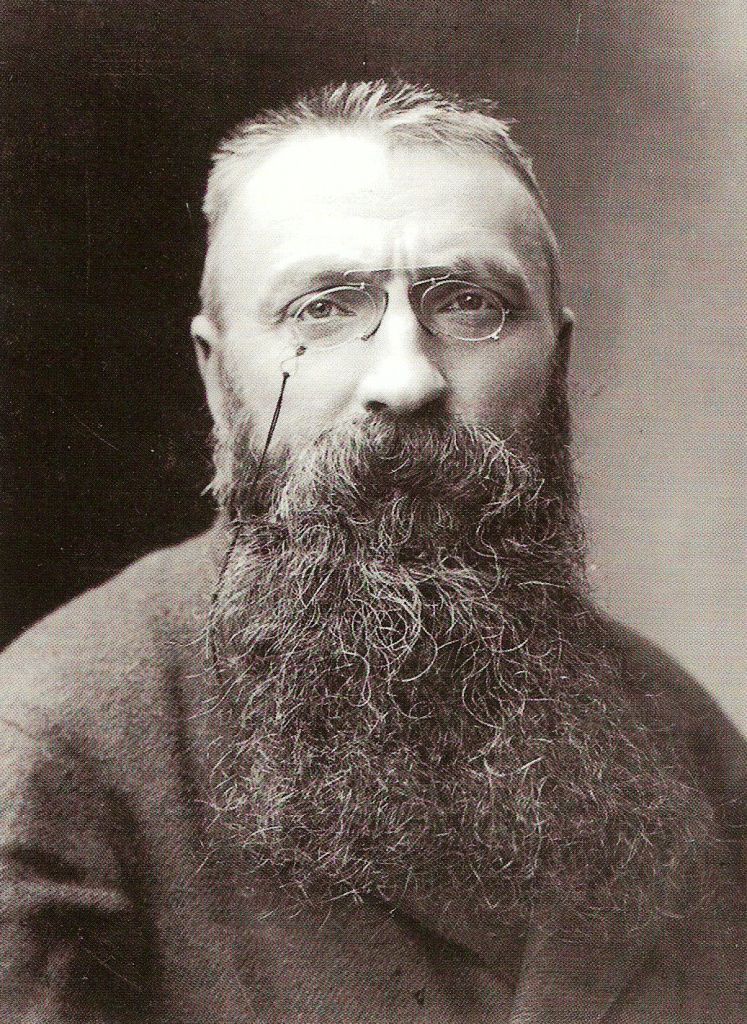
Auguste Rodin
Paris, 1840
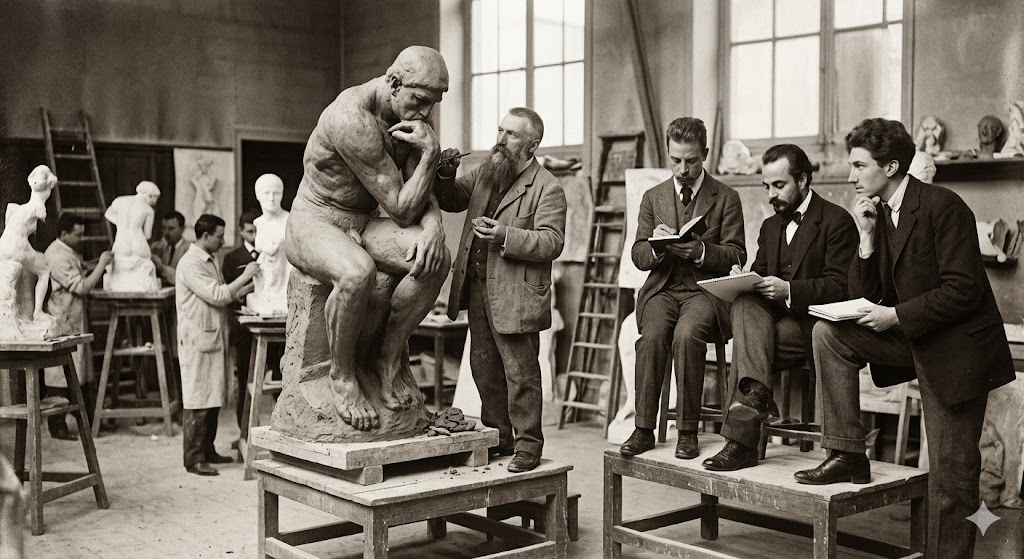
He was born into a Paris that still smelled of coal smoke and river mud, in a city that had not yet decided what it wanted to be. The year was 1840, the reign of Louis-Philippe, a France suspended between revolution and respectability, its grandeur real but brittle, its confidence performing an ease it did not entirely feel. Into this world, on the twelfth of November, François Auguste René Rodin arrived — second child of Jean-Baptiste Rodin, a minor clerk in the Paris police prefecture, and Marie Cheffer, a woman of modest Lorraine stock. They were not poor in the grinding, desperate sense, but they were close enough to that edge to feel its presence daily. They lived in the Latin Quarter, in rooms that were clean but spare, where ambition was measured in small increments and the life of an artist would have seemed, to most in that building, a kind of madness.
Jean-Baptiste was a decent, unremarkable man whose idea of the world’s possibilities stopped at the boundary of steady employment and a quiet death. He had no particular feeling for art. He could not have anticipated what was sleeping in the boy who sat at the kitchen table drawing shapes on the margins of his schoolbooks — could not have read in those small, obsessive marks the outline of a future that would shake the art world to its foundations. But the boy knew, even if he couldn’t have named it. From the beginning, Auguste Rodin looked at the world differently. He saw surfaces where others saw solids. He saw the way light moved across a face, the tiny shadows that gathered in the crook of an elbow, the particular melancholy of a human hand at rest. He was, from the very beginning, paying a different kind of attention.
His eyesight was poor — severe myopia that made the world, particularly in his early years, a place of soft masses and gathered forms rather than sharp outlines. Where another child might have traced the precise edge of a rooftop against the sky, Rodin saw the rooftop as a dark weight pressing against the luminous, a weight with feeling in it, with what he would later call soul. Whether this early blurring of the world’s edges shaped his way of seeing or merely coincided with it, we cannot say with certainty. What we know is that the adult sculptor would insist, all his life, that the emotional truth of a surface mattered more than its literal geometry — and that this insistence felt, to those who knew him, less like a theory than a temperament.
School was a failure, or rather, school failed him. He was ten years old when his father sent him to a school in Beauvais, a brief experiment in provincial education that produced nothing except a deepened conviction, in the boy himself, that the formal transmission of knowledge was not the way his mind worked. He returned to Paris and was sent, at fourteen, to the École Spéciale de Dessin et de Mathématiques — known in the city simply as the Petite École, a school of decorative arts that operated in the shadow of the great and terrible École des Beaux-Arts. The Petite École was the tradesman’s entrance to the world of art, the place where those without sufficient breeding or connections went to learn enough to be useful. It was not supposed to be the beginning of genius. For Rodin, it was.
The Education of the Hand
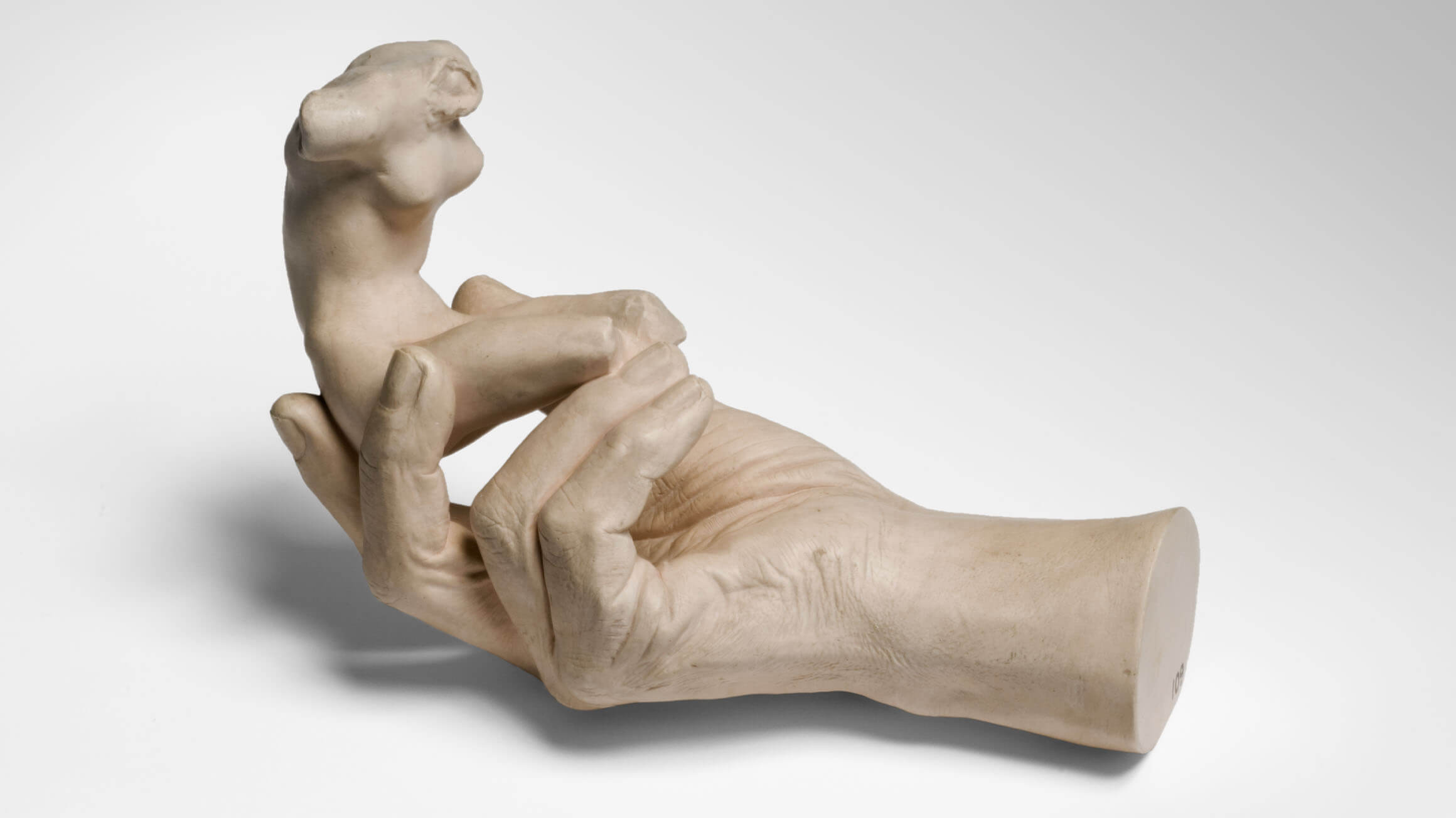
The Petite École gave Rodin something that the more prestigious institutions, with their insistence on classical perfection and academic finish, might have made considerably harder to develop: the freedom to look without a predetermined destination. The school’s emphasis was practical rather than theoretical, its atmosphere less charged with the tyrannical worship of the antique ideal that paralysed so many students of the period. Rodin drew. He drew constantly, obsessively, from early morning until his hand cramped and the light failed. He drew the plaster casts of ancient busts that lined the studio walls. He drew his fellow students. He drew his own hand, watching the tendons move beneath the skin, trying to understand what lay beneath the surface of things.
It was here that he first encountered the art that would haunt him for the rest of his life. The Petite École maintained a collection of reproductions — drawings and plaster casts of the great works of antiquity — and even in reproduction, even at one remove from the originals, something of their force came through. What Rodin saw in the ancient Greek sculptors was not idealisation but truth. The conventional understanding of Greek sculpture, dominant in the academies of the nineteenth century, held that it represented the perfection of the human form, the body as it ought to be rather than as it was. But Rodin looked at the fragments differently. He saw how the Greeks had understood that the body was not a collection of parts but a single integrated system, each element continuous with every other — weight shifting through the hip, the shoulder rising in compensation, the whole figure organised around a single moment of balance and intention.
“I love the sculptures of ancient Greece. They have been and remain my masters.”
This was not a formal declaration. It was a statement of ongoing devotion, the acknowledgment of a lifelong conversation. At night, in the later years when he had the resources to indulge it, Rodin would build fires in his studio at Meudon and by lamplight show visitors his collection of antiquities — over six thousand pieces gathered over a lifetime — passing an oil lamp slowly across the carved marble to demonstrate what he wanted them to see: the way shadows gathered in the hollows of Greek drapery, the way a single curved surface could hold multiple planes in delicate tension. The collection was not a possession. It was a classroom that he never stopped attending.
Three times, as a young man of seventeen, eighteen and nineteen, Rodin presented himself at the gates of the École des Beaux-Arts and three times was turned away. The rejection committee’s deliberations went unrecorded, and we cannot know precisely what they objected to. What we can say is that the qualities most visible in his early work — a roughness, a preference for the felt over the polished, a reluctance to suppress the evidence of the making hand — were precisely the qualities that the academic tradition had most systematically trained its students to eliminate. The rejections were crushing in the way that institutional refusals always crush young artists who have staked everything on admission. He did not reframe them as hidden blessings. He simply survived them and kept working.
The Long Apprenticeship
What followed was years of unglamorous, necessary labour. Rodin had no private income, no patron, no family connections in the art world. He was a craftsman’s son who wanted to be an artist in a city that had strict hierarchies about what those two things were and who was permitted to be which. To survive, he hired himself to the prominent sculptor Albert-Ernest Carrier-Belleuse, a successful and prolific maker of the decorative objects the Second Empire’s prosperous bourgeoisie wanted for their drawing rooms — nymphs and angels and allegorical figures, lovely and accomplished and without the fever that drove Rodin. The work was skilled and, for him, largely meaningless. He did it with the professional competence of a man determined not to be destroyed by compromise.
From Carrier-Belleuse he learned, despite himself, a great deal. He learned the logistics of running a large studio — the practical organisation of a sculptural enterprise employing dozens of assistants, the protocols of commission and delivery, the industrial side of sculpture: casting, carving, the translation of a clay model into bronze or marble through the hands of specialists. These were not the lessons he wanted. They were the lessons he needed, the infrastructure beneath all the ambitious work to come.
During this period, he also worked in Brussels, where Carrier-Belleuse had commissions, and it was from Belgium, in 1875, that Rodin scraped together enough money to travel to Italy. It was the journey that changed everything.
Italy and Michelangelo
He arrived in Florence in the early spring of 1876 with the specific intention of finding out whether Michelangelo was as extraordinary as his reputation claimed. By the mid-nineteenth century, Michelangelo had been so thoroughly institutionalized — so incorporated into the machinery of academic reverence — that it was genuinely possible to admire him in the way one admires a fact, without feeling him in the way one feels a wound. Rodin wanted to get past the reverence to the reality. He wanted to stand in front of the actual marble.
What he found in the Medici Chapel, in the Accademia, in the unfinished Prisoners straining toward liberation from their stone, hit him somewhere below thought. He wrote letters home from Florence that vibrate with the shock of it — a man trying to articulate an encounter that exceeded his language. What Michelangelo showed him, above all, was the possibility of expressing inner states — anguish, longing, the particular terror of consciousness trapped in matter — through the distortion and intensification of the body. The Florentine master had understood that anatomical accuracy was not an end in itself but a foundation from which the artist might leap toward expressive truth.
The non finito technique particularly seized him — the deliberate incompleteness that left figures half-emergent from unworked stone, as in the great unfinished Slaves made for the tomb of Pope Julius II. Rodin had been trained to see the finished, polished surface as the goal of sculpture. Here was the greatest sculptor since antiquity insisting that the unfinished could be more powerful than the finished — that a figure emerging from stone rather than standing free of it carried within its very form the drama of becoming, the struggle of form against matter, of consciousness straining toward expression.
“After visiting Italy, I understood Michelangelo, who taught me to plumb the expressive potential of the naked body in situations of passion and duress.”
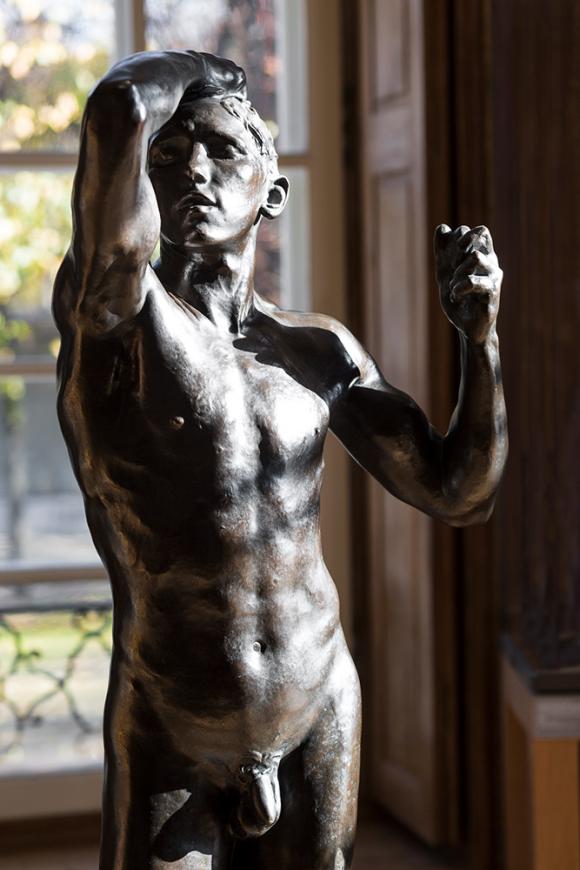
Back in Brussels, he began the sculpture that would announce him to the world and nearly destroy him. The Age of Bronze — a full-scale male figure modelled after a Belgian soldier named Auguste Neyt — is one of the most extraordinary things Rodin ever made, not because it is the most complicated or the most emotionally intense, but because it is the most alive. The figure stands in a pose simultaneously classical and completely contemporary, one arm raised, the face tilted upward in an expression reaching toward something just beyond articulation. The musculature is precise but not clinical; the surface holds the memory of movement in a way that defies the permanence of bronze. It looks like a man who has just stopped moving.
It looked, in fact, so much like a man who had just stopped moving that when it was exhibited first in Brussels in 1877 and then in Paris, critics accused Rodin of surmoulage — the practice of taking a cast directly from a living model and presenting it as sculpture. The accusation was devastating, amounting to the claim that his supposed genius was a fraud, a theft from a living body. He fought it with controlled fury. He invited inspection, provided photographs of the model alongside the work, secured letters from fellow sculptors testifying to its authenticity. Eventually, a committee exonerated him. The accusation itself was, in its way, a perverse testament: his enemies could not believe a human hand had made something that living.
The Gates of Hell
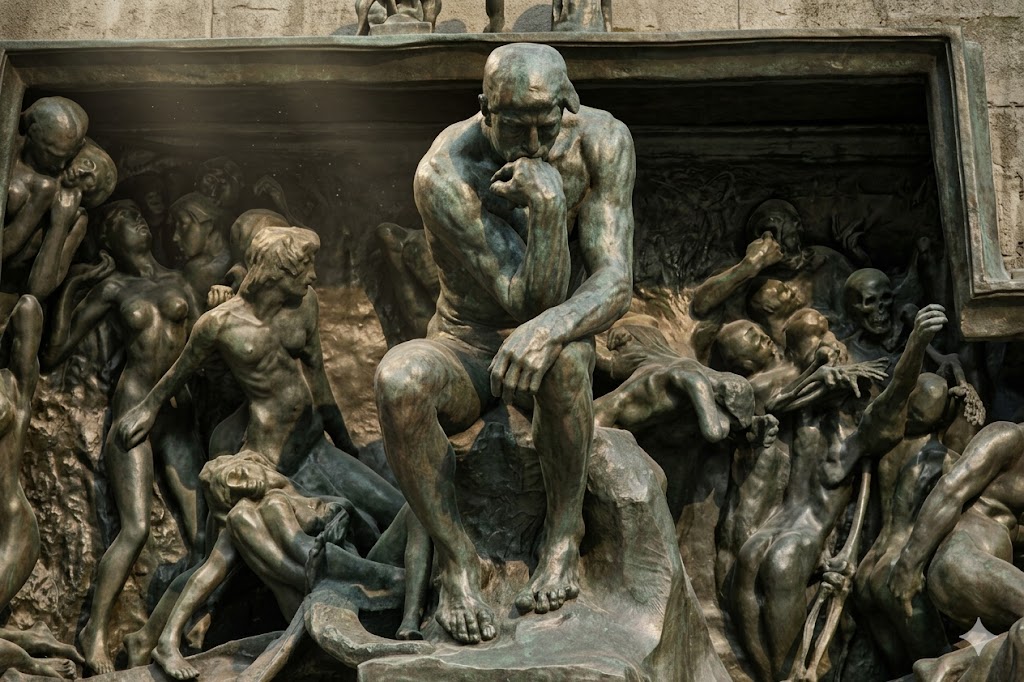
It was not until 1880, when Rodin was forty years old, that he received the commission that would define the rest of his life. Under France’s President Jules Ferry, Under Secretary Edmond Turquet signed the order commissioning from him a pair of monumental bronze doors for a new decorative arts museum to be built in Paris — the brief specifying, with unusual literary precision, a work of “bas-reliefs representing Dante’s Divine Comedy.” The museum was never built. The commission, however, took root in Rodin like a second self, and the Gates of Hell would occupy him for the remaining thirty-seven years of his life — not as a project to be completed but as a permanent arena of investigation, an ongoing meditation on everything that mattered to him, from which figures emerged and to which he returned, again and again, as a man returns to a question that will not be answered.
“For a whole year I lived with Dante, with him alone, drawing the eight circles of his inferno.”
He carried a copy of the Divine Comedy everywhere. He made hundreds of drawings — not illustrations in the conventional sense but explorations, attempts to find in the Dantesque landscape of suffering some visual equivalent for the emotional states the poem described. The drawings were intimate and ferocious, the work of a man wrestling with a text rather than decorating it. At the end of that first year of total immersion, Rodin made a decisive turn. He set the drawings aside and began again from a different direction. The figures he had made from specific passages of the Inferno had, he felt, become too remote from lived reality — too literary, too illustrative, too many translations of someone else’s vision, rather than expressions of his own. He would keep Dante’s architecture and atmosphere while filling it with bodies and urgencies entirely his own.
The initial structural model for the Gates was Ghiberti’s Gates of Paradise — the great fifteenth-century bronze doors of the Baptistery in Florence, which Rodin had spent long hours studying on his Italian journey. Ghiberti had organised his doors into compartmentalised panels, each depicting a specific episode, the whole arranged with the lucid narrative order of a master storyteller. Rodin’s early sketches followed this compartmentalised structure. But he soon abandoned it entirely in favour of something more radical: a single continuous field of figures on each door, pouring from top to bottom in what he imagined as an “astounding fall of the damned” — a structure that obeyed no laws of gravity or conventional perspective, that presented the chaos of hell as experienced from within rather than observed from a safe narrative distance.
The result, which grew to nearly twenty-one feet in height and eventually included over two hundred figures, is less a pair of doors than a cosmology. To stand before it — as Rodin imagined viewers doing, approaching it frontally, perhaps ascending steps, allowing the scale to overwhelm them — is to be confronted not with a story but with a condition. The figures do not illustrate the Inferno. They are the inferno, or rather, they are Rodin’s understanding of what the inferno means: the endless, unresolvable torment of human beings caught in the machinery of their own desire.
The Figures
Several of the Gates’ most significant figure groups carry identifiable Dantesque origins, and tracing them illuminates both the depth of Rodin’s engagement with his source material and the distance he eventually travelled from it.
At the very summit of the doors stand Les Trois Ombres — the Three Shades — three identical male figures whose arms drop and whose hands point downward toward the suffering mass below. These three figures, inspired directly from Michelangelo’s Adam, were originally intended to gesture toward Dante’s inscription: “Abandon every hope, who enter here.” But Rodin made a decision of quietly radical significance: he removed the inscription entirely. The words of warning were replaced by the figure of The Thinker, brooding in silence above the central tympanum. Language gives way to image. Dante’s verbal caution yields to Rodin’s embodied anguish. The message remains, but it is now carried in flesh rather than in letters.
Below the Three Shades, on the left door panel, crouches one of the most emotionally devastating groups in the entire composition: Ugolino and His Sons, drawn from Canto XXXIII of the Inferno. Count Ugolino della Gherardesca endured starvation in a tower until his sons died, at which point, consumed by desperation, he was rumoured to have eaten their flesh. Rodin does not depict the act itself but the moment before — the father crouching over his children in a posture that conflates tenderness with the first stirring of something darker, the face registering the impossible equation between love and survival. It is one of those moments where Rodin’s insistence on psychological ambiguity, on the complexity of moral experience rather than its simplification, achieves something no purely illustrative sculpture could reach.
The lovers Paolo and Francesca — drawn from Canto V, where the lustful are tossed by an eternal whirlwind — appear in the doors in multiple configurations, their story threading through the composition as a recurring motif. Rodin wanted to represent both their initial joy and their final damnation, but removed the figure that became known as The Kiss because it seemed to conflict with the surrounding scenes of suffering. The decision is revealing. The Kiss, in isolation, is a work of transcendent sensual beauty — two bodies lost in each other, oblivious to everything outside their embrace. Within the Gates, surrounded by suffering, that same beauty becomes unbearable. Rodin understood that pleasure placed inside a context of eternal consequence is not neutralised but intensified — that the Gates needed The Kiss to be removed from it in order for both works to achieve their full power. Separated, they speak to each other across the studio in a dialogue that neither could sustain alone.
In the right-hand door jamb, at the very bottom, kneels a bearded figure many scholars identify as Rodin himself, accompanied by a small attendant that may represent the fruits of his imagination. At the bottom of each door is a tomb — a reminder of the temporal entrance to Hell. The sculptor places himself inside his own inferno. He is not outside the suffering he depicts, observing and rendering it from a position of safety. He is among the damned, present in his own creation, a confessor rather than a judge.
From Dante to Baudelaire — The Fathers of the Gates
As the work evolved through the 1880s, a second literary presence pressed into the Gates with increasing force alongside Dante’s. The subject matter draws from Baudelaire’s Les Fleurs du Mal as much as from Dante’s Divine Comedy, and the relationship between these two sources is worth examining carefully, because they pull in different directions and the tension between them is part of what gives the work its extraordinary charge.
Dante provides the architecture — the structure of circles, the idea of graduated punishment, the narrative organisation of suffering into a comprehensible if terrible system. His hell is medieval in its logic: sin has consequences, consequences are proportionate, and the whole apparatus of damnation serves a cosmic moral order. There is suffering in Dante’s Inferno, but there is also meaning.
Baudelaire provides something else entirely: the modern atmosphere of meaningless, self-generated torment. His fleurs du mal — his flowers of evil — grow not in any cosmic hell but in the human heart itself, in the dark soil of boredom and desire and the peculiar modern anguish of consciousness that cannot be satisfied by anything the world offers. The damned souls of Baudelaire’s Paris do not suffer because a divine mechanism has assigned them to their circle. They suffer because they are human, because desire is insatiable, because beauty is always accompanied by the shadow of its own dissolution.
Dante provided the structure and the grand narrative, while Baudelaire offered the psychological depth, the modern sensibility, and the exploration of moral ambiguity that permeate the individual figures. Rodin himself read the two poets in constant parallel — his copy of Les Fleurs du Mal as worn and annotated as his Divine Comedy, both books present in his studio throughout the decades of the Gates’ creation. When he spoke of having lived with Dante for a year, he might equally have said he lived with Baudelaire for thirty.
The sculpture Je suis belle — I Am Beautiful — makes this double paternity explicit. The title comes directly from Baudelaire’s poem La Beauté, in which Beauty speaks in the first person: cold, stonily perfect, indifferent to the suffering of those she inflames. Rodin’s figure takes this image and gives it violent physical form: a man clutching a woman who arches away from him in an embrace that cannot be distinguished from a struggle, desire and possession and loss compressed into a single impossible gesture. The piece appeared within the Gates and was also cast independently, and in both contexts it carries the same disturbing ambiguity: Is this love? Is this torment? Baudelaire’s answer, and Rodin’s, is that the question contains its own answer — they are the same thing.
The Gates as Process
Perhaps the most radical aspect of the Gates of Hell is not any individual figure but the work’s relationship to completion — or rather, its absolute refusal of it. During the thirty-seven years that Rodin worked on the project, he continually added, removed, or altered the more than two hundred human figures that appear on the doors. Figures were detached and cast independently. Others were removed entirely, reconsidered, and reinserted in different positions. The Gates became, in Rodin’s hands, not a composition to be finalised but a permanently open field of experimentation — a three-dimensional sketchbook on a monumental scale.
It was in 1900 that a plaster cast of the Gates of Hell was first exhibited in public, at the Exposition Universelle — seventeen years after the commission began in earnest, and seventeen years before Rodin’s death. It was shown uncast in bronze, unfinished by every conventional measure, and yet it was already unmistakably itself: a monument not to the completion of a vision but to the process of a life’s inquiry. Rodin would not live to see it cast in bronze. The first bronze cast was made after his death, in 1926. But this posthumous casting was in some sense the right outcome for a work that was always more interested in becoming than in being — that embodied, in its very resistance to completion, the same restless, unsatisfied reaching that it depicted on its surface.
The Gates of Hell, understood whole, is Rodin’s autobiography. It contains virtually every formal idea he ever pursued — the fragment, the non finito, the figure emerging from raw material, the body in extremis, the combination and recombination of figures into new configurations, the dissolution of narrative into pure emotional state. It is the laboratory and the testament simultaneously. Every major work he made draws something from it, and everything he learned in making it flows outward into the rest of his achievement. Ultimately, the doors became a metaphor for the futility of life, the inability to satisfactorily fulfil our deepest uncontrollable passions — which is, of course, also a description of the act of making art itself: the endless reaching toward an expression that fully satisfies, and the endless falling short, and the continuation of the reaching despite the falling short, because the reaching is the only life worth living.
The Thinker
The Thinker is so famous that it has become almost impossible to see. It exists now as a cultural symbol — reproduced on postage stamps, coffee mugs, editorial cartoons — its image so thoroughly saturated into the visual vocabulary of Western culture that it functions less as a work of art than as a shorthand for the very idea of thinking. To recover the actual object from beneath this accumulation of familiarity requires some effort. The effort is worth making because the actual object is extraordinary.
What Rodin made in The Thinker is not a man thinking in the comfortable, scholarly sense. He is not a philosopher in a warm room with a book. He is thinking the way a man thinks at the edge of something he cannot bear — with his entire body engaged, not just his fist-supported head but his knotted back, his gripping toes, the compressed muscles of his thighs. This is a figure in the grip of something that goes beyond intellectual effort into something closer to anguish — the anguish of consciousness that sees clearly and cannot look away.
“He thinks not only with his brain, with his knitted brow, his distended nostrils and compressed lips, but with every muscle of his arms, back, and legs, with his clenched fist and gripping toes.”
This is Rodin’s fundamental conviction, the thing that separates him from every academic sculptor of his age: that the body and the soul are not separate, that there is no thought that does not have a physical form, no passion that does not write itself on skin and muscle and bone. The mind is not housed in the body like a tenant in a building. The mind is the body, expressed at its highest intensity.
Ancient Greece — The True Foundation
To understand Rodin’s debt to ancient Greece, it is necessary to understand what ancient Greece meant to him — which was not what it meant to the academicians. For the academic tradition, Greek sculpture represented a perfected ideal, the body purged of accident and imperfection, elevated into a timeless standard against which all subsequent art was measured. This was the Greece of Winckelmann’s famous formulation — edle Einfalt und stille Größe, noble simplicity and calm grandeur — a Greece of pure form and cool transcendence.
Rodin’s Greece was earthier, more physically urgent. The Greek sculptures he loved most were not the calm, idealised Apollos of the academic tradition but the Parthenon friezes, with their tense horses and straining human figures; the Laocoön, that shrieking expression of a body in the grip of its own destruction; the Hermes of Praxiteles with its mysterious, almost modern psychological inwardness. He had first studied these in reproduction — plaster casts and engraved plates — but in 1881, aged forty-one, he made the first of many visits to London specifically to see the Parthenon sculptures in the British Museum.
The effect was lasting. The Parthenon marbles — the carved procession from the Panathenaic festival, horses and riders and sacrificial animals and gods and heroes gathered in a single continuous celebration of mortal and immortal life — represented Greek art at its summit, and what Rodin found in them was not the cool idealisation of the academic tradition but physical intensity, a captured vitality that made the marble seem to pulse. He stood in front of them for hours. He came back on visit after visit. He would lop off the heads and limbs from his own sculptures in response to what he saw there — reducing figures to the essential torso, the breathing centre of the body’s life — insisting that meaning persisted even when the most conventionally expressive elements were removed. This practice, which created what we now recognise as a new genre — the headless, armless sculpted torso — was not destructive. It was a question: how much can the body say without the face? The answer, Rodin demonstrated, was: more than you imagine.
In summer, he would carry Greek sculptures into the garden at Meudon and place them on funerary altars in the open air, letting the natural light move across them through the day. He wanted to see them in conditions closer to those for which they had been made — not in the artificial, controlled light of a museum but in the living, variable light that had produced them. He was always trying to get closer to the original experience, to feel the work as its makers had felt it, to learn from the inside.
The Touch of a Working Hand
Rodin worked in clay. Not marble, not bronze — clay, the most ancient and most immediate of sculptural materials. He pressed it with his hands, worked it with his thumbs and fingers, and he left in the finished surface the visible record of his touch. His fingerprints appear in his finished work. The evidence of the making hand — the very thing that academic sculpture systematically suppressed in the name of divine, impersonal perfection — is present in every Rodin.
“The sculptor must learn to reproduce the surface, which means all that vibrates on the surface, soul, love, passion, life. Sculpture is thus the art of hollows and mounds, not of smoothness, or even of polished planes.”
This was a radical statement in its time. The high academic tradition demanded that the sculptor’s intervention be invisible — that the finished work appear to have emerged fully formed from some higher realm, the fingerprints and tool marks polished away behind a surface so perfect that the work seemed to preexist its own making. What Rodin insisted on was the presence of the maker in the made. The fingerprints were not accidents. They were his argument: that art is not transcendence from the human but its intensification.
He directed a studio of nearly fifty assistants — artisans who handled the casting of bronzes, the carving of marble, the translation of his clay and plaster models into their final materials. But Rodin was the conductor at every stage, inspecting finished marble carvings and directing their reworking, deciding which bronzes met the standard he had set in clay. His method with living models was equally distinctive: rather than posing them in fixed positions, he had them move around the studio freely, continuously, while he worked. He made rapid clay sketches — esquisses — capturing moments of movement, the body caught in the instant before a gesture resolved into stillness. It was a method closer to what the Impressionist painters were doing with light — catching the transient, the alive — than to anything in the sculptural tradition. This is why Rodin’s sculptures demand to be seen from multiple angles, why they reward the circling viewer with different revelations from different positions: they are designed not as front-facing images but as full three-dimensional presences, alive from every point of approach.
Controversy, Triumph, and the Sculptor’s Circle
Through all the controversy and the long years of gathering recognition, Rodin maintained around him a circle of artists, writers, musicians and intellectuals that constituted one of the most extraordinary creative communities of the late nineteenth century. He was not, in his earlier years, a natural socialite. During his early appearances at social events, Rodin seemed shy; it was only in his later years, as his fame grew, that he displayed the loquaciousness and temperament for which he is better known. The shyness of the working-class boy from the Latin Quarter never entirely disappeared — it merely learned to coexist with the confidence of a man who had proved his vision correct against decades of institutional resistance.
His entry into Paris’s wider cultural life came partly through the salons — those distinctly French institutions where artists, politicians, writers and wealthy patrons gathered to argue, display and connect. Through the early 1880s, as commissions began to arrive and his reputation widened, Rodin frequented the salons of Juliette Adam and the Ménard-Dorian family, gatherings that drew the significant minds of Republican France. It was through these networks that he met the novelist Émile Zola — a figure whose commitment to naturalism, to the unflinching examination of human life in all its unglamorous particularity, resonated deeply with Rodin’s own artistic values. Zola became an advocate and, eventually, an instrumental figure in securing the commission for the Balzac monument in 1891. When that commission was rejected, and Rodin came under withering public attack, it was Zola who was among those who rallied most loudly to his defence.
The writer Octave Mirbeau was perhaps Rodin’s most fervent literary champion — a critic and novelist of anarchist sympathies whose appreciation of Rodin was passionate to the point of partisanship. Mirbeau understood, before many others did, that what Rodin was doing in sculpture was analogous to what the most radical writers were doing in prose: insisting that art owed its allegiance to truth rather than to beauty as socially defined. His early articles on Rodin, written when the sculptor was still fighting for recognition, helped create the critical language through which the work could be understood and defended.
Among painters, the friendship with Claude Monet was the most significant and most personally felt. The two men were born within days of each other — Monet on November 14th 1840, Rodin two days later — and this near-coincidence of birth seemed to both of them emblematic of a deeper kinship. They had in common the obsessive, all-consuming relationship with the visible world, the inability to see a surface without registering how light moved across it, the conviction that art’s highest purpose was to capture the living moment before it dissolved. They exhibited together, corresponded regularly, and spent time in each other’s company with the ease of men who did not need to explain themselves. When the Balzac scandal erupted, Monet’s was among the most prominent names on the petition of support. Alongside him stood Paul Signac, Henri de Toulouse-Lautrec, the composer Claude Debussy, and the writers Anatole France and Paul Valéry — a coalition of the French artistic avant-garde declaring that Rodin’s cause was their cause.
Debussy’s presence in that coalition is worth pausing on. The composer, who was at that moment working toward the innovations of Pelléas et Mélisande and the Prélude à l’après-midi d’un faune, inhabited a world of artistic concerns that had striking parallels with Rodin’s. Both men were interested in dissolving the hard outlines of their respective arts — Debussy dissolving tonal certainty into something more liquid and ambiguous, Rodin dissolving the clean boundary between worked and unworked surface, between finished and unfinished, between figure and ground. They knew each other’s work and respected it with the particular regard of artists who recognise, across the distance of different mediums, the same fundamental project.
Among the writers who came to sit for portrait busts were figures of the first rank in European letters. George Bernard Shaw sat for Rodin in 1906, and the Austrian composer Gustav Mahler in 1909 — the latter encounter producing one of Rodin’s most psychologically penetrating portrait busts, the Mahler head capturing something of the composer’s tortured, visionary intensity with an economy that Shaw himself, never short of an opinion, described as uncanny. Shaw’s own sitting was characteristically theatrical: he arrived at the studio with the self-possession of a man who understood that he was meeting his artistic equal, and the two men’s mutual regard was both genuine and competitive — each recognising in the other a comparable ferocity of conviction.
Camille Claudel occupied a place in the circle that was categorically different from anyone else’s. She arrived in his studio in 1883 at eighteen years old — a sculptor of already remarkable ability, technically accomplished and aesthetically bold in ways that went beyond anything her training could fully explain. She was, in the judgment of those best equipped to assess it, a major artistic intelligence. For years she assisted him with major commissions, sculpting the hands and feet of his figures, bringing to that contributory work a quality that Rodin recognised and depended on. She was simultaneously developing her own body of work — darker in emotional register, more concerned with the specifically female experience of longing and abandonment and time’s erosion, pushing into psychological territories that Rodin’s more universal humanism tended to avoid.
Rodin and Claudel’s relationship was tumultuous; it was both an artistic partnership and a sexual romance, with a significant age and power differential. When their romantic relationship ended in 1898 — Rodin refusing, as he always had, to leave Rose Beuret, the companion of his lean years — Claudel’s precarious mental equilibrium began to collapse. She was eventually committed to a psychiatric institution by her family in 1913, where she remained until her death thirty years later.
Whether Rodin absorbed her artistic ideas in any specific technical sense is a question the historical record cannot definitively settle. What is undeniable is that his fame occupied the artistic atmosphere in a way that made it very difficult for any sculptor working near him to develop an independent reputation — and that for a woman in the Parisian art world of the late nineteenth century, that difficulty was multiplied many times over by institutional barriers that had nothing to do with ability. Claudel’s tragedy is not a footnote to Rodin’s story. It is a shadow that falls across it, a reminder that the brilliant circle around a great man can have a penumbra of damaged and diminished lives that the brightness at the centre tends to obscure.
In his final decades, the circle expanded in directions that would bear extraordinary fruit. A young poet arrived from Prague — nervous, intense, possessed of an almost alarming sensitivity to the things Rodin cared most about — who would spend the better part of a year as his secretary, absorbing the sculptor’s way of seeing into the texture of his own art before carrying it forward into the German language. A young Lebanese artist arrived from America with a portfolio of drawings and an inner life searching for its form. And from across the Atlantic, from London’s literary avant-garde, a brash American poet was already writing about Rodin’s achievement with the passionate specificity of a man who understood that what this sculptor had done was not separate from what poetry needed to do next. The circle was never simply an entourage. It was a conversation — one of those rare and unrepeatable moments when a single gravitational force brings into proximity a set of minds that would otherwise never have met, and what passes between them changes everything.
Temperament, Criticism, and Complexity
No account of Rodin is complete without reckoning honestly with the man behind the mythology — and the mythology, by the time of his later career, had grown dense enough to be a problem in itself. His champions were ferociously devoted. His critics were ferociously hostile. And Rodin himself, caught between these competing projections, was a considerably more complicated figure than either managed to convey.
He was, in the testimony of those who knew him best, a man of profound contradictions. Patient to the point of obsession in his work — spending seven years on a single monument, reworking a figure across decades, returning to the Gates in his seventies with the same exacting attention he had brought to it in his forties — he could be capricious and emotionally unreliable in his personal life, as he himself acknowledged. In a letter to Rose Beuret written during one of his absences, he confessed: “I think of how much you must have loved me to put up with my caprices.” It is a sentence that reveals, in its brief self-awareness, both genuine tenderness and genuine selfishness coexisting in the same soul.
He always became enraged at the word “inspiration” — enraged at the common notion that fire descends from heaven upon the head of the favoured neophyte of art. Rodin believed in but one inspiration: nature. He despised improvisation and had contemptuous words for what he called “fatal facility.” He was a profoundly deliberate artist who worked through hard thinking and harder labour, and he resented being cast as a force of nature rather than a conscious craftsman. The critic Camille Mauclair, one of his more perceptive commentators, pushed back against this mythologising directly: Rodin, he argued, was a man of strong will, logical, and conscious of what he was doing — a man who held himself to be a real classical artist, not a revolutionary, whose example could not possibly be harmful. The emphasis on classical is important. Rodin consistently understood himself not as rupturing with tradition but as its most faithful living servant — the man who had comprehended what the Greeks and Michelangelo were actually doing and carried it forward, whereas the academicians had merely imitated its surface forms.
But if he resented the exaggerations of his worshippers, he was not always immune to their effects. A contemporary biographer observed, with direct access to the man: that to give Rodin his due, he stood prosperity not quite as well as poverty. In every great artist, there is a large area of self-esteem — it is the reservoir from which he must, during years of drought and defeat, draw upon to keep fresh the soul. Without the consoling fluid of egotism, genius would perish in the dust of despair. But fill this source to the brim, accelerate the speed of its current, and artistic deterioration may ensue. In the later years, some critics detected a loosening of the fierce self-discipline that had driven the masterworks — an occasional slippage toward the facility he himself had always condemned.
The attacks on his work were sustained and various. He was accused of obscenity — the erotic content of his figures, particularly the more explicit drawings and the late female nudes, drawing hostility from conservative critics and civic authorities who found in his insistence on the body’s honesty a threat to public morality. He was accused of incompetence — the Balzac, that supreme achievement of his mature vision, dismissed as evidence that he did not know the art of modelling. He was accused, in the surmoulage affair, of outright fraud. Each accusation was, in its way, a measure of how far his work pushed beyond what the prevailing taste was prepared to accommodate.
The surmoulage accusation deserves particular attention because it illuminates the deeper nature of the resistance to Rodin’s work. What the claim expressed, beneath its pseudo-technical surface, was a kind of aesthetic panic: the impossibility of accepting that human hands, working in the conventional ways, could produce something that alive. The academic tradition had trained its viewers to understand sculpture as a production of elevated artifice — polished, idealised, visibly made rather than merely found. A sculpture that looked as if it had stepped from life into bronze was, within this framework, not better than the academic standard but fraudulent — because it appeared to have bypassed the labour of making rather than surpassed it. Rodin’s exoneration by committee settled the legal question. The deeper anxiety took rather longer to resolve.
He has been called, with more enthusiasm than accuracy, a second Michelangelo. He has been hailed as a modern Praxiteles. And he has been damned as a myopic decadent whose insensibility to pure line and deficiency in constructional power were elevated by his admirers into sorry virtues. None of these captures him. He was simply Rodin — a man from a Paris back street who looked at a piece of clay and understood, with the certainty of a vocation, that this was what the world had given him to do.
The Fingerprint in the Bronze
In 1917, in the last year of his life, Rodin married Rose Beuret — the seamstress who had been his companion and anchor for fifty-three years. She died two weeks later. He survived her by nine months, dying on the seventeenth of November as the war whose full horror he had lived to see was approaching its end.
He left behind a body of work that had permanently altered what sculpture was permitted to be. He had taken the art form that the academic tradition had ossified into a vehicle for historical commemoration and civic symbolism and returned it to something closer to what the ancient Greeks had known it could be: a means of engaging with the most urgent questions of human experience, of putting into permanent form the things that most resist permanence — desire, suffering, the straining of the conscious mind against the limits of the knowable.
His fingerprints are in the bronze. Not metaphorically — literally. In sculpture after sculpture, if you look closely enough, you can see the whorls and ridges of his thumb in the finished surface. This was not carelessness. It was a statement: I was here. A person made this. The making is part of the meaning. It connects him, in a line unbroken across forty thousand years, to the hand-prints on the walls of Lascaux and Altamira — the same gesture, the same astonishment at the fact of existence, the same need to press that astonishment into the material world and leave it there.
The ancient Greeks had been his masters. Michelangelo had shown him what extremity the body could express. Dante had given him the architecture of human suffering. Baudelaire — of whom we will speak at length in the chapter that follows — had given him permission to find beauty in the places the official world preferred not to look: in the erotic, in the morbid, in the complicated territory where desire and death press against each other in the dark.
But the fingerprints in the bronze were entirely his own.
— — —
The world Auguste Rodin shaped with his hands would go on shaping others. From his studio and his circle, from his example and his patronage and his restless, unfinishable vision of what human expression could be. Other artists would carry what they had learned into the new century — carrying it into a world that was about to break apart, into a war that would make Dante’s Inferno seem, to those who lived through it, less like a medieval fantasy and more like a prophecy.
But before we follow those artists into the twentieth century and its devastations, we must first go back — back before Rodin’s great commissions, back to the Paris of the 1850s and the poet whose dark, radiant work had given the sculptor his deepest permission. The man who found in evil its flowers, and in suffering its terrible beauty: Charles Baudelaire.
Darren Gall
