
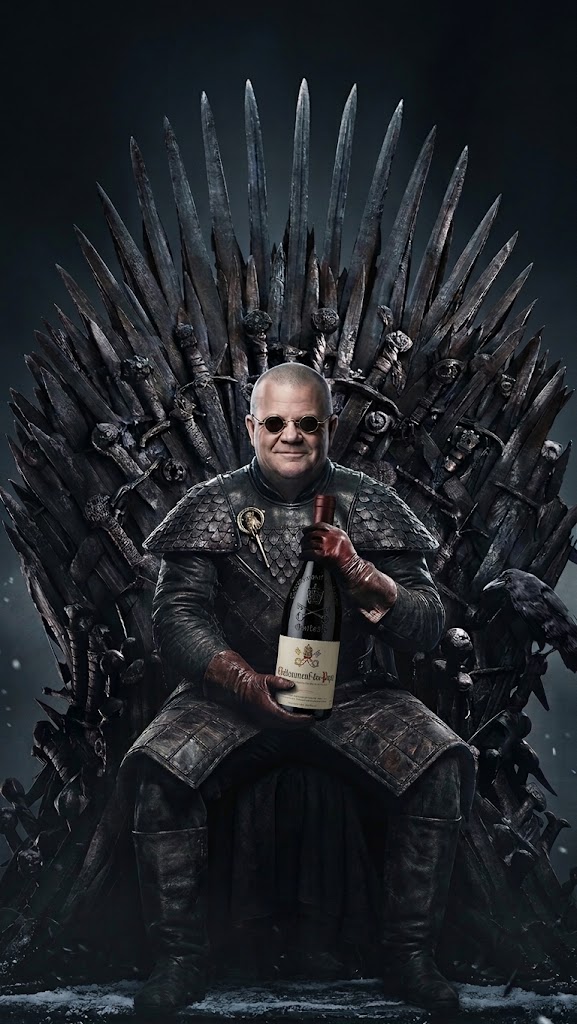
A Game of Rhônes – Act One: Babylon on the Rhône
From the Palais des Papes of the Avignon Popes,
to the Hermit on the Hill at Tain-l’Hermitage;
from the roasted slopes of the Brune et Blonde
to the Arc de Triomphe d’Orange,
no galets roulés shall be left unturned
as we undertake our quest and enter into
A Game of Rhônes.
—An invitation
Rhônes and Thrones
One evening, a long table at Baldwins: seventeen guests, five courses, and seven wines. Five came from the Rhône, another was a migrating Italian, and the last came from Banyuls, courtesy of a great Rhône house. The invitation offered a choice of dress: smart casual or medieval battle armour. Everyone chose smart casual.
A Confession
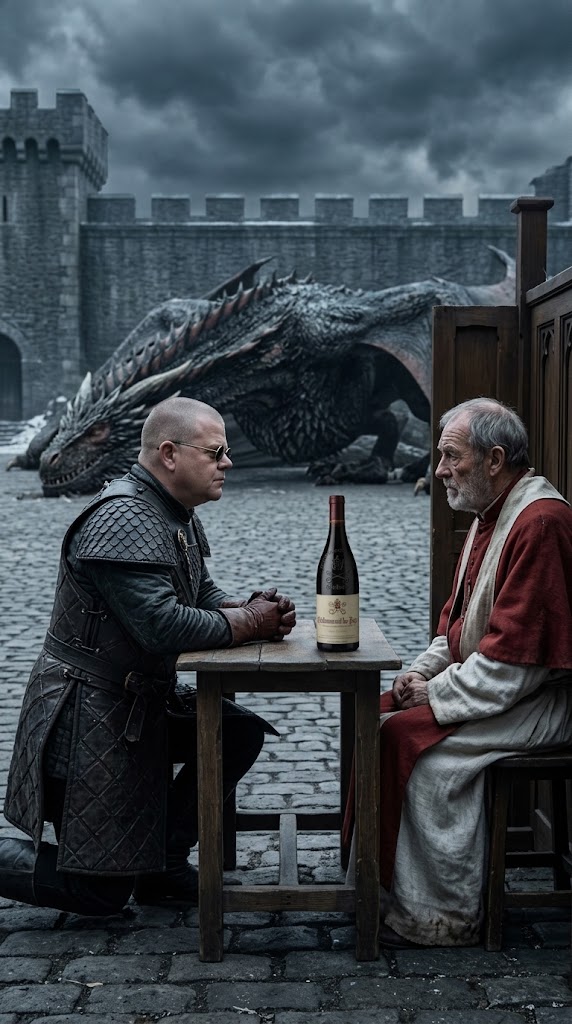
First, a confession. Although the evening’s title is a play on words borrowed from the enormously successful television series Game of Thrones, I have never watched a single episode. I know virtually nothing about it, save what can be gleaned from occasional snippets on social media. I have nothing against it; I simply do not watch television.
What I do know is the Rhône. I have long adored its wines, from the depth and complexity of its reds made from Syrah, Grenache, and Mourvèdre, often blends of all three and sometimes more, to the perfumed lushness of its whites made with Viognier, Marsanne, and Roussanne. Wine merchants would often quip that the region’s reds offered the body of Bordeaux and the aroma of Burgundy at a fraction of the price of either. What I have always admired is that these are wines of enormous complexity, wines that seek to find balance on a scale weighing finesse, depth, and concentration against glorious tradition, stoic local character, and an enchanting rustic charm.
As for the pun, it is less of a stretch than it looks. In the fourteenth century the Rhône held the throne of Christendom, and before the century was out there would be more men claiming that throne than there were thrones. But that is a story for the end. Here, we are at the beginning.
Of Rivers and Dragons
The Rhône rises in the Rhône Glacier high in the Swiss Alps, runs into and then back out of Lake Geneva, takes in the Saône at Lyon and the Durance downstream of Avignon, and reaches the Mediterranean through the marshes of the Camargue. Its wines come in two halves. In the north: steep slopes of granite and schist, a continental climate, and Syrah as the principal red grape, with Côte-Rôtie famously permitting a small proportion of the white grape Viognier in the blend. In the south: a broad Mediterranean valley, galets roulés underfoot, and Grenache-led blends. Our menu would zigzag between the two, north, south, north, before slipping out of the valley altogether for the final glass.
Like Lyon and Avignon, Phnom Penh is a city built where rivers meet. At Chaktomuk, the Tonlé Sap River joins the Mekong, which then divides into the Mekong and Bassac channels. By the time the river reaches the sea in Vietnam, it has divided into the many distributaries traditionally celebrated in the Vietnamese name Cửu Long: the Nine Dragons. The invitation promised an evening that would run “until the last dragon is slain”. In Phnom Penh, the dragons are born on our doorstep.
Babylon on the Rhône
The region’s roots go back to the Ancient Greeks, who founded Massalia, today’s Marseille, around 600 BCE and are believed to have brought the first cultivated vines upriver. The Romans followed. Writing his Natural History in the AD 70s, Pliny the Elder praised “the famous grape that confers such celebrity on the territory of Vienne”, whose wine had a natural taste of pitch; later writers identify it with the vine the Romans called Allobrogica. Vienne is just across the river from today’s Côte-Rôtie, and tradition holds that it was the Romans who first cut the now famous stone-walled terraces into those slopes. After the fall of the Western Roman Empire the vineyards survived the Dark Ages thanks to the monks and their abbeys. The very idea of a medieval Dark Age, as it happens, owes much to Petrarch, of whom we will learn more later.
In 1305, almost a year after the death of Benedict XI, a conclave at Perugia finally broke its deadlock between French and Italian cardinals and elected Raymond Bertrand de Got, the archbishop of Bordeaux, as Pope Clement V. He was a man who knew his vines: the vineyard at Pessac that his brother Béraud gave him on his appointment to Bordeaux still carries his papal name as Château Pape Clément. As a French pope he was reluctant to move to Rome and beyond the influence of his king, Philip IV. He never went. He was crowned not in Saint Peter’s but at Lyon, on the Rhône, on 14 November 1305, and the omens were poor. As the procession passed, a wall crowded with onlookers collapsed onto the Duke of Brittany, who was leading the pope’s horse. He died four days later.
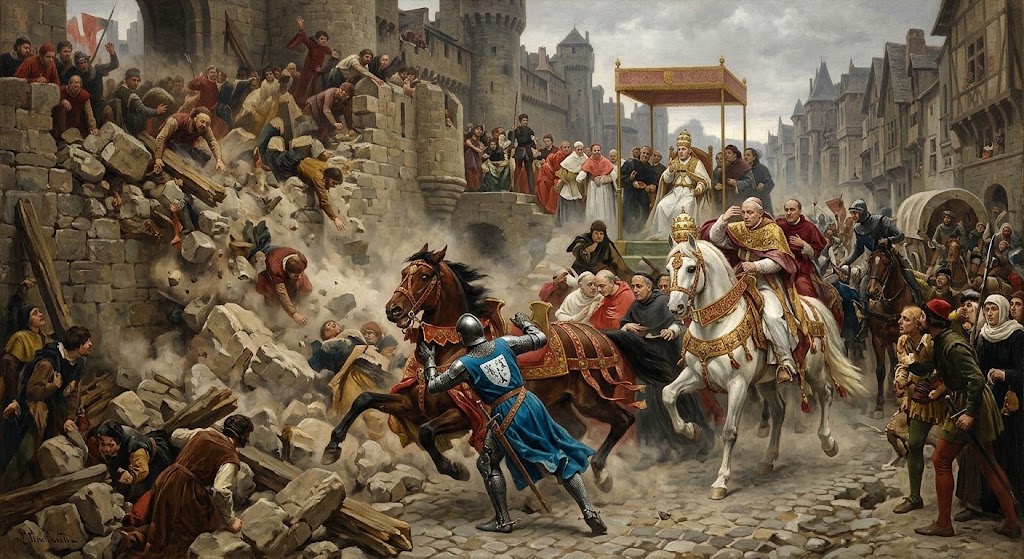
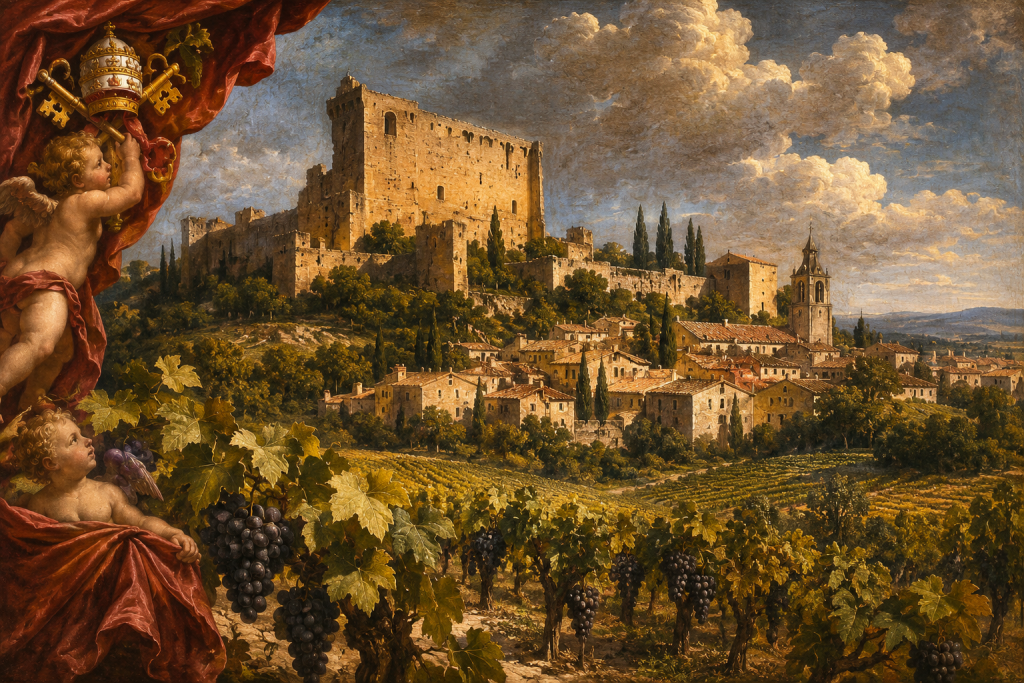
For years, the papal court wandered. Then, in March 1309, the Curia settled in the Dominican priory at Avignon, on the east bank of the Rhône. Avignon was not even strictly French; it belonged to the counts of Provence, and the papacy only bought the city outright in 1348. Until 1377, seven successive popes would reign from here, all of them French-born, and the Palais des Papes, part palace, part fortress, rose above the river to house them.
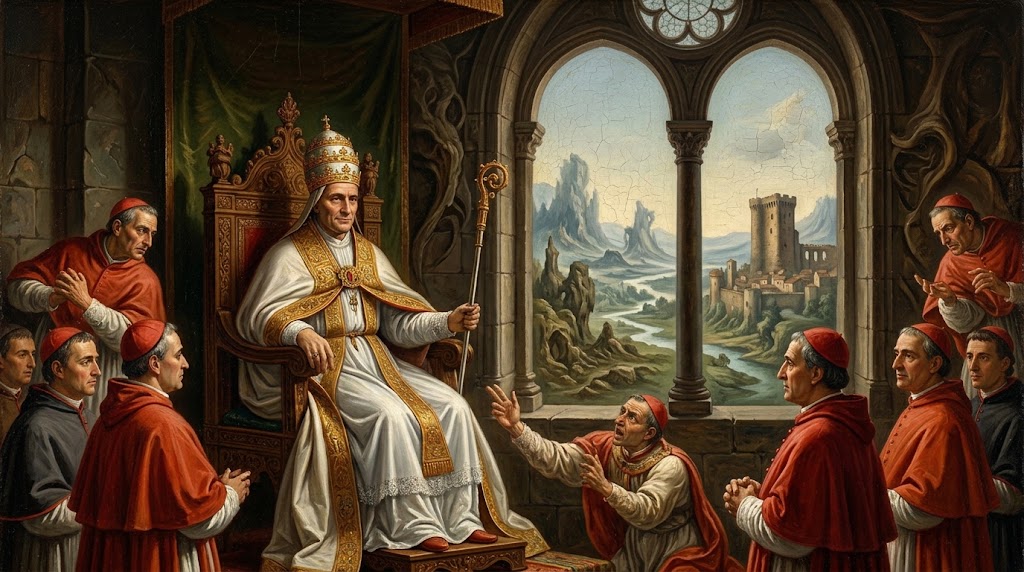
The second of them matters most to our story. In 1316, after more than two years of wrangling, the cardinals elected Jacques Duèze of Cahors, then in his seventies, as John XXII. A year later he ordered a new castle built on a hill north of Avignon, above a village whose wine he drank and promoted; it was finished around 1333. The village had been called Châteauneuf, after an older fortress, since at least 1094, and for centuries Châteauneuf-Calcernier, after its lime kilns. The pope’s name was in common use by the sixteenth century, but the village became Châteauneuf-du-Pape, the pope’s new castle, officially only in 1893.
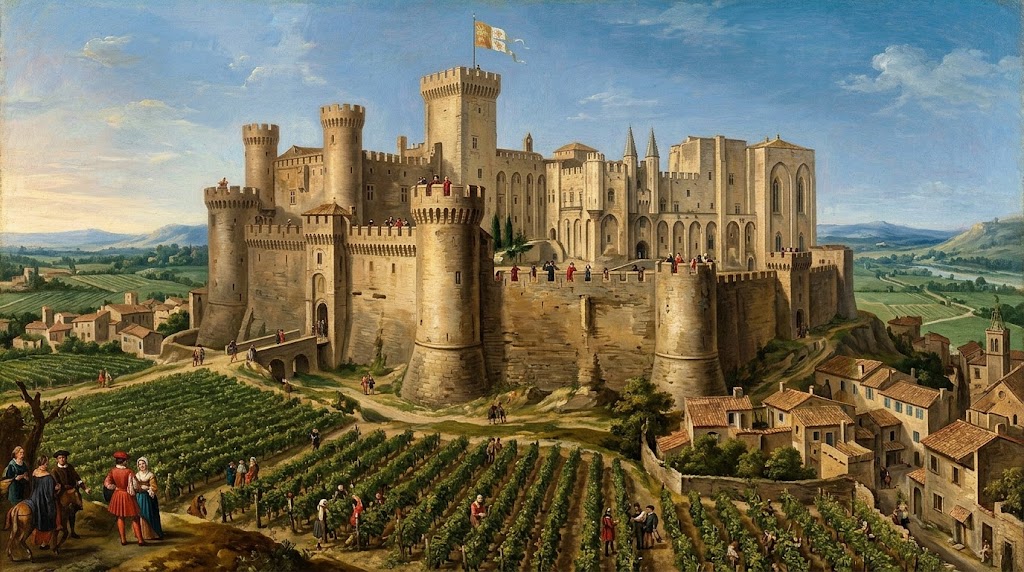
In John XXII’s day, peddlers sold its wine as the “vin du Pape”, and the court’s wealth and thirst made the papal name valuable to the Rhône’s growers, though the popes and their cardinals, it must be said, favoured Burgundy. That scandal waits for another Act.
Pope John XXII was a formidable old man to cross. In the 1320s an English Franciscan, a political philosopher from Padua, and a German Dominican mystic would each be summoned, excommunicated, or condemned by him; each will join us at the table in the Acts that follow. A fourth guest, a young poet whose exiled family had settled in Avignon, would come to call the city Babylon.
ACT ONE
The Pilgrimage
Upon arrival, guests were poured the Astoria Ribolla Gialla, a fresh, dry Italian sparkling wine. Italy as a starting point before a pilgrimage to Avignon, a journey that brought the papacy there in 1309. The wine displayed notes of green apple, citrus zest, white peach and subtle floral nuances. The palate was crisp and refreshing, with bright acidity, a delicate mineral edge and a gently savoury finish. Clean and fresh, an enticing and pleasurable start to the journey. 86/100 DG
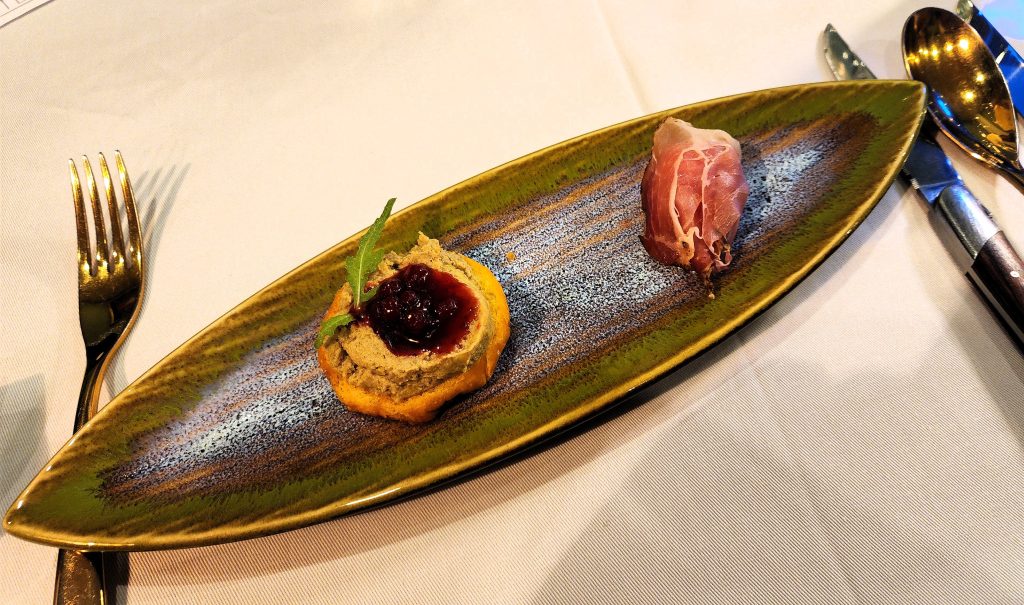
With it came the amuse-bouche, a study in texture and rich, savoury harmony: house-made foie gras and tissue-thin slices of Pata Negra cured ham. The foie gras’s buttery, delicate sweetness met the ham’s nutty, melt-in-your-mouth saltiness, and the wine’s fine bubbles and bright acidity cut cleanly through both.
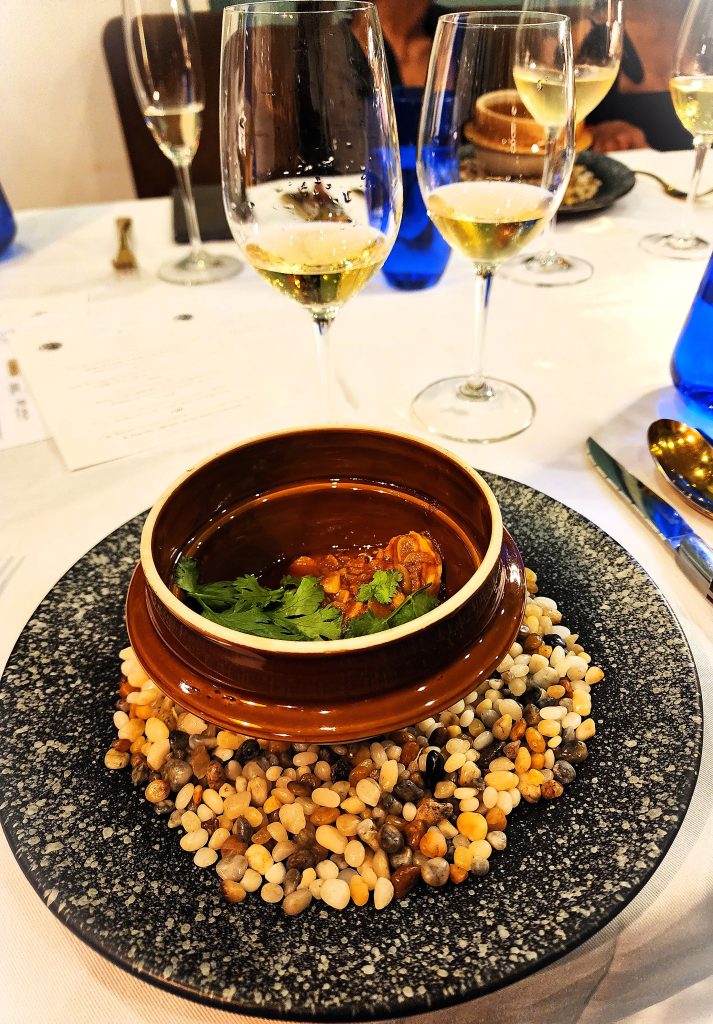
Gambas Pil Pil
Mekong prawns, chilli oil, curry, coriander, and toasted sesame
Pil pil is Basque, named for the sound the sauce makes as it bubbles and emulsifies in the pan, but these crustaceans came from our own river. A stunning dish: juicy, plump prawns sizzling on the plate, wafting out aromas of sweet, subtle spices, the seasoning and spices beautifully fragrant and intoxicating. Pata Negra, then pil pil: Spain had slipped onto the menu twice before the first red.
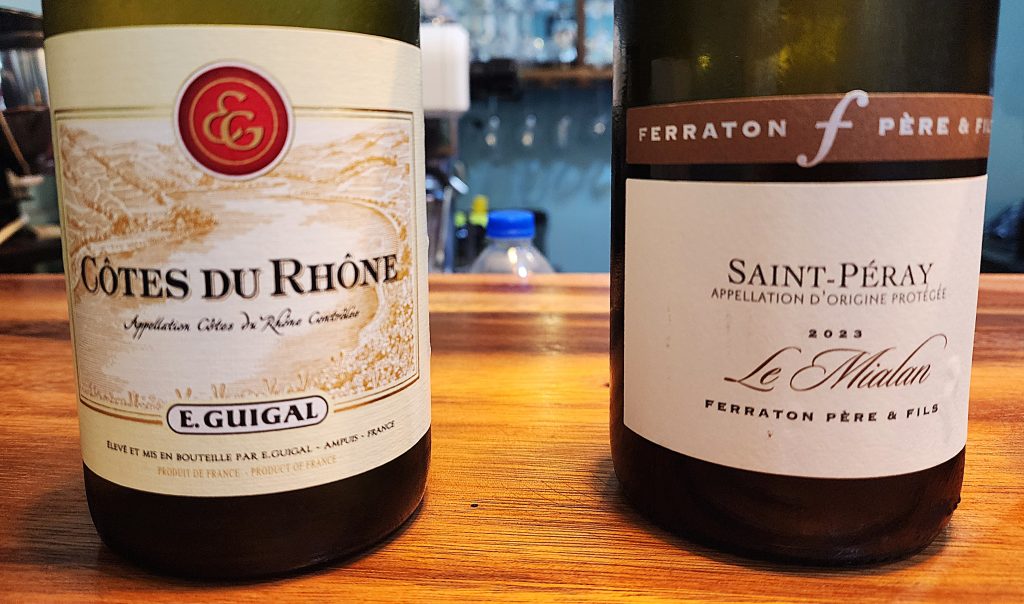
- Guigal, Côtes du Rhône Blanc, Rhône, France, 2024
Guigal builds its white Côtes du Rhône on Viognier, a grape that very nearly disappeared: in 1965 just eight hectares were left in Condrieu, its northern home. Today, the cuvée runs to some 700,000 bottles a year.
A blend of Viognier 60%, Roussanne 15%, Marsanne 10%, Clairette 8%, and lesser amounts of Bourboulenc 5% and Grenache Blanc 2%, aged entirely in stainless steel for about nine months.
An expressive, aromatic wine, opening with white flowers, apricot, almond, and a suggestion of wild honey. The palate is medium-bodied, with an open, generous expression of fruit: white peach, citrus zest, and marzipan, supported by refreshing acidity and a clean finish.
A delightful, easy-drinking way to start dinner. 89/100 DG
Ferraton Père et Fils, Le Mialan, Saint-Péray, Rhône, France, 2023
Saint-Péray sits at the southern tip of the northern Rhône, across the river from Valence, its vineyards climbing beneath the ruins of the Château de Crussol. In the nineteenth century its sparkling wine, first produced here in 1829, enjoyed considerable prestige, and Wagner is said to have ordered a hundred bottles while writing Parsifal.
Named for the Mialan, the stream that runs through Saint-Péray into the Rhône, the wine is 100% Marsanne, from soils that are mostly granite and Jurassic limestone, with some sandy marine deposits. The must is cold-settled for 48 hours before a temperature-controlled fermentation with indigenous yeasts gets under way, and the wine is aged 70% in stainless steel and 30% in old oak demi-muids.
Bright straw in colour, with lemon-flecked highlights. The bouquet is lifted and perfumed, a note of flint giving way to marmalade, tangerine, pomelo zest, and minerality. On the palate the wine demands your attention: exceptional in balance and structure, with ripe stone fruit, a touch of citrus, and a fine backbone of minerals and acidity. Focused, precise, and very impressive. 94/100 DG
The Pairing
Both wines brought sufficient weight of fruit to meet the spice head-on, while the freshness of the Marsanne, in particular, cleansed the palate and kept the flavours lively throughout. It was a harmonious combination, one wine offering aromatic generosity, the other structural precision. Food and wine were not merely accommodating one another here; they were positively revelling in each other’s company.
One wine named for a single stream through a single village, the other for an entire valley. Is “Côtes du Rhône” a thing at all, or simply a name we give to a great many particular things? It is a question an English friar, summoned to Avignon in 1324, would have relished.
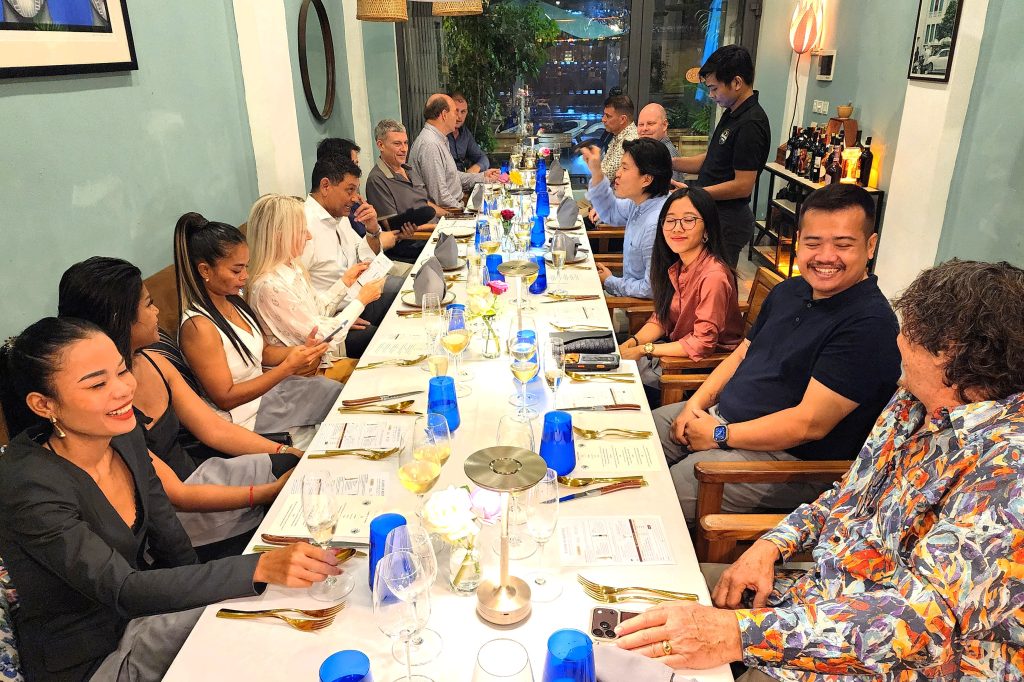
Guy Baldwin was already performing wizardy with his cauldrons back in the kitchen. Glasses refilled and palates refreshed, we were ready for the first red, and for the first of the pope’s awkward customers.
Next, Act Two: a friar with a razor, and two daughters on a hill.
Darren Gall
