
Things of Stone & Soil
Saison d’octobre
Over thirty years ago I spent a pleasant Sunday afternoon at the National Gallery of Victoria, meandering through an exhibition of paintings by Vincent van Gogh. The exhibition also featured works by some of the artists who had influenced him, and by the artistic movement to which he belonged. As I came to the end of a wall of van Goghs, the programme invited me to turn over my left shoulder and cross to the other side of the room.
I turned, I saw it, it drew from me a short, sharp breath, I had to look again, my mind could not quite believe what it was seeing, and then, just as quickly, I was amazed.
I was staring, for the first time in my life, at Jules Bastien-Lepage’s Saison d’octobre (1878), better known today as The Potato Gatherers. A work so striking that this first encounter with it is one I shall never forget; it left me breathless as no painting had before, and none has since.
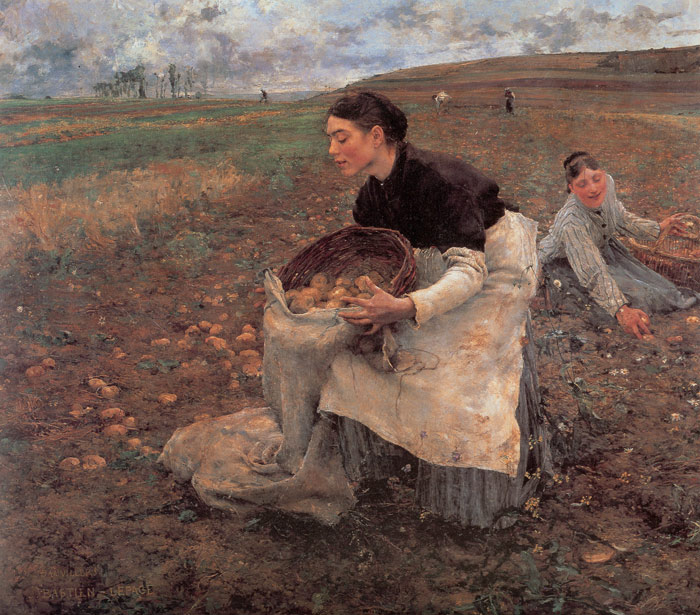
The painting still belongs to the National Gallery of Victoria, and on that day whoever hung it had done their job to perfection. Saison d’octobre is a large work, almost two metres high by two metres wide. To my eye, at that distance, the central woman seemed to be standing right there in front of me, outside the painting altogether, with a presence so physical that – just for an instant – it startled me and then held me. (Or was I suddenly out there in the field with her, transported? For a nanosecond I could not be sure.) That wretched field she stood in: threatening, almost an affront to her beauty — grey skies, damp, sticky mud, hard labour, abject poverty, even cruelty.
The catalogue describes a different painting. Read the scholarship and you will find Saison d’octobre called the gentle one of the pair, the idyll set against Les Foins of the year before: its peasants notably content in their work, the hardship sweetened for a Salon audience. I have never been able to see that painting. Perhaps that is the privilege of a first encounter — you meet the thing before anyone has told you what to look at. I saw a truth rubbed raw in it, and something of where my people had come from.
I am an Australian because the cattle hand John Gall was transported from Brechin, Scotland to Van Diemen’s Land (Tasmania), Australia for the term of his natural life. The year was 1828, the crime was cattle theft. He was prosecuted without ever having the chance to call any witnesses, nor mount any case for the defence whatsoever. I have never doubted that he was carrying out the orders of his landowner and master — who paid for the drove and kept himself clear of it. If it all went wrong, the labourer took the fall. Farm hands of the time were paid little money; they worked for food and lodging, they had no hope of ever owning land or cattle.
None of this was in my mind on that summer afternoon in Melbourne. I only knew the field.
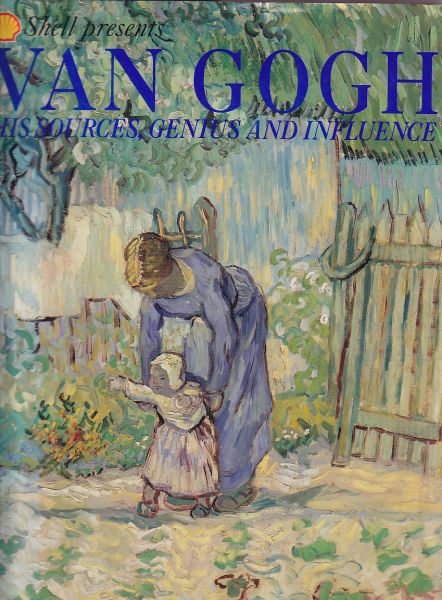
Van Gogh, in his regular correspondence with his brother Theo, wrote many times in praise of Bastien-Lepage and his naturalist style. He admired the honest realism and the focus on the difficult yet dignified daily labour of country folk. Works such as The Grape Harvest served as an important thematic model for van Gogh’s own early interest in rural and agrarian subjects. In Letter 400 (old numbering), written to Theo around 13 April 1885, he notes how newer generations of realist painters build upon foundations laid down by “Father Millet” and Bastien-Lepage.
In April 1885 — the very month he began The Potato Eaters — van Gogh explicitly grouped Bastien-Lepage with Jean-François Millet and Jozef Israëls as the master painters of rural workers. Five years earlier he had ‘made his own’ Angelus after Millet, an homage to Millet’s The Angelus, in which two peasants bow over a basket of potatoes to say a prayer, the church and its steeple on the horizon behind them, the bell marking the end of a day’s work.
The connection is close enough that in 2016 the Van Gogh Museum in Amsterdam bought Bastien-Lepage’s The Grape Harvest of 1880, specifically to hang in the museum as evidence of how directly French naturalism informed Van Gogh’s early path.
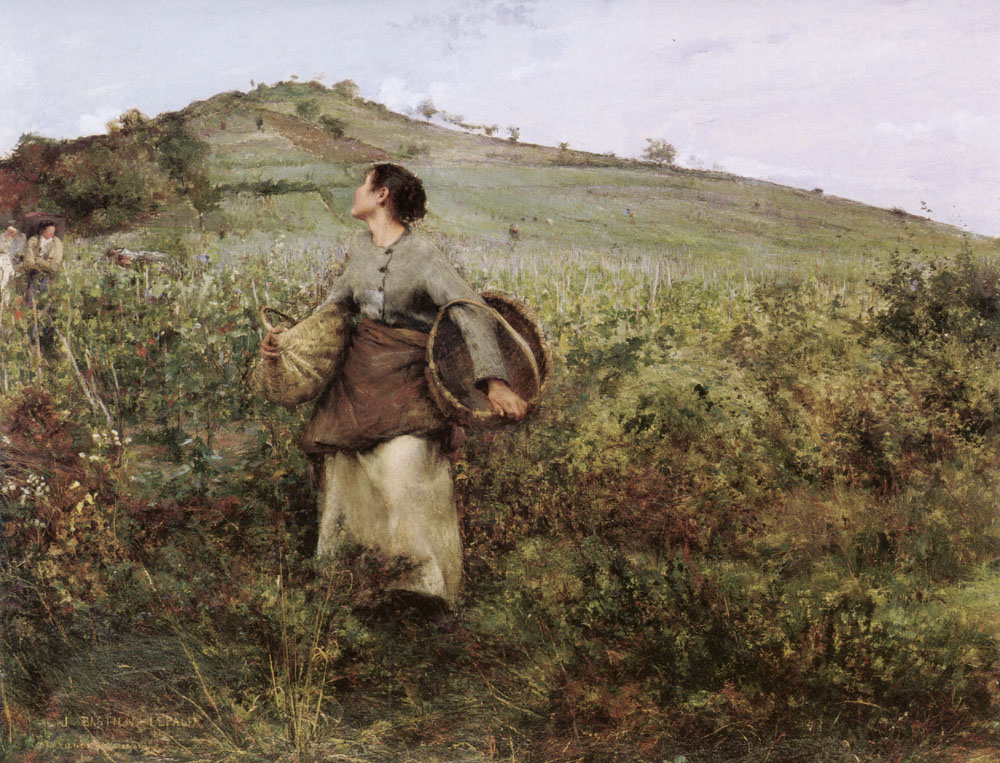
No print can do justice to Bastien-Lepage’s technique. It showed some of the earliest photography-assisted composition, but the critics of the day understood they were watching something more than accomplishment. Set against the extraordinary detail and polish of the central figure was a background that was less focused, less resolved, and somehow more dramatic for it. The technique invited interpretation into the work; it made room for emotion and depth, and it gave a glimpse of a new kind of art, of new directions, and of where painting might go now that photography was taking over from realism and life-like portraiture.
That shift was not only a matter of taste. It was also a matter of chemistry and tin.
The camera, announced in 1839, released painters from the obligation to replicate. Once photography could document a face, a fact, or a landscape instantly and cheaply, painters increasingly abandoned strict mimetic realism and turned towards abstraction, emotion, and subjective experience. Creativity was released onto the canvas; painters were free to be whimsical, and were given licence to explore and exploit the one thing photography could not yet deliver: colour.
All they needed then was mobility. Before 1841, artists (or their apprentices) ground raw pigment by hand and mixed it with oil daily, and storage in animal bladders or poorly sealed glass was hopeless. In that year, an American portraitist, John Goffe Rand, patented the collapsible tin tube. Paint could now be kept for months and carried safely out of the studio. Renoir is said to have remarked that without tubes of paint there would have been no Impressionism.
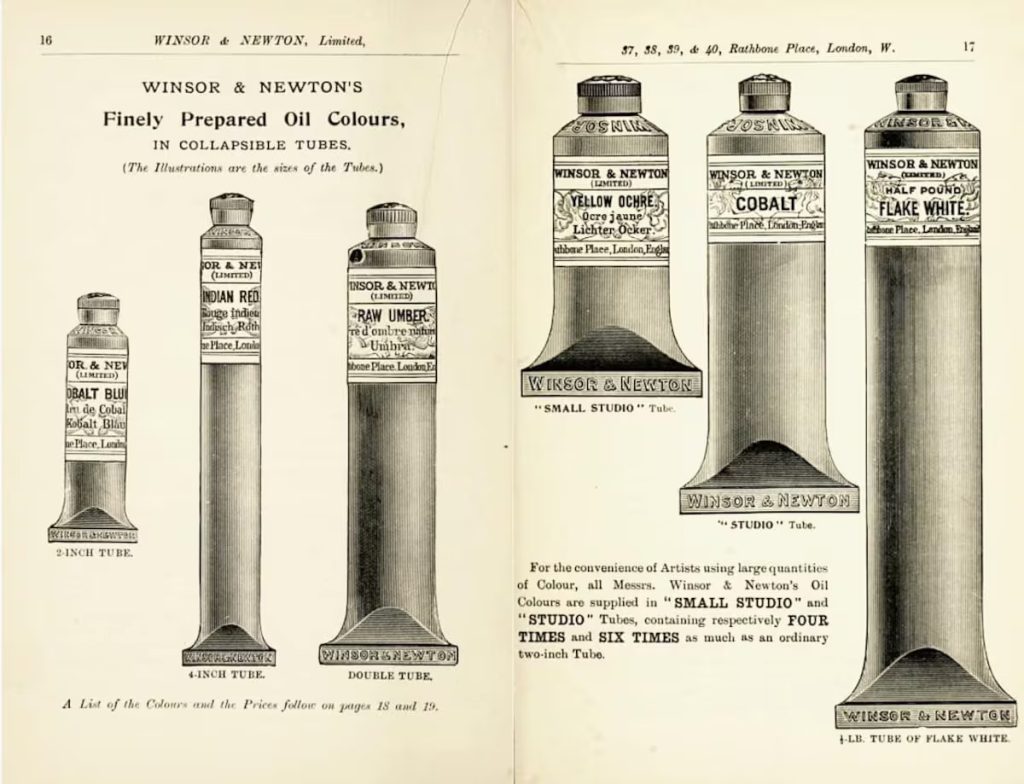
It is worth being precise about what the tube actually delivered, because it was not only colour. A studio painter works from studies, from memory, from a model hired to hold a pose in good light. A painter with tubes in his pocket walks out into the field and stays there while the light moves and the cold comes down. And what was waiting in the field was labour.
Bastien-Lepage could paint that October mud because he could stand in it. Peasants themselves were nothing new — they run back through Millet to the Le Nain brothers and to Brueghel — but they had largely been painted from studies, indoors, at a remove. The tube did not create the subject. It let a painter stay out in the field with it, at that scale, from life, while the light moved and the season turned. He and others in the Naturalist and Realist movements could now attend to the physical toll of agriculture, to workers earning their meagre food through calloused hands and sweat. He rejected the romanticised, urban conception of the countryside in favour of the true, bleak conditions of the soil, wanting to convey the silent resilience of his subject — the heavy, repetitive motion of digging for root crops standing for endurance against poverty and the unyielding rhythm of nature.
Saison d’octobre was exhibited at the Paris Salon of 1879, where the large canvas (180.7 × 196 cm) became a great public attraction and drew considerable critical acclaim. It brought Bastien-Lepage international fame and the Légion d’honneur at the age of thirty-one. The recognition helped establish a rural Naturalism that would go on to shape late nineteenth-century painting well beyond France.
Worn Out
If Bastien-Lepage took me aback with the quiet endurance of October, I was not ready for H. A. Brendekilde’s silent scream.
I said a moment ago that no print can do justice to Bastien-Lepage. That is true, and it is also the strongest argument against everything I am about to tell you, because I have never stood in front of the Brendekilde. I have only ever seen it in reproduction, and it still does this to me.
Udslidt — Worn Out — was finished in 1889 by the Danish painter H. A. Brendekilde. It is 2.07 metres high by 2.70 metres wide, which means that everything I know of it I know at a tenth of its size, off a page, and it has never once mattered. I challenge anyone to take it in and not be affected, not be moved. It is a striking, confronting work.
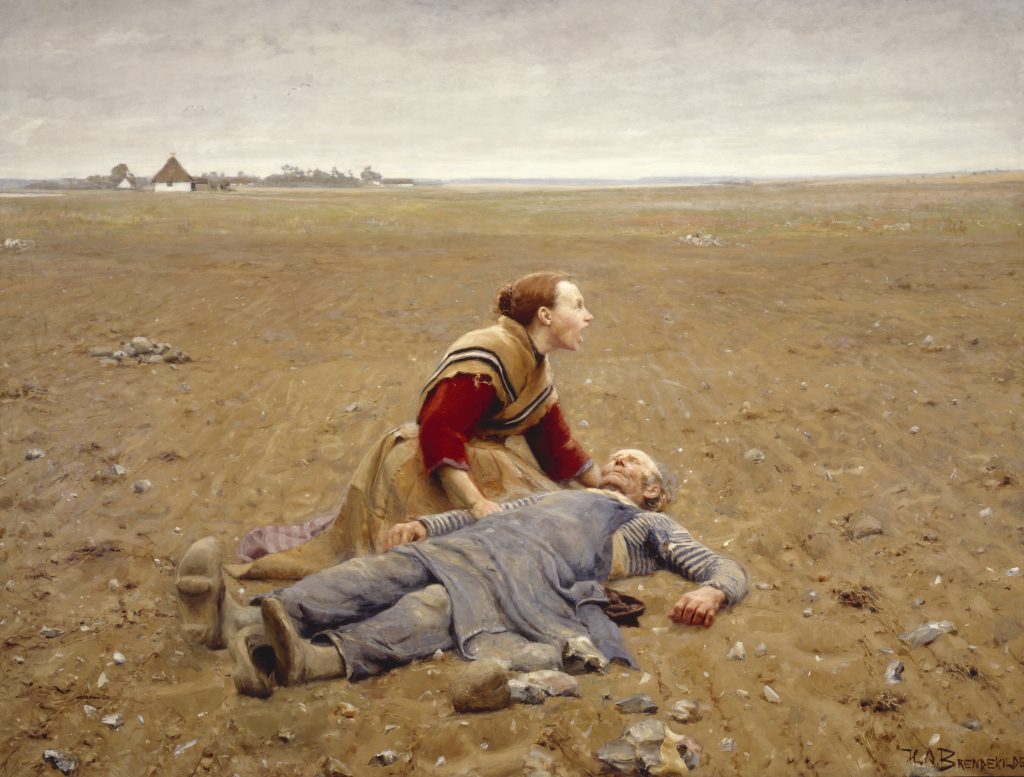
An elderly stone-collector has collapsed onto his back in a vast, barren, and rocky field after a lifetime of backbreaking manual labour. A younger woman, perhaps his daughter, kneels over him in despair, crying out for help with wide, tearless eyes. A high horizon and a wide angle of view make the two figures look tiny and isolated against a bleak landscape. The painting is a stark critique of poverty, and of the fate of a working class driven into hard manual labour until they dropped dead. Brendekilde used the image to show how the poor were treated as disposable tools, to be used up and replaced.
My own grandfather was found in much the same position, in his own vegetable garden, the shovel close by. He was eighty-nine, and it was his own soil. The posture is identical; everything else is a century of difference.
Brendekilde’s painting provoked intense reactions. Conservative critics and the upper class attacked the work as melodramatic and explicitly political, uncomfortable with how directly it challenged the social hierarchy; the emerging socialist and worker movements in Denmark adopted it as a rallying cry. It exposed the brutal reality of a still near-feudal agricultural system with no safety net and no pension. The novelist Henrik Pontoppidan, who knew Brendekilde well enough to take him as the model for the socialist painter-hero of his 1894 novel Nattevagt, read the collapsed labourer as a martyr of an unjust economic system. Some art historians have since called the kneeling woman the first living person in painting to cry out at the condition of a society, breaking a long tradition of passive, silent grief.
Brendekilde used international platforms to amplify the critique. The painting debuted at the 1889 Exposition Universelle in Paris, which marked the centenary of the French Revolution, where it took a silver medal and appeared in the catalogue under the provocative title Au Secours — Help. It went on to Copenhagen in 1890, to Munich in 1891 as Zu Hülfe, and to the World’s Columbian Exposition in Chicago in 1893. That exposure cemented it as a seminal European work of social realism.
Edvard Munch reached Paris in the closing weeks of the Exposition in 1889; his own Morning hung in the Norwegian room just a few doors along from the Danish room, where Worn Out was being shown. Four years later he painted The Scream; nobody can prove he looked.
Rebellion
What struck me first in both — in one across a gallery floor, in the other across a page — was the sheer brilliance of their scale and composition. It took longer to understand that what I had walked into was a rebellion: one conducted through a quiet endurance, the other in dramatic shock.
The first part of it was simply where the paintings hung. Bastien-Lepage and Brendekilde carried the harshness, grit, sweat, and pain of the fields into direct confrontation with the wealthy upper echelons of society by invading the spotlessly clean, grand spaces of their galleries. Hung amidst works of Romanticism that offer smooth, blended, almost invisible brushwork, warm glows, spotlit gods and heroes, perfectly staged poses and settings, figures clean and muscular and triumphant — here now were workers under overcast skies, toiling in the soil, their hands dirty and scarred, sweat on their brows.
But the deeper rebellion was in the painting, not of the painting. A rebellion in technique, in composition, and in subject.
Both men use thick, gritty applications of paint — impasto — for the mud, the rocks, and the soil, so that the surface physically mimics the rough, unyielding texture of the earth. Bastien-Lepage keeps his background soft and the woman’s face incredibly sharp; her eyes are slightly glazed and look past you, and he uses thin, dry layers to show chapped lips and windburned cheeks, catching a state of mental numbness. Brendekilde puts sharp, harsh highlights on the screaming woman’s face — you can see the tension in her neck, painted in quick, urgent strokes — while the collapsed man’s hand lies rough, dark, and stained with dirt, resting limply on the rocks he spent his life clearing.
I felt the emotional impact of both works, their confrontation, and an empathy for their subjects. Standing inside the lavish grandeur of a gallery, here was art that forced you to witness structural injustice and human fragility, offering no grand explanation and no comfort, only a profound connection to a life spent on unyielding soil. The two paintings looked into me and taught me a little about who I was.
For a time, I was inspired enough to attend the Melbourne School of Art, studying oil painting.
But it was Bastien-Lepage and Brendekilde who taught me, as a young man, what a painting can do to a body. I can feel them both still: the turn of my shoulder, the field opening in front of me, the breath going out before I had understood a thing; and a woman screaming over a stone field I have never once stood in front of, whose scream reaches me anyway, off the page, every time.
Darren Gall
