
CHAPTER THREE
The Hinge
The Beautiful Era and Its Fractures
First Movement — 1880 to 1902
The Beautiful Unease
The Rue de Rome
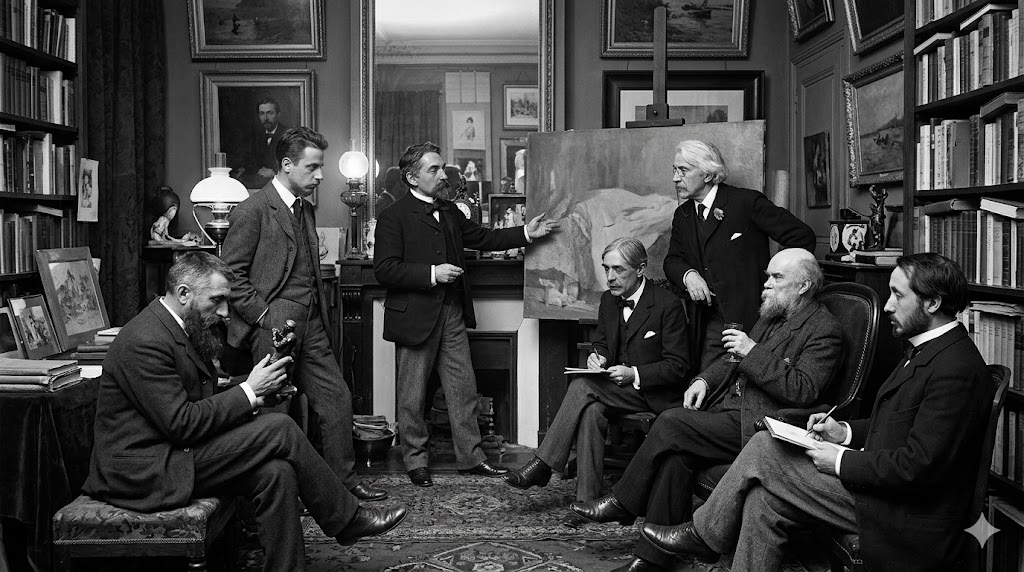
On regular evenings in the late 1880s and into the 1890s, a small apartment on the rue de Rome in Paris held what was arguably the most concentrated gathering of artistic intelligence in European life. The apartment itself was modest: a square room that also served as the family dining room, simply furnished with a table, chairs and a sideboard. Outside, the tracks of the Saint-Lazare railway ran close enough to shake the windows. The sound of arriving trains — the hiss of steam, the slow metallic percussion of the age — provided an industrial counterpoint to the conversations inside. Outside, the machine century pressing in. Inside, Stéphane Mallarmé in his mahogany rocking chair, rolling his own cigarettes, speaking in a voice so low it compelled silence.
They came every Tuesday, ‘Les Mardistes’ as they would become known. Paul Verlaine was a regular — the poet who had survived prison, penury and the most turbulent literary friendship of the century, and who now appeared at the rue de Rome with the dignified ruin of a man who had burned everything and was still standing. Paul Valéry, young and already brilliant, sat on the floor and listened. The painter James McNeill Whistler came — close friends with Mallarmé, their aesthetic kinship real and documented. Debussy was a regular, drawn to Mallarmé’s poetry with the specific intensity of a composer who understood that what the poet was doing to language — dissolving its hard edges, making it suggest rather than state — was precisely what he needed to do to music. Their connection was not incidental. It was generative. Mallarmé’s poem L’Après-midi d’un faune would become the source material for the Prélude that marks the beginning of musical modernism, the piece in which Debussy dissolved tonality in pursuit of the same shimmer and ambiguity that Mallarmé had found in the symbol. The Tuesday evenings were, among other things, the room where that transformation was seeded.
The atmosphere was described by those who attended as resembling a secular mass. Mallarmé spoke; his guests listened with the concentrated attention of people who understood that something important was being said. He led not by volume or authority but through what his contemporaries called intellectual magnetism — by treating a struggling young poet with the same quiet dignity as a famous novelist, by asking questions rather than issuing pronouncements, by making the room feel like a space where the fashionable world and its noise had been deliberately set aside in favour of something that mattered more. His wife and daughter would briefly appear to serve hot grog before retreating. The only refreshments were tobacco and warm drink. Nobody appeared to mind.
On the sideboard sat a plaster sculpture — a faun clasping a nymph — gifted to Mallarmé by Auguste Rodin. The gift was not a courtesy. It was an acknowledgement of deep artistic kinship. Both men were working at the same border: the place where the physical and the spiritual touch, where the body becomes the vehicle of something the body alone cannot contain. Rodin’s faun sculptures and Mallarmé’s poem occupied the same mythological territory, asked the same question from different directions. Rodin appeared at the Tuesday evenings occasionally — not every week, his studio and his commissions consuming most of his evenings — but when he did, he found a room that received his radicalism as what it was. The same Paris that accused him of fraud and obscenity in the newspapers celebrated him here as a serious artist. He needed that. And he returned the gift by placing his work on the sideboard, where it presided over conversations he did not always attend.
The Lilac Enclosure
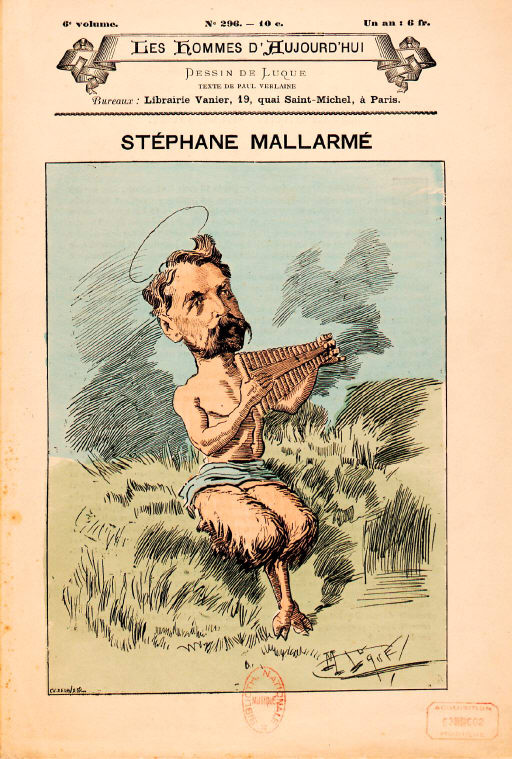
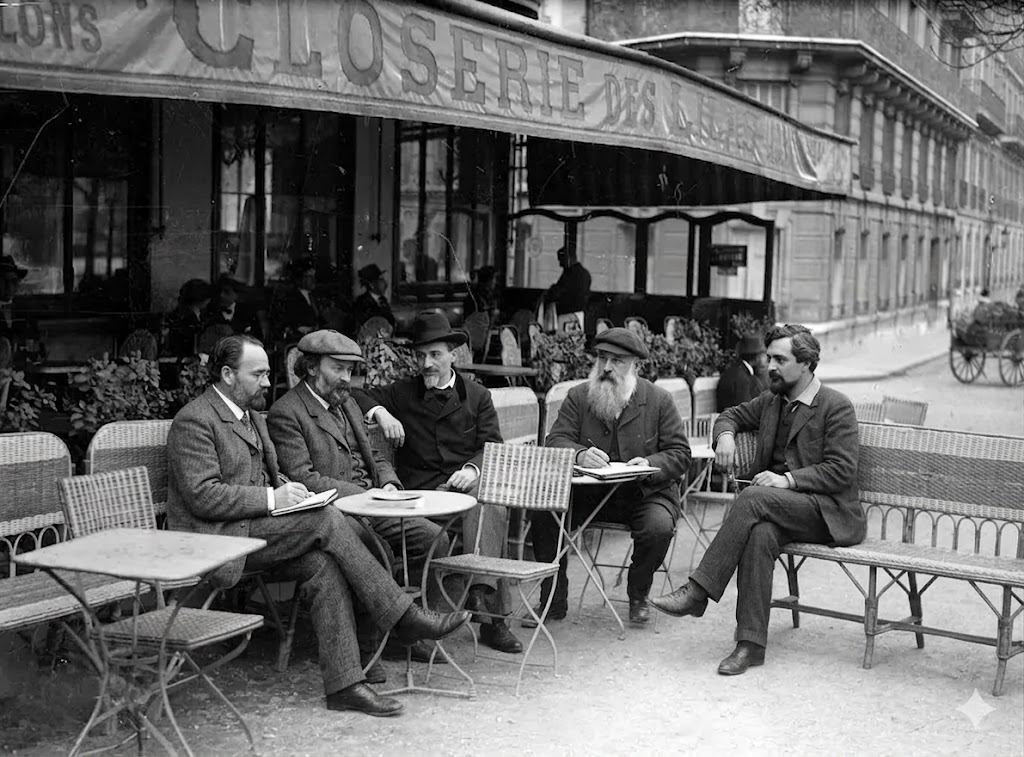
A short distance south and west, at 171 Boulevard du Montparnasse, La Closerie des Lilas had been gathering artists and writers since 1847, when François Bullier planted lilac bushes around an open-air guinguette and gave the place a name that carried both beauty and enclosure: a beautiful space, slightly hidden from the boulevard, slightly apart from the world outside. By the 1880s it had become something more than a café — a room where the significant minds of the Left Bank gathered not to perform but to think, to argue, to sit alongside each other in the specifically Parisian way that required no justification beyond the quality of the company.
Physically, it was distinct from the grand cafés of the boulevards. The shrubbery that partially screened it from the street gave it the character of a room rather than a stage. Inside: a mahogany bar, red leather stools, a mosaic floor, low warm light that pooled on the tabletops. On the terrace in summer, chestnut trees provided shade, and from the corner table you could see the bronze statue of Marshal Ney — sword raised among the new-leafed branches, his top-boots catching the afternoon light — standing in perpetual command over a street that had long since moved past the world he represented.
Émile Zola came here. He was at that time the most famous novelist in France and the architect of the Rougon-Macquart cycle — twenty novels documenting the social reality of the Second Empire with the combined precision of a scientist and the emotional range of a poet. He and Rodin had been friends since the mid-1880s, bound by what contemporaries recognised as a shared creed: that truth required looking at the world without idealisation, and that the human body, in all its specificity, was a worthy subject for the highest artistic ambition. Critics had taken to calling Rodin the Zola of Sculpture — the sculptural counterpart to the man who had brought naturalism to French prose. They ate dinner together, argued across tables at which Claude Monet and Guy de Maupassant also sat, and shared the particular ease of artists who understand each other’s obsessive relationship with the unglamorous particular.
Their friendship had produced something concrete. In 1891, when the Société des Gens de Lettres commissioned a monument to Honoré de Balzac, it was Zola — serving as the Société’s president — who pushed for Rodin to receive the commission. The sculptor was not the obvious choice; safer candidates were available. Zola chose him anyway. Rodin wrote to Zola that he had “often studied [Balzac], not only in his works but in his native province” — travelling to Touraine to find men who resembled the writer, reading the novels until they were part of his own thinking, trying to find not Balzac’s likeness but his creative force. He addressed his friend as “dear colleague and friend.” The phrase carried warmth. It also carried, in the event, a weight neither man could yet have anticipated.
The Earthquake — J’Accuse
In October 1894, a memorandum listing French military secrets was found in the waste-paper basket of the German military attaché in Paris. The French army’s intelligence section, working with panic-driven speed, identified its author as Captain Alfred Dreyfus. He was Jewish, Alsatian, precise — qualities that in the atmosphere of that moment made him a convenient target. The evidence against him was thin. Evidence exonerating him was suppressed. He was court-martialled in December 1894 in a secret session and sentenced to life imprisonment on Devil’s Island.
On 5 January 1895, Dreyfus was publicly degraded in the courtyard of the École Militaire. His epaulettes were torn off. His sword was broken. The ceremony was designed to be witnessed and to be humiliating — a display of institutional contempt staged for the crowd. Among those watching was a young Viennese journalist named Theodor Herzl, who heard the crowd shouting “death to the Jews” and went home to begin writing The Jewish State, the founding document of modern Zionism. France’s internal wound had, in a single morning, opened a fissure that would run through the coming century.
For two years, nothing moved officially. Dreyfus sat in solitary confinement in the tropical heat while his health deteriorated and the truth remained buried. In March 1896, Lieutenant-Colonel Georges Picquart — the new head of army intelligence — discovered that the memorandum had been written by a Major named Ferdinand Walsin-Esterhazy. He reported this to his superiors. They posted him to Tunisia and buried the evidence. The army knew it had imprisoned the wrong man. It kept him there.
The cover-up held until the pressure became unbearable. By late 1897, Dreyfus’s brother had identified Esterhazy publicly. A senator declared Dreyfus innocent. Esterhazy was brought before a military tribunal in January 1898 and acquitted in a single day, the verdict was rendered in closed session. The fix was not merely apparent. It was explicit.
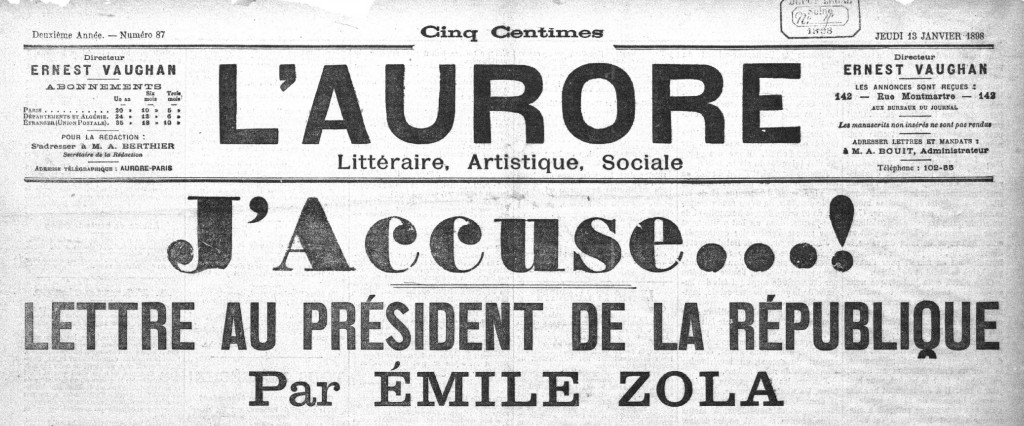
Then, on 13 January 1898, on the front page of Georges Clemenceau’s newspaper L’Aurore, Émile Zola published four thousand words addressed to the President of the French Republic. The letter named names. It catalogued each lie, each suppressed document, each forged piece of evidence. It accused the War Ministry, the General Staff, and the courts martial. And it ended with a series of accusations, each preceded by the same two words that Clemenceau had chosen as the letter’s title:
“J’accuse…!” I accuse. I accuse the War Minister. I accuse the General Staff. I accuse the courts-martial. I accuse them of having made themselves accomplices in this social crime.
France divided as cleanly as if a blade had been drawn across it. Monet was a Dreyfusard. Pissarro was a Dreyfusard. Degas was furiously anti-Dreyfusard, and friendships of decades ended in bitter silence. Cézanne avoided the question and lost friends on both sides. Zola had understood exactly what he was doing. He expected conviction. He published anyway.
Rodin — the man his own era called the Zola of Sculpture, whose entire artistic life had been built on the refusal to look away from uncomfortable truth — maintained a silence that, against the backdrop of his friend’s courage, was audible. Some accounts place him in the anti-Dreyfusard camp; others describe him as simply unwilling to involve himself in politics. Contemporary criticism captured the distinction with precision: Rodin was a conservative citizen in public affairs but a radical artist in his work. He kept those two selves rigorously separate. In 1898, with his closest friend facing imprisonment, that separation cost him nothing and cost Zola everything.
Zola was convicted of libel in February 1898 and fled to England rather than face prison — arriving in London in the middle of the night, carrying almost nothing, unable to speak the language. He spent a year in Surrey, writing to his wife in letters that mixed homesickness with the dignity of a man who knows he has done right. He returned under amnesty in 1899. Dreyfus was brought back for a second trial at Rennes and found guilty again — guilty with extenuating circumstances, one of the most grotesque legal formulations in French history. The president pardoned him immediately. Full exoneration did not come until 1906. Twelve years for an institution to admit a truth it had known since 1896.
There is a coincidence of timing that history did not arrange for dramatic effect but that carries dramatic weight nonetheless. The spring of 1898 saw two scandals erupt simultaneously. The Société des Gens de Lettres rejected Rodin’s Monument to Balzac in May — the commission Zola had secured for him, the seven-year labour that critics called a block of salt caught in a shower. In the same weeks, Zola was in court defending his right to have told the truth. Both men were under public attack. Both were defending their versions of what art owed to reality. One of them was defending a plaster statue. The other was defending himself against imprisonment.
The Closing
Zola returned from England to a France that had grown tired of being divided. The machinery of institutional self-protection ground slowly toward its partial admission of guilt. Picquart was eventually reinstated and would become a government minister. Esterhazy lived comfortably in England until 1923. The army’s forgeries were officially acknowledged. None of it felt like justice. It felt like exhaustion.
Zola did not live to see the final exoneration. On 29 September 1902, he was found dead in his Paris apartment. The gas flue had been blocked. The official verdict was accidental asphyxiation. Witnesses believed it was deliberate. The question was never formally resolved. He was fifty-eight.
His funeral drew fifty thousand people. Dreyfus stood at the graveside.
Mallarmé had died in 1898 — the same year as J’Accuse, the same year as the Balzac rejection. His apartment on the rue de Rome was emptied, the rocking chair and the sideboard dispersed. The plaster faun that Rodin had placed there found its way into other hands. The Tuesday evenings had ended with the man who presided over them.
At the Closerie des Lilas, younger and louder voices filled the tables. The first movement ended.
— — —
Second Movement — 1902 to 1912
The Acceleration
The Tuesday Soirées — A New Engine
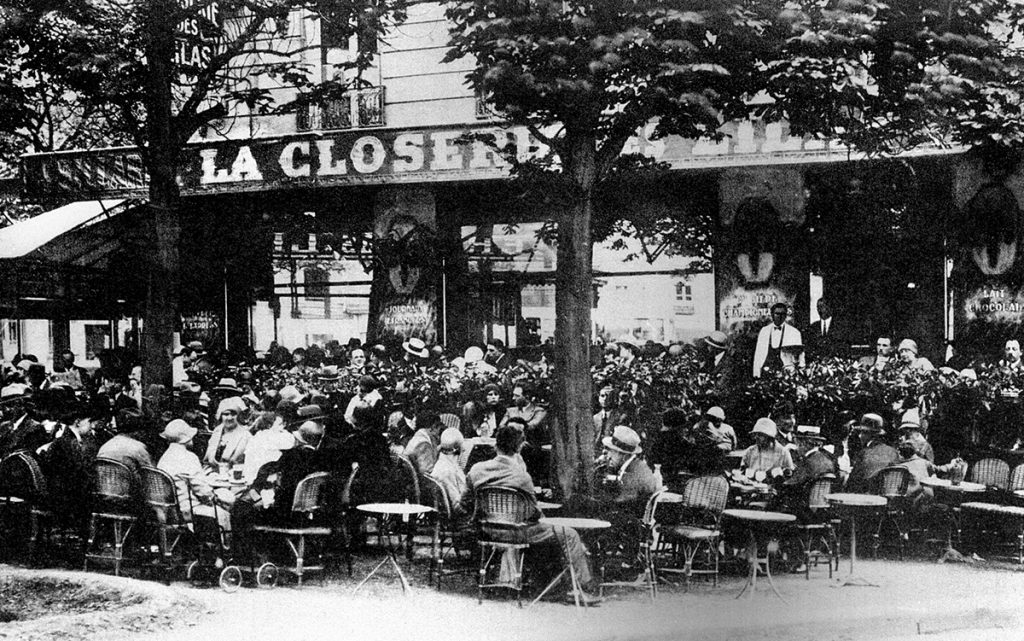
By the early 1900s, the Closerie des Lilas had found a new engine. The poet Paul Fort — who would later be named Prince of Poets by a vote of his contemporaries — had established weekly Tuesday evening gatherings at the café that became, in the decade before the war, the intellectual headquarters of Parisian avant-garde life. Fort did not hold court through the quiet authority of deep thought. He convened through energy, through the specific gift of a man who understood that Paris ran on argument and that argument needed a room.
The room was considerably louder than anything Mallarmé had presided over, and considerably more combustible. Guillaume Apollinaire was a regular — the poet, critic and impresario who combined the functions of all three with a theatrical ease that made him the most socially central figure in the Parisian avant-garde. In 1905, Apollinaire introduced a young Spaniard named Pablo Picasso to the circle; Picasso began attending the Closerie’s Tuesday gatherings and absorbing the intellectual atmosphere that would feed, among other things, his coming dismantlement of pictorial convention. The future Cubists were there — Fernand Léger, Jean Metzinger, Robert Delaunay — their arguments about pictorial space already dismantling perspective with systematic thoroughness. André Breton appeared in later years, the seeds of Surrealism not yet germinated but present in his restlessness.
Alfred Jarry — author of Ubu Roi, the play whose opening word had caused a riot in the theatre in 1896 — was a notorious regular who once fired a revolver loaded with blanks at the café windows during an argument. Nobody was hurt. The atmosphere, as contemporaries described it, was a hubbub of madness fuelled by litres of absinthe and arguments that lasted well into the night. Vladimir Lenin played chess at a corner table, occasionally against Paul Fort himself. The man who would reshape the political world of the coming century and the Prince of Poets, moving pieces across a board while around them the future of Western art was being loudly debated. Neither appears to have remarked on the company.
And at another table, on specific evenings, held court Filippo Tommaso Marinetti — the Italian poet and provocateur who described himself as the caffeine of Europe. By the mid-1900s his direction was set. The arguments he made at those Tuesday tables were audible beneath the general noise: speed was the only beauty, the past was a disease, everything the room’s older occupants had built their lives around was a cemetery waiting to be demolished. He was not yet famous for these views. He was working toward the document that would make him so.
Matisse and Rodin — A Dinner That Said Everything
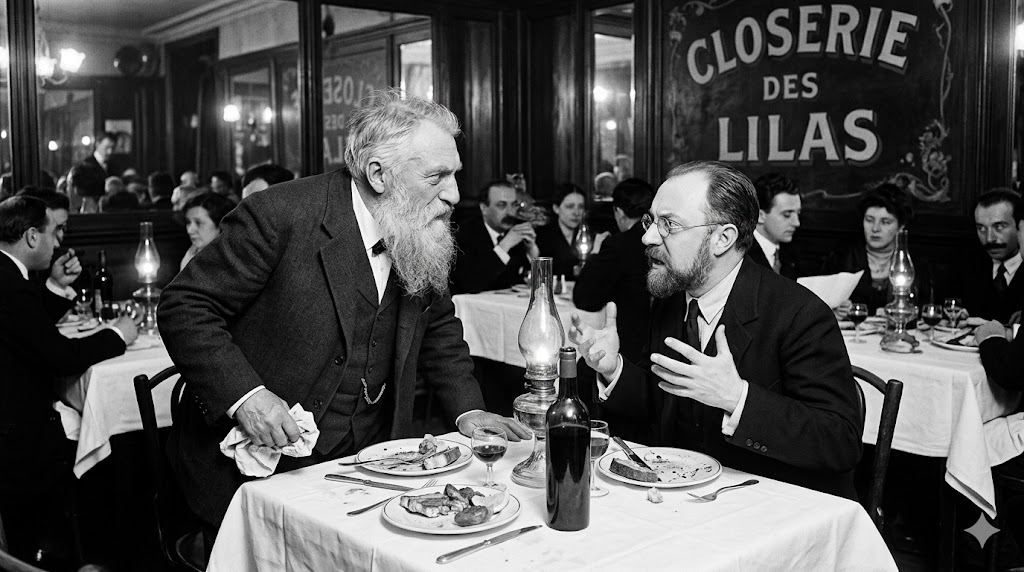
In 1905, the Closerie des Lilas hosted a dinner in Auguste Rodin’s honour. He was sixty-five, at the summit of his reputation, the most famous sculptor alive. Among those attending was Henri Matisse — thirty-five, and in the process of becoming the leader of the Fauves, the movement that was, in that very moment, exploding colour free from its obligation to represent the visible world accurately.
The two men had history. In 1899, a young Matisse had shown his drawings to Rodin and received a critique that had rankled for years. Rodin told him his drawings showed a facile hand and needed more detailed modelling — pignochés, the French word for fussed over, worked more carefully. Matisse was dismayed. The irony, visible only in retrospect, was precise: Rodin himself was at that moment moving toward freer, looser styles in his own late work. He was criticising in Matisse the quality his own drawings were developing toward. And the man being told to be more careful would go on to strip painting to its essential gesture and liberate colour from description entirely. Matisse had avoided Rodin’s studio for years afterward.
Now he sat across the table, the frostiness documented by those present, and the occasion’s symbolic weight was apparent to everyone in the room. Rodin was being honoured. Matisse was beginning. The world Rodin had built — in which the ancient body expressed permanent truths, in which beauty resided in patient attention to the particular, in which Michelangelo and the Greeks were living masters — was the world the younger generation was moving past. They admired it. They were done with it. The dinner was simultaneously a tribute and a valediction, and everyone at the table knew it, and nobody said so directly.
Rodin returned to Meudon that night — to the garden where he kept his antiquities. The same garden where, in summer, he arranged Greek sculptures on funerary altars and watched the afternoon light move across their surfaces the way it had moved across them in the Mediterranean world that made them. He was a man who had built his artistic life on the proposition that the ancient was still alive, that stone could hold the permanent truth of the body, that the Greeks and Michelangelo had something still to teach. The dinner at the Closerie had placed him, without ceremony, on the other side of a generational line he had not been asked to cross.
Le Figaro
On the morning of 20 February 1909, Parisians who opened their copy of Le Figaro found on the front page a document without precedent in European cultural life. The newspaper — which a decade earlier had led the public attack on Les Fleurs du Mal, and which had published the coverage hostile to Zola during the Dreyfus years — now carried, as if the irony were unremarkable, a manifesto by an Italian poet named Filippo Tommaso Marinetti that called for the destruction of everything Le Figaro had been founded to celebrate.
The Futurist Manifesto was designed to provoke, and it succeeded completely. But beneath the performance — and it was a performance, deliberately constructed for maximum outrage, as much marketing as philosophy — was a genuine set of convictions that deserves to be understood rather than merely catalogued.
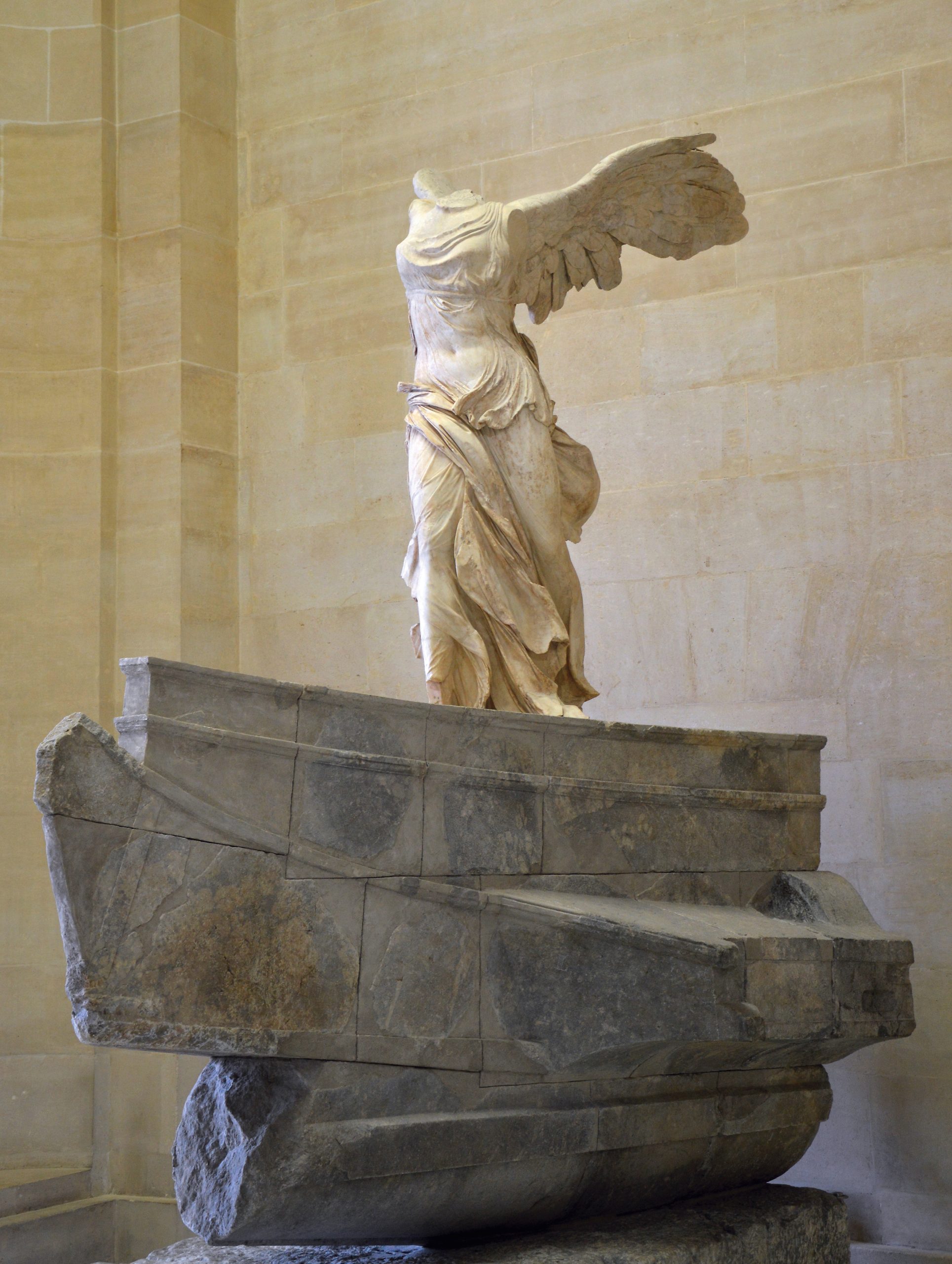
Marinetti declared that a roaring motor car was more beautiful than the Winged Victory of Samothrace. Museums were cemeteries. Libraries should be demolished. War was the world’s only hygiene. Time and space had died yesterday. The manifesto glorified speed, violence, the machine, the destruction of the past. It was one part prose poem, one part political programme, and — in retrospect — one part prophecy about its own trajectory: the movement would produce founding members who became ardent supporters of Mussolini. The line between the glorification of violence in art and its practice in politics turned out to be shorter than the Futurists had imagined.
The specific claim about the motor car and the Winged Victory was not casual provocation. The Nike of Samothrace stood in the Louvre a few kilometres from the Closerie. Rodin had stood in front of it — had looked at it with the concentrated attention he brought to all ancient sculpture, had seen in its captured movement exactly what he had been trying to achieve in clay and bronze throughout his career. For Marinetti to declare this object superseded by an engine was not a stylistic preference. It was a declaration of war against values Rodin’s entire life had embodied. Speed versus permanence. The machine versus the body. The future versus the truth of things.
Rodin was sixty-eight years old when the manifesto appeared. He read it or had it described to him. What he felt is not documented. What we can say is that the man who had built a museum at Meudon to house six thousand antiquities, who had spent his Sundays arranging Greek sculptures in his garden and watching the light move across them — who had, only months earlier, been honoured at a dinner where Matisse sat in a frostiness that signalled the generational passing of the baton — was now living in a cultural moment that had declared his deepest convictions not merely old-fashioned but actively harmful. The Futurists did not argue that Rodin was wrong. They argued that being right in the old way was itself the problem.
The Foundations Shift
The Futurist Manifesto was the loudest of several concurrent assaults on the stable world. Consider what the first decade of the twentieth century had produced, in rapid succession.
Freud’s The Interpretation of Dreams appeared in 1900. It argued that the self was not transparent to itself — that beneath the conscious mind lay a vast, ungovernable darkness that shaped everything the conscious mind did while remaining invisible to it. For artists who had staked their practice on the idea that the inner life could be expressed through disciplined observation of the outer world, this was genuinely unsettling. If even the self was unknown to itself, what exactly was the artist expressing?
Einstein’s special theory of relativity appeared in 1905. Time was not absolute. Two events simultaneous in one frame of reference might not be simultaneous in another. The stable Newtonian universe — in which a sculptor could believe that permanent forms expressed permanent truths, in which the ancient and the contemporary inhabited the same continuous time — was simply wrong at the level of its deepest assumptions.
These discoveries did not immediately filter into the studios and cafés. But they created an atmosphere in which certainty of any kind required more defence than it had previously needed. And the artists were doing their own work in the same direction. Picasso and Braque were dismantling perspective — showing several simultaneous views of an object in a single image, proposing that there was no single privileged viewpoint from which the truth of a thing could be definitively seen. Each of these — the physicist, the psychologist, the painters — arrived at the same conclusion from a different direction: the world was more unstable, more multiple, more resistant to stable interpretation than the nineteenth century had believed.
At the Closerie, the arguments grew louder and the certainties fewer. Mondrian arrived in 1912 and sat in on the Cubist debates, absorbing what he heard into the beginnings of his own project — the reduction of painting to pure geometry, the elimination of everything representational, the search for an order so fundamental it could not be destabilised by the chaos of the visible world. He was, in his way, responding to the same anxiety as Rodin: if the surface could not be trusted, what lay beneath it? He and Rodin arrived at different answers. But they were asking the same question.
— — —
Third Movement — 1912 to 1914
The Gathering Dark
The Last Years
In March 1912, the newspapers carried reports from the Balkans. The Ottoman Empire was losing its grip on the territories it still held in south-eastern Europe. The Balkan League — Serbia, Bulgaria, Greece, Montenegro — was preparing to move. The reports appeared in the middle pages, alongside theatrical reviews, society gossip, the weekend weather. They were there for those paying attention.
Most people were not.
A German painter named Franz Marc looked at the Balkans and changed what he painted. His earlier canvases had been filled with horses and deer in lyrical landscapes — animals in harmony with their surroundings, the natural world as gentle order. In 1913, the wolves arrived. He painted them in the fractured geometry that Cubism had taught him, angular and violent, and titled the work The Wolves — Balkan War. He wrote to his wife: “it is artistically logical to paint such pictures before a war — not as stupid reminiscences afterwards.” He was called to the front in 1914 and killed at Verdun in 1916. He was thirty-six.
At the Closerie, the year 1913 had a particular quality. D’Annunzio dated the dedication of a book published that year “1912+1”, as though the number thirteen were too cursed to be written directly. The First Balkan War had ended in May 1913; the Second began in June. The newspapers explained, with careful patience, that these were regional conflicts. Peripheral. Contained. The great powers were managing the situation.
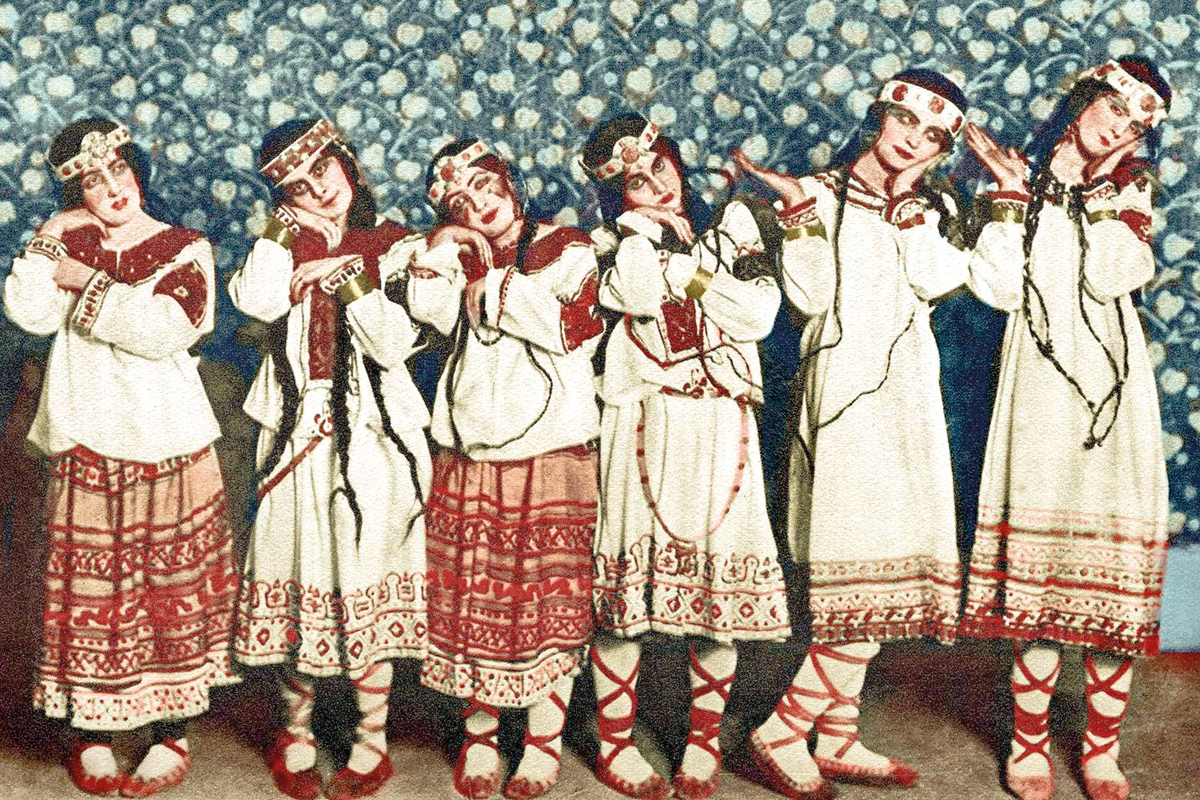
In May 1913, Stravinsky’s The Rite of Spring had its premiere at the Théâtre des Champs-Élysées. The audience rioted before the first act ended. The booing and shouting became so loud the dancers could not hear the orchestra. Diaghilev ordered the house lights raised and lowered repeatedly to restore order. The performance was completed over the noise. The ballet was about an ancient pagan sacrifice — a young girl danced to death so that spring would come. It was the work Paris staged for itself in the last spring before the last summer of the old world.
The conversations at the Closerie continued. The word mobilisation appeared in the newspapers with increasing frequency. Always in the context of other countries. Germany was mobilising. Russia was mobilising. Austria-Hungary was mobilising. The French papers reported this with the careful tone of observers watching something happening at a safe distance. Jean Jaurès — the socialist leader and the most prominent anti-war voice in France — argued against the momentum with the passionate clarity of a man who understood exactly what the alternative was. He was widely read. He was not widely heeded.
Spring and Summer, 1914
On 16 March 1914, Henriette Caillaux walked into the offices of Le Figaro and shot its editor dead. The editor, Gaston Calmette, had been conducting a sustained press campaign against her husband, the Finance Minister Joseph Caillaux, a moderate politician whose reputation for conciliation toward Germany had made him a target for the nationalist press. The trial, which began on 20 July 1914, consumed the newspapers. The front pages of the major dailies were given over almost entirely to its details — the love letters, the political implications of the defence, the question of whether a wife’s protection of her husband’s honour justified murder — in the precise weeks when the diplomatic machinery of Europe was assembling for something incomparably larger.
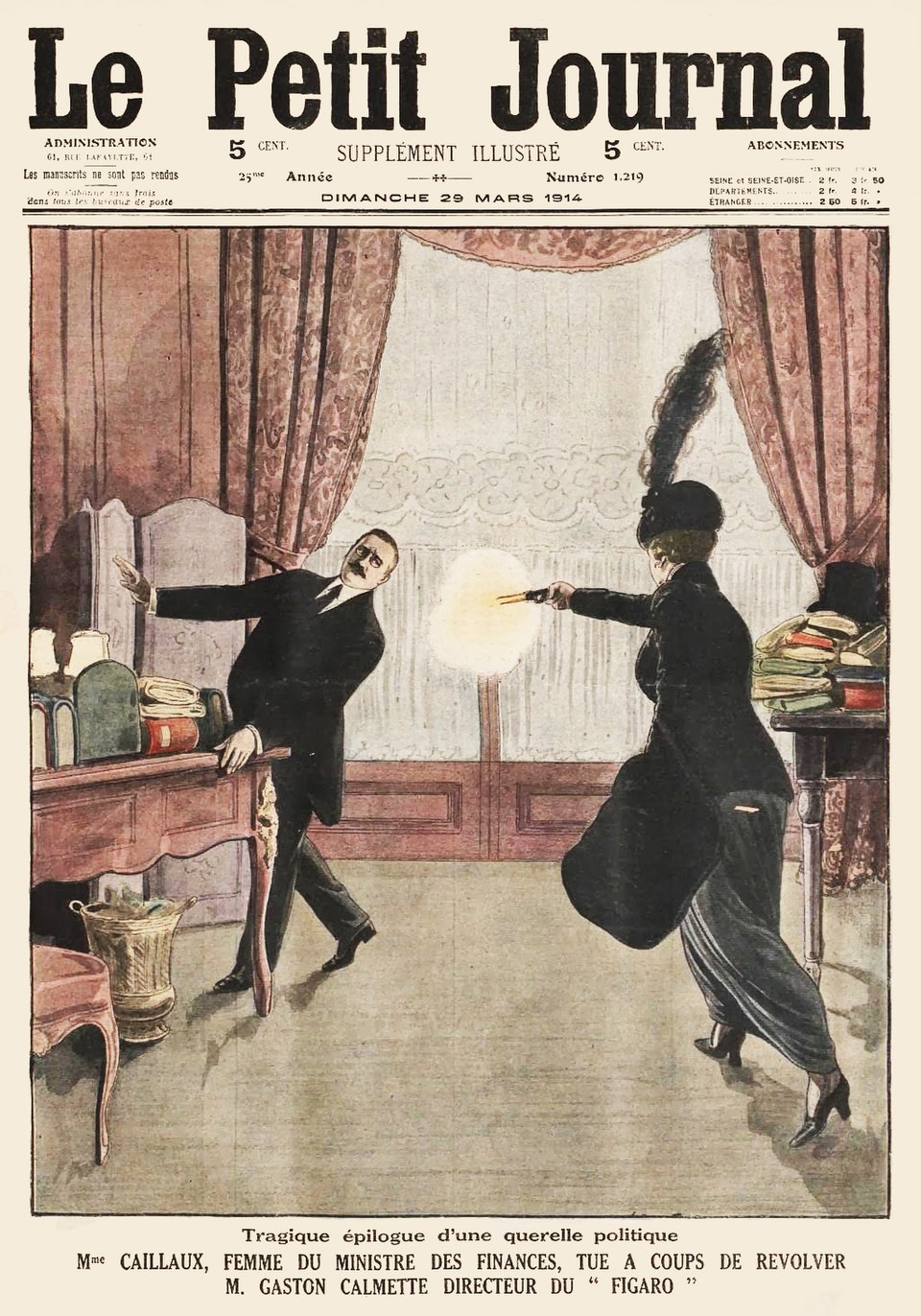
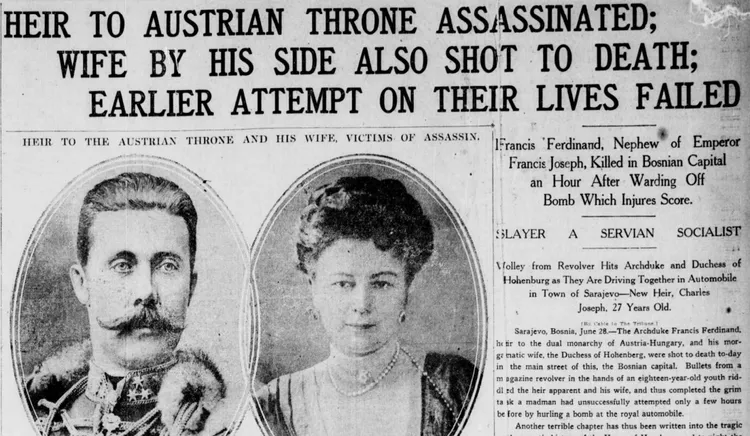
On 28 June 1914, in Sarajevo, Archduke Franz Ferdinand was shot by a Serbian nationalist. The newspapers reported it. Most Parisians noted it and turned back to the Caillaux coverage. The diplomatic machinery, they assumed, would manage it. It always had.
It did not. The July Crisis unfolded with a speed that the newspapers, still absorbed in the trial, were slow to register. Austria-Hungary issued an ultimatum to Serbia. Russia mobilised. Germany issued its own ultimatum. The alliance system — that elaborate machinery of mutual obligation built over forty years — began converting a regional assassination into a continental catastrophe with the mechanical logic of a device set in motion long before. On 28 July, Austria-Hungary declared war on Serbia. The same day, Henriette Caillaux was acquitted. There was bedlam in the courtroom as the verdict was delivered. Outside the courthouse, the world was ending.
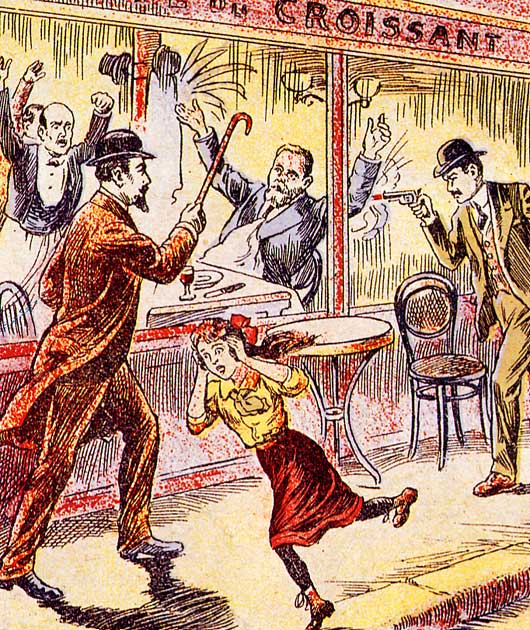
On 31 July 1914, Jean Jaurès sat down to dinner at the Café du Croissant, a few minutes’ walk from the offices of his newspaper. He had spent the day working to prevent what was now clearly coming. He sat at a table by an open window. A young nationalist named Raoul Villain stepped up to the window and shot him twice in the head. Jaurès died immediately. He was fifty-four. France mobilised two days later.
The Lamps Going Out
Rodin’s exhibition at the Victoria and Albert Museum had closed on 21 July 1914. His sculptures were still in England when war was declared a fortnight later — stranded across the Channel, their maker’s world collapsed around them.
He was in London at the invitation of his friend and biographer Judith Cladel when the news arrived. It was there that he learned the German army had bombed Reims Cathedral. In March of that year — five months before the war — he had published Les Cathédrales de France, a lifetime’s meditation on the French Gothic monuments he had loved since boyhood. He had studied those buildings as he had studied Greek sculpture and Michelangelo: as living teachers, as repositories of something permanent expressed in permanent form. The German guns had fired on one of them.
Cladel described what happened when the newspaper confirmation arrived: disbelief, then shock, then something harder to name. The particular grief of a man who has spent his life insisting on the indestructibility of certain values, confronted with their physical destruction. The cathedral could be bombed. The beautiful permanent world could be ended. He had spent forty years making The Gates of Hell as a monument to human suffering. The world had just proved his subject inexhaustible.
In November 1914 — by which point the initial German advance had been halted at the Marne and the front had settled into the static horror of the trenches — Rodin gave the Victoria and Albert Museum eighteen of his sculptures. It was the greatest gift ever made to the museum by a living artist. He explained his decision simply: “The English and French are brothers; your soldiers are fighting side by side with ours. As a little token of my admiration for your heroes, I decided to present the collection to England.”
The British Foreign Secretary, Edward Grey, had stood at his window on the night of 3 August 1914 watching the street lamps being lit in the darkening city, and said to a friend: “The lamps are going out all over Europe; we shall not see them lit again in our lifetime.”
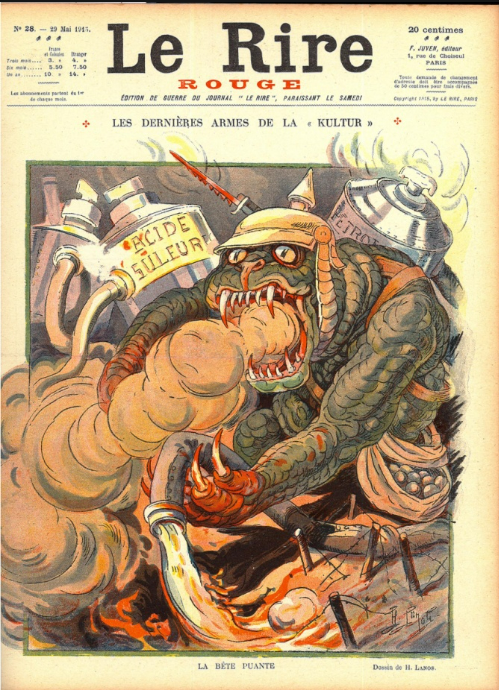
He was not thinking, presumably, of the Tuesday evenings on the rue de Rome, or of the lilac enclosure at 171 Boulevard du Montparnasse, or of the plaster faun that had once sat on Mallarmé’s sideboard while the trains went by outside. But he might have been.
— — —
Coda
At the Closerie des Lilas, the brass nameplates on the tables still wait to be read. Each one marks a person who sat there, ordered something, argued about something, wrote something that mattered or did not. The café has survived two world wars and a century of everything that followed, and it still operates on the same corner, partially hidden by its shrubbery, the terrace shaded in summer by the same chestnut trees.
In the years after the war, different people sat at those tables. A young American from Oak Park, Illinois, who had been wounded in Italy and had come to Paris to write, found the Closerie the one decent café in his neighbourhood and worked there in the afternoons, on the early drafts of a novel about people who had lost something they could not name. A generation of writers and painters who had survived the trenches, or had been too young for them, gathered in this same room and tried to begin again.
But before them — carrying what they had taken from Rodin’s world, from Baudelaire’s dark flowers, from the extraordinary pressures of the years this chapter has traced — came three other figures. A poet from Prague who had absorbed the Symbolist movement’s deepest preoccupations, and who would spend the better part of four years in Rodin’s orbit before finding, in that proximity, the key to his own deepest work. A young Lebanese artist who had sat in Rodin’s studio and carried what he found there into a book that half the world would read. An American poet, brash and brilliant and gathering, who understood that what Rodin had done to sculpture was precisely what poetry needed to do next.
The chapter of the beautiful era closes here. The next chapter belongs to the poets who inherited its ruins — and who, in doing so, built something that has outlasted the catastrophe that ended it.
Darren Gall
