Stranger, Here You Will Do Well to Tarry
Oct 20, 2026 · Darren Gall
The Swerve
In September, OpenAI announced that some ten thousand of its AI agents, working for eighty-eight hours, had settled the Navier–Stokes problem, one of seven Millennium Prize Problems the Clay Mathematics Institute set in 2000, with a million-dollar prize for each. The equations, written in the nineteenth century, describe how fluids move: water in a pipe, air over a wing, wine turning in a glass. The question was whether a smooth flow must stay smooth forever. The machines said no. Under the right push, in finite time, the smooth description breaks.
I am in no position to judge the proof. A machine has checked it, in a formal language called Lean; mathematicians are still reading it, and the Clay Institute says its verdict will be deliberately unhurried.

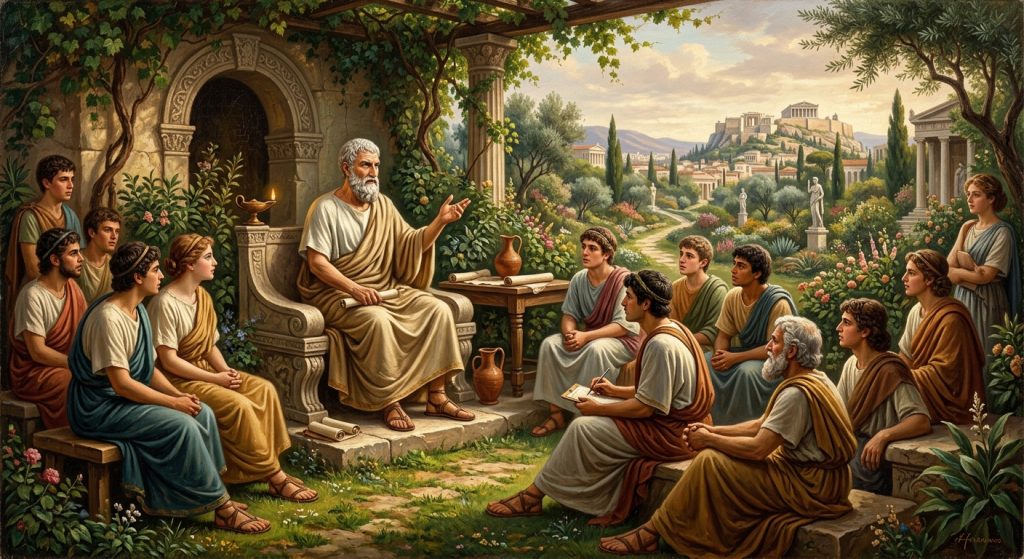
What the news set me thinking about was the swerve. Lucretius, the Roman poet who put Epicurus into verse, imagined atoms falling side by side, straight down, forever, ‘like drops of rain, through the bottomless void’. Falling so, they would never meet, and nature would create nothing. So, at no fixed time or place, an atom swerves by the least amount possible. Collisions follow, then tangles, then everything there is. Epicurus word for this is: clinamen.
Here is the romantic notion, and I hold it knowing what it is. Nearly two thousand years before Navier and Stokes, Lucretius drew smooth parallel flow and the small deviation that breaks it, and without that picture the equations could not have been imagined. A mathematician would tell me, rightly, that they came from Newton, not from a Latin poem. Cicero, nearer the source, called the whole idea ‘perfectly childish’. I concede all of it.
Michel Serres, the French philosopher, did not. In The Birth of Physics, he read Lucretius as a physicist of fluids, and the swerve as the point where laminar flow tips into turbulence. I find I am with him. If the new result is held, smoothness can fail in the equations too, though nothing in them is left to chance.
From the swerve it is a short walk back to Epicurus, who has come to feel less like a philosopher than an old friend. I have a great deal of empathy for him, and with him: for the man slandered in his lifetime and misread ever since, who called the last day of his life blissful; with the man who kept a plain table for his friends and thought it enough. His physics was medicine. Had we never been troubled by the heavens and by death, he wrote, ‘we should have had no need to study natural science’. The swerve mattered to his school because it sundered what Lucretius called ‘the covenants of fate’. It left room for choice, for free will, and his ethics is an account of choosing well.
He has shown me the path to his garden, to happiness. I know how that sentence sounds. His directions are short: enough bread, friends at the table, a mind no longer afraid of the gods or of the dark.
A Pot of Cheese
Epicurus bought a garden outside Athens, opened its gate to people the city kept at its margins, and taught that a good life comes to rest in ataraxia: the untroubled mind. A reflection from inside the trade that borrowed his name.
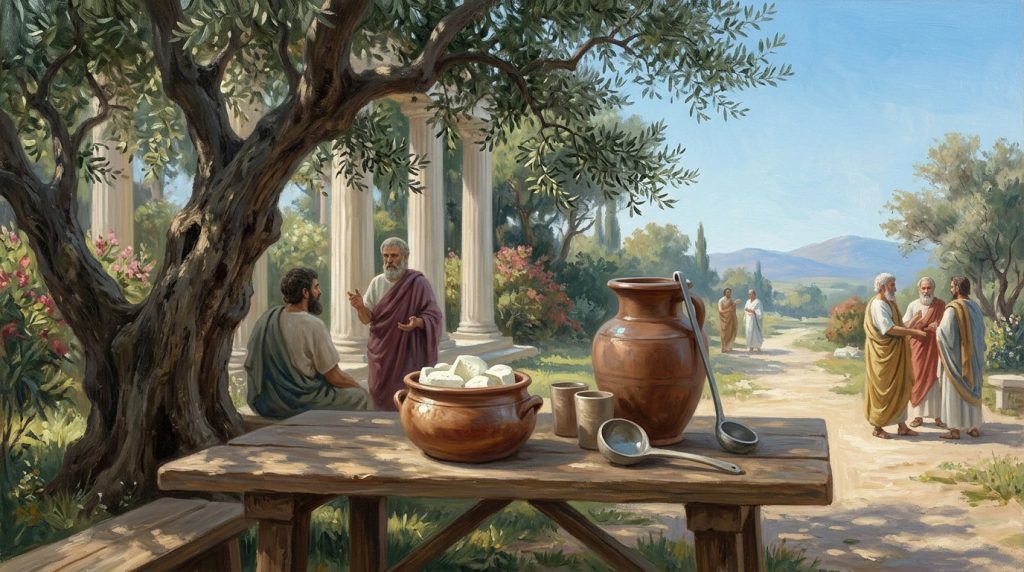
‘Send me a little pot of cheese,’ Epicurus wrote in one of his letters, ‘that, when I like, I may fare sumptuously.’
I should declare an interest. I have spent over thirty-five years in the wine trade, which borrowed his name long ago and has been spending it freely ever since: on tasting menus that run to nine courses, on back labels that promise an epicurean experience to anyone with the price of the bottle.
He was not an epicure. By his own account he was content with plain bread and water. His friends, Diogenes Laertius records, made do with ‘half a pint of thin wine’ and were otherwise ‘thorough-going water-drinkers’. The cheese was the feast. It is one of the odder accidents of language that the man who asked for so little became a byword for appetite.
The Garden
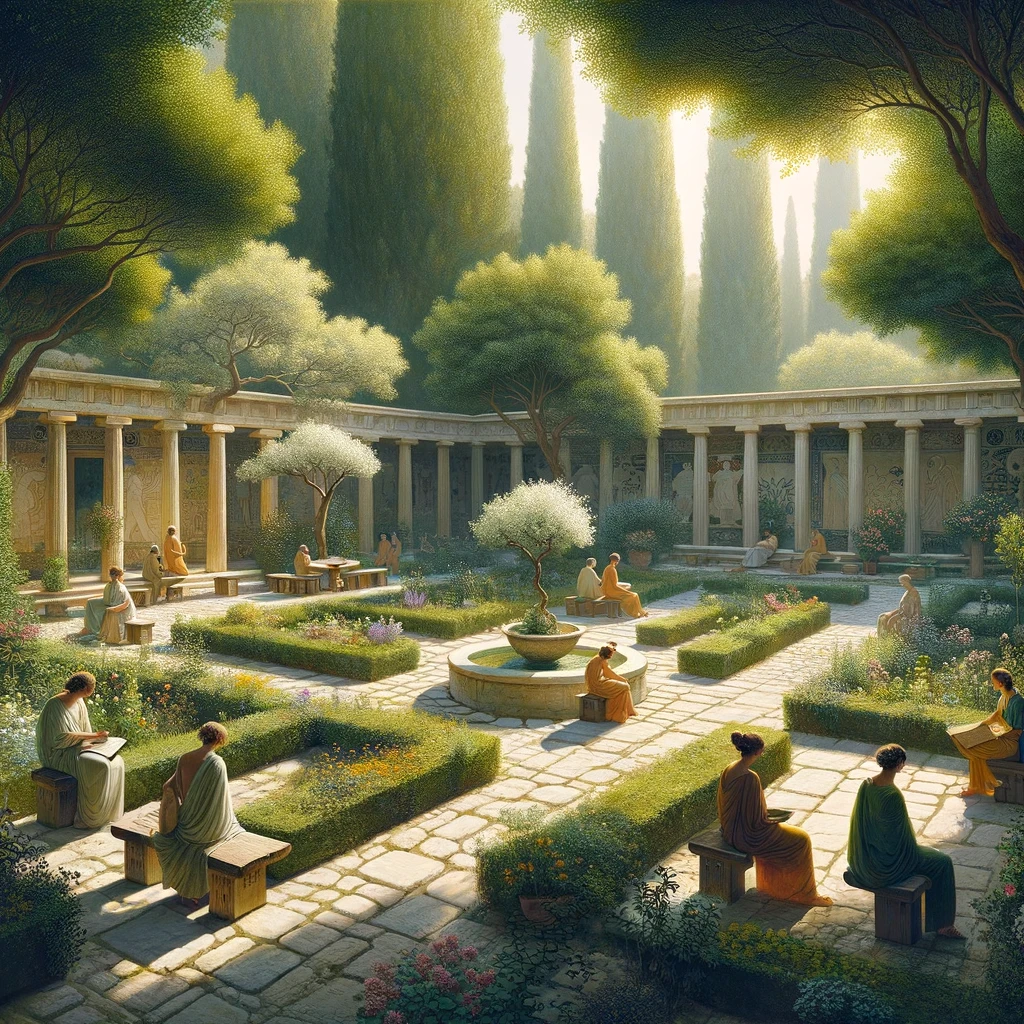
In 307 or 306 BC Epicurus, an Athenian raised on Samos, bought a garden just outside the city, on the road that ran from the Dipylon gate to the Academy. It cost eighty minae. Friends, his biographer says, came to him from all parts and lived with him there.
The choice of ground mattered. Zeno taught in the Stoa Poikile, a painted public porch in the Agora, and his followers took their name from it. Epicurus chose soil that had to be dug and watered and waited on, and his school became, simply, the Garden. Nothing of its layout is known.
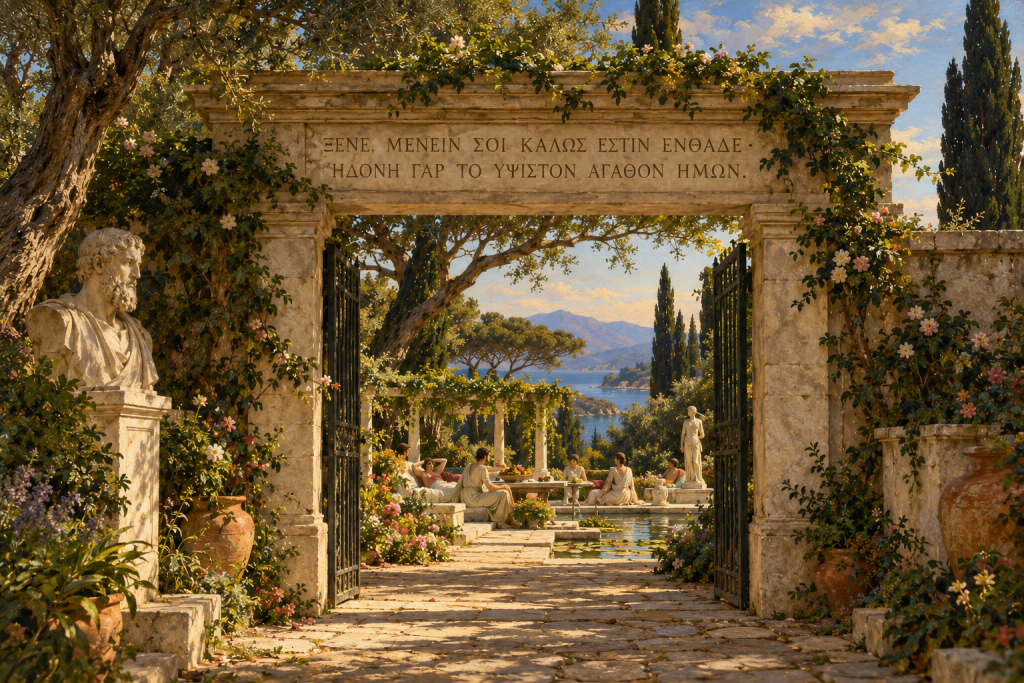
What survives is the welcome. Seneca, a Stoic writing nearly four centuries later, records the words inscribed there: ‘Stranger, here you will do well to tarry; here our highest good is pleasure.’ A kindly keeper, he says, would greet you with barley-meal and water in abundance, and ask whether you had not been well entertained. ‘This garden’, he would tell you, ‘does not whet your appetite; it quenches it.’
The Gate
The welcome was meant. Philosophy in Athens was, with rare exceptions, a conversation among free men with leisure. The Garden admitted others. Diogenes Laertius records that Epicurus’s slaves were members of the school, the most eminent a man named Mys. There were women: Leontion, companion of Metrodorus, who wrote a treatise against Theophrastus, Aristotle’s successor; and Themista of Lampsacus, who named her son Epicurus.
Some were, or were said to be, courtesans, and the school’s enemies made the most of it. More than two centuries later Cicero was still mocking Epicurus for ‘so many volumes about Themista’, with never a word, he complained, for Solon or Themistocles.
The concession should be made plainly. The Garden was not a revolution. Mys philosophised with his master and remained a slave until his master’s will freed him, with Nicias, Lycon and a woman named Phaedrium. The openness was real, and it had limits. The Garden also kept its distance from politics: ‘live unnoticed’, Epicurus advised, and Plutarch attacked the maxim in an essay.
What the Garden refused was the idea that philosophy belonged to a class, a sex or a time of life. ‘Let no one be slow to seek wisdom when he is young’, begins his letter to Menoeceus, ‘nor weary in the search thereof when he is grown old.’ Four centuries after his death, in the Lycian city of Oenoanda, another Diogenes had the doctrine carved along some eighty metres of a public wall, ‘not least’, he wrote, ‘for those who are called foreigners, for they are not foreigners’. The earth, he reasoned, is one country, and the world one home.
I have lived in Cambodia since 2008, an Australian who married and raised a family here. I know of no kinder sentence about belonging.
Enough
Epicurus said plainly what a life is for. ‘We call pleasure the alpha and omega of a happy life,’ he wrote to Menoeceus, and in the same letter he anticipated the misreading. He did not mean ‘the pleasures of the prodigal or the pleasures of sensuality’. He meant ‘the absence of pain in the body and of trouble in the soul’.
It is a definition with a ceiling built in. Once the pain of want has gone, bodily pleasure ‘admits no increase’; it ‘only admits of variation’. Bread and water ‘confer the highest possible pleasure when they are brought to hungry lips’. Desire past that point, for fame or fortune or a banquet every night, has no natural limit and can never be satisfied.
None of this is puritan. The good bottle is not forbidden, and a man in my trade is grateful for the sentence that proves it: ‘they have the sweetest enjoyment of luxury who stand least in need of it’.
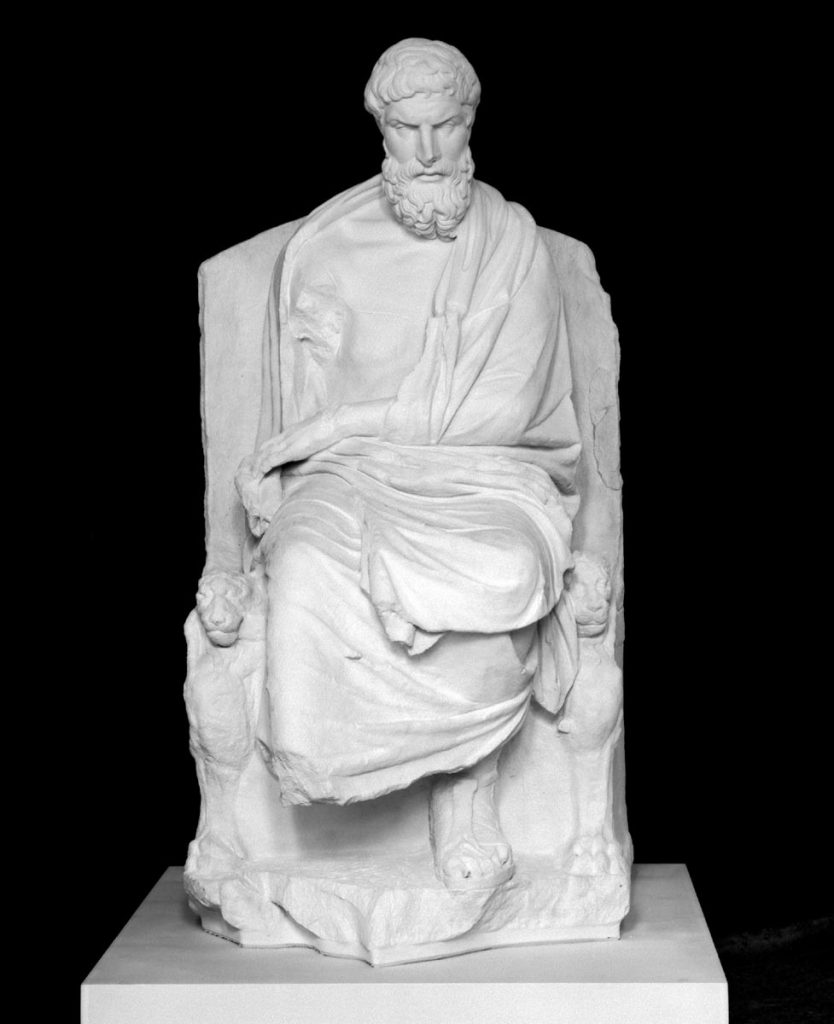
Ataraxia
The verb behind ‘trouble in the soul’ is tarassein: to stir up, to trouble. Homer uses it when Poseidon gathers the clouds, takes up his trident and troubles the sea against Odysseus. Ataraxia is the same root with a negative in front of it. Health in the body and ataraxia in the soul, Epicurus told Menoeceus, are ‘the sum and end of a happy life’. He counted it a pleasure in itself, the settled kind rather than the kind in motion: less the drink that slakes a thirst than the condition of not being thirsty.
He thought he knew what stirs the water. Not hunger, which bread answers, but fear: of the gods, and of death. His physics of atoms and void was built to take both away. The gods exist, he taught, but they are happy and eternal, untroubled themselves and troubling no one. Death is nothing to us, ‘seeing that, when we are, death is not come, and, when death is come, we are not’. Once pain and fear are gone, ‘the tempest of the soul is laid’. What he offers is a sea that no god is troubling.
Above Inle Lake, where I spend part of each month among the vines at Red Mountain, there are mornings when the water lies so still that the Shan Hills stand in it twice. A fisherman’s boat breaks the image and, with no one’s help, it mends. Ataraxia is not stillness imposed by will. It is what the mind does once understanding has removed what was stirring it.
It would be easy to make all this sound like a long lunch. It was not. Epicurus died of a kidney stone, and on his last day wrote to his friend Idomeneus that his sufferings from strangury and dysentery were so great that nothing could augment them, ‘but over against them all I set gladness of mind at the remembrance of our past conversations’. That is ataraxia in heavy weather. Nietzsche, who admired him, thought only a man in constant pain could have invented such a happiness: ‘the happiness of an eye before which the sea of existence has become calm’.
Friends
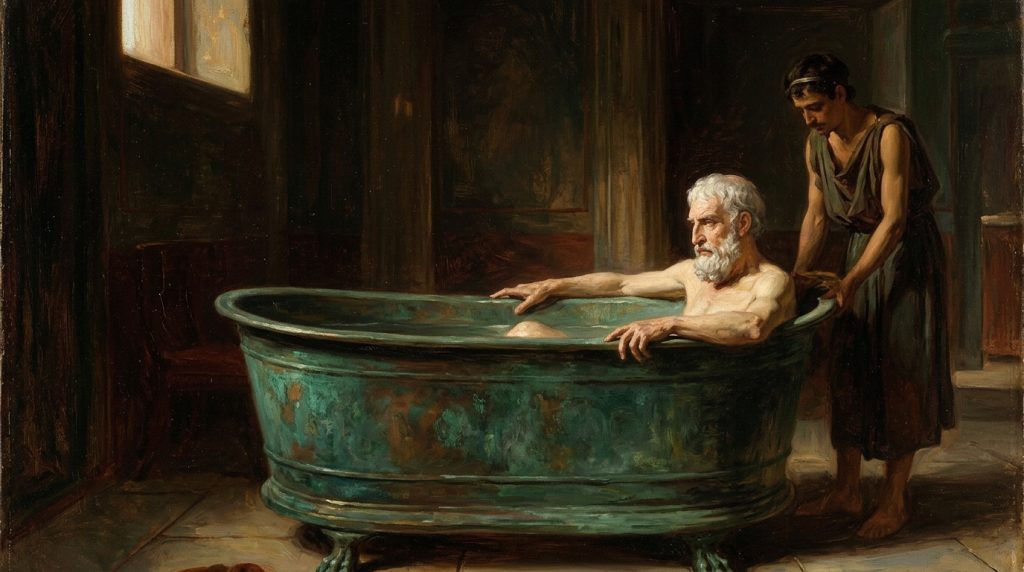
The biographer Hermippus says that at the end Epicurus entered a bronze bath of lukewarm water, asked for unmixed wine, drank it, and told his friends to remember his doctrines. His will provided for the remembering: the school was to meet on the twentieth day of every month to commemorate Metrodorus and himself.
Of all the means to a happy life, he had written, by far the most important is the acquisition of friends. On his last day he set the memory of conversation against his pain. He left that memory to the Garden as an appointment.
“On this truly happy day of my life, as I am at the point of death, I write this to you. The disease in my bladder and stomach are pursuing their course, lacking nothing of their natural severity: but against all this is the joy in my heart at the recollection of my conversations with you.”